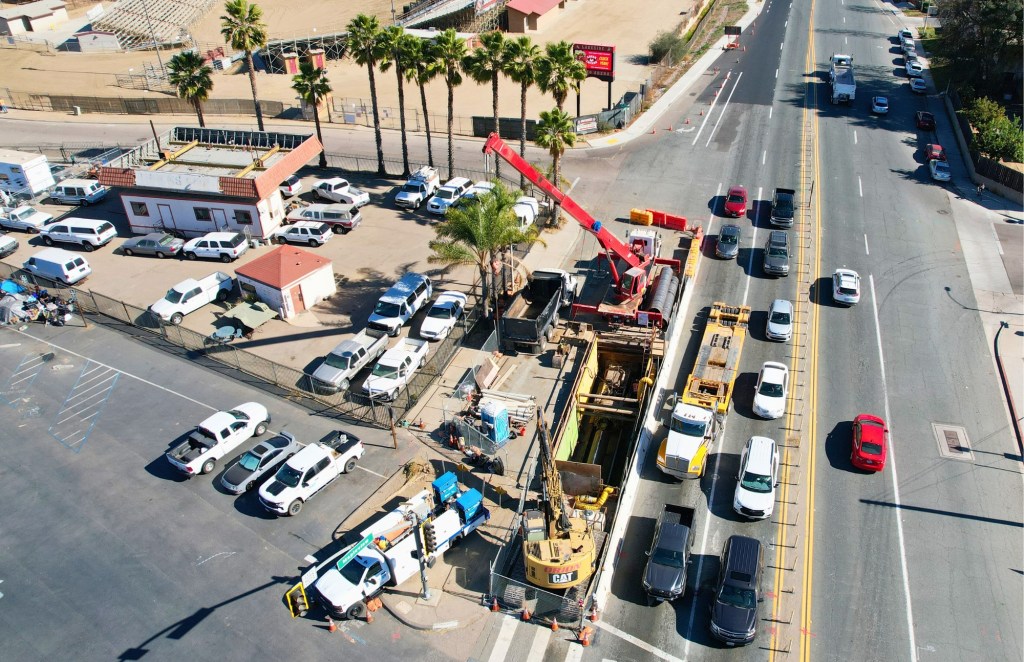
Because leaders across this drought-afflicted region all embraced the same innovative idea a decade ago, three separate sewage recycling systems will soon come online in Oceanside, East County and San Diego.
While drought was the main motivator for spending millions to purify sewage into drinking water, local leaders were also spurred by increasing costs for imported water and long-term concerns about the Colorado River.
Whatever the motivation, years of planning and construction are nearing separate finish lines for each of the three projects: Pure Water Oceanside, East County Advanced Water Purification and Pure Water San Diego.
Oceanside, which actually completed a small first phase of its sewage recycling in 2022, is slated to complete a major expansion by the end of this year to produce 6 million gallons of purified water per day.
East County Advanced Water Purification, a partnership between the city of El Cajon and multiple water districts, is scheduled to start producing 11.5 million gallons of purified drinking water sometime this fall.
And Pure Water San Diego, the largest and most expensive of the three systems, is slated to begin producing purified water in early 2027 and ramp up to 30 million gallons per day by the end of 2027.
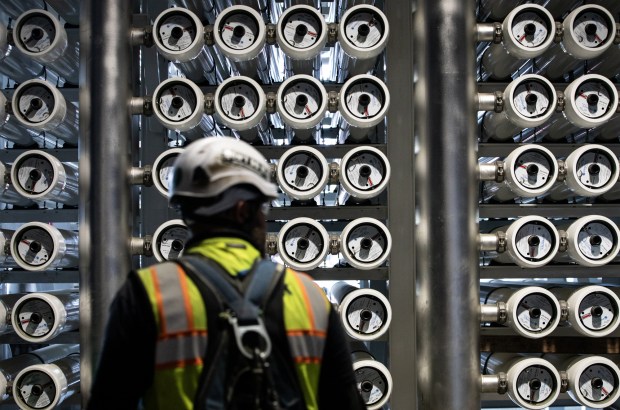 A reverse osmosis system at the Pure Water facility in San Diego. (Ana Ramirez / The San Diego Union-Tribune)
While it may seem odd that San Diego County will quickly go from having no sewage recycling systems to having three come online nearly all at once, local leaders say it makes sense in some ways.
It can take a decade or longer to plan a sewage purification system, get needed regulatory approvals, build the system and then make sure the complex pipelines and pump stations work together effectively.
So what was happening a decade ago?
The region experienced nearly six years of severe drought between 2011 and 2016, prompting many city and water officials to begin dreaming of a reliable local supply.
Costs for imported water have continued to rise for local water agencies, but they rose particularly sharply during those drought years because supplies shrunk everywhere.
And concerns about the long-term viability of the Colorado River as the primary source of San Diego’s water supply became stronger than ever during that time.
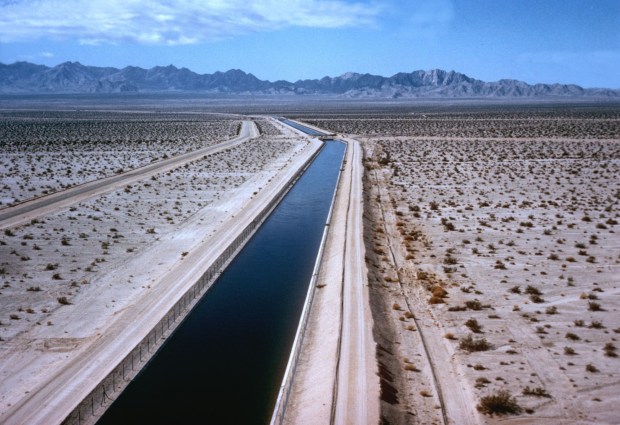 Water flows through the Southern California desert in an aqueduct supply channel. Some 75% of Southern California’s water supply comes from the Colorado Aqueduct, which transports water from the Colorado River to the region. (MWD of Southern California via AP)
“A confluence of these factors drove those different communities to consider recycling as a way to stabilize their water supply,” said Phillip Musegaas, executive director of the environmental group San Diego Coastkeeper.
Environmental groups support sewage recycling for multiple reasons, but primarily because it reduces the amount of sewage pumped into the ocean where it can damage sea life and reduce water quality.
El Cajon Councilmember Steve Goble agreed that multiple motivations were spurring local efforts to purify sewage into drinking water, but he said the dream of water independence was at the heart of it.
“We wanted to be more in control of our water supply and our water rates,” Goble said last week.
But Goble said there were also bigger-picture concerns.
“I think the uncertainty about the Colorado River water woke everybody up,” Goble said.
Oceanside Mayor Esther Sanchez said her city’s motivation was mostly about keeping water rates down because more than 50% of Oceanside residents are low-income.
Costs for purified sewage, although sometimes criticized as high, are less than what local water agencies pay the County Water Authority for imported water.
Just this week, San Diego city water official Lisa Celaya said a recent analysis showed Pure Water San Diego will produce water at $2,100 per acre foot compared to the $2,600 cost from the County Water Authority.
In addition, purifying sewage also saves ratepayers by eliminating the expense of disposing of sewage somewhere.
“We were focused on keeping rates as low as possible and we knew we had to address the rising costs,” Sanchez said. “This was the goal of a very diverse City Council that was looking into the future.”
However, county water officials say they may have to increase their prices to account for lower sales to the three water agencies adding sewage recycling systems in the next 18 months.
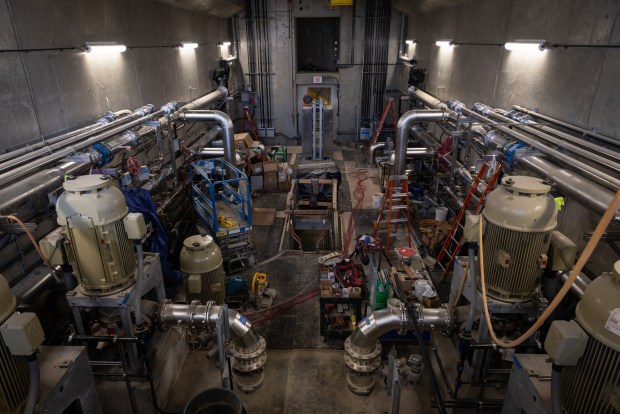 Ozone equipment at the Pure Water facility in San Diego. (Ana Ramirez / The San Diego Union-Tribune)
The fundamental problem facing the county water authority is that it’s contractually obligated to buy more water than its member agencies typically need, forcing it to raise rates to cover its built-in costs.
The sewage recycling systems will worsen that problem. The Oceanside and East County projects are estimated to supply 30% of the water needed in those areas. In San Diego, the ratio will be nearly 20%.
The price tag for PureWater San Diego is $1.3 billion, with a planned second phase costing that much or more. The East County project cost $950 million and Pure Water Oceanside about $160 million.
When decisions were being made about sewage purification a decade ago, San Diego had an additional motivation: the city was threatened with legal action by environmental groups for dumping under treated sewage into the ocean.
The outdated Point Loma Wastewater Treatment Plant isn’t capable of treating sewage to the level required under the federal Clean Water Act, leaving the city vulnerable to litigation.
“That Point Loma (sewer) outfall was the ultimate decider,” former San Diego Mayor Kevin Faulconer said last week.
The city was facing an estimated $3 billion in costs to upgrade the treatment plant, roughly the cost it would take to build a sewage purification system that would make those upgrades unnecessary.
But Faulconer, whose district included Point Loma when he was on the City Council from 2005 until he was elected mayor in 2014, said big-picture concerns were also a factor.
San Diego has very little local water and Los Angeles is closer geographically to the key water resources the city relies on, he said.
“The reality is we are always going to be at the end of the pipe,” Faulconer said.
San Diego – and the other water agencies contemplating sewage purification – faced another key challenge: some critics tried to pump up the ick factor by calling sewage purification “toilet to tap.”
Faulconer was a leader in the fight against that campaign. He visited the Orange County Water District’s Advanced Water Purification Facility shortly after it opened in 2008, drank some purified sewage and became a true believer.
And when he became mayor, he helped shepherd the project toward City Council approval in 2014 and then groundbreaking in 2018.
Progress was slowed by multiple lawsuits, complex labor deals and errors like underestimating how easily a pump station site in Linda Vista could fill up with water.
The East County project, on which El Cajon is partnering with the Helix Water District and the Padre Dam Municipal Water District, was also delayed by a dispute with the city of San Diego over who would pay for a special pipeline. That dispute was resolved in 2022.
 Fishermen cast out on Lake Miramar. Output from San Diego’s Pure Water recycling plant will be stored in the lake. (K.C. Alfred / The San Diego Union-Tribune)
Oceanside had a key advantage over San Diego and the East County agencies: the ability to store the purified sewage in the underground Mission Basin.
In San Diego and East County where underground basins aren’t available, the purified sewage will need to be stored above ground – in Lake Miramar for San Diego and Lake Jennings for East County.
The East County project will be the first time in California that purified sewage has been stored above ground.