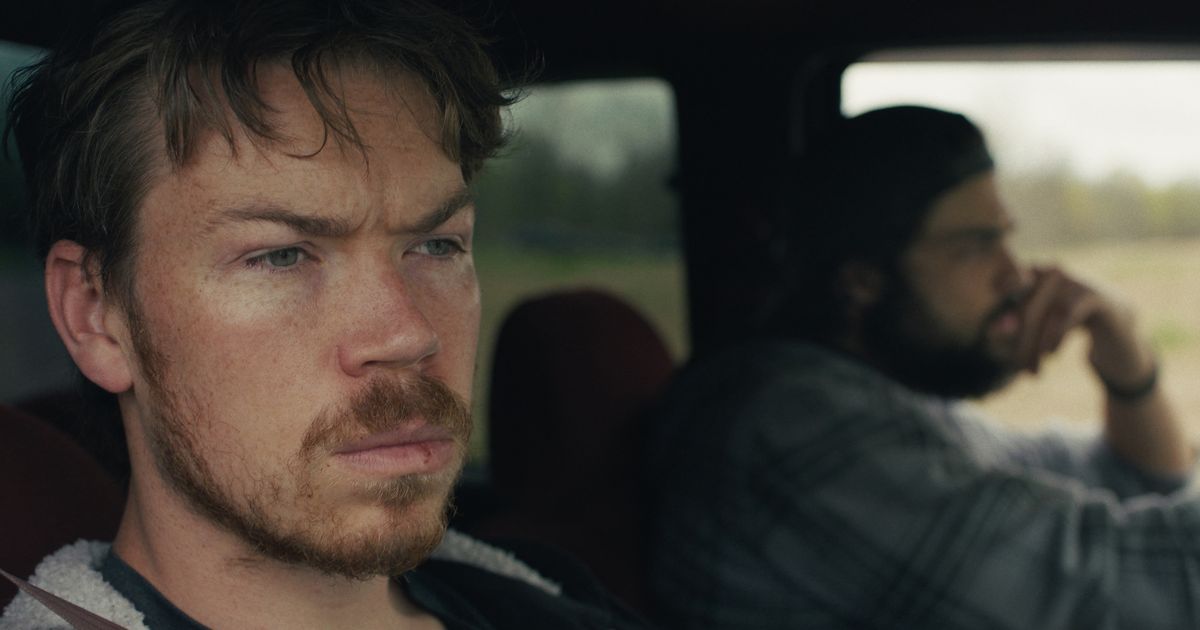
Photo: Courtesy of Sundance Institute
It’s amazing how much ordinary people can pop onscreen. We spend a lot of time thinking and talking about the screen presence of this or that professional actor, but nonprofessionals also often have a distinct, unstudied vibe. You can sense it in the opening minutes of Adam Meeks’s Union County, which features real participants from an adult recovery court in Bellefontaine, Ohio, as they stand before a real drug-court judge and talk about the progress they’ve made in their ongoing rehab. It feels like someone opened a door to the real world. These people have lived-in faces, voices that you can’t just mimic, and a shy, unpremeditated delivery you can’t teach. So that when British actor Will Poulter shows up, still recognizable under some deglamorizing scruffiness, we immediately think, All right, there’s the star, now here comes the story.
Amazingly, this turns out to be a virtue. Poulter is one of those actors who has stood out in supporting parts for so long that it seems high time he got some meaty lead roles. In Union County, he plays Cody Parsons, a recovering addict who has just entered this rehab program in lieu of prison. His younger, more flamboyant brother, Jack (Noah Centineo), is also in the program and helps Cody get a job working alongside him in a lumber yard. And while Poulter doesn’t fully blend in among these nonprofessionals, one could argue that he’s not really supposed to. Cody is from this area — as we learn soon, the two also have a sister (Emily Meade) nearby, and she’s trying to hold down a normal life amid all the dysfunction in her family — but there’s an awkwardness to his behavior that makes it feel like he’s just now learning how to function properly. With his hangdog face and perpetually watchful eyes, Poulter makes for an ideal outsider: He looks like he’s always trying to figure out how the universe works. His is a quiet performance, one that involves not just a lot of watching but also a lot of turning away, his posture an embodiment of the shame Cody feels. Our heart goes out to him.
There have been a number of pictures set in similarly depressed stretches of the heartland — some very good ones, like Holler, and some not so good ones, like Hillbilly Elegy — but they all struggle with the challenge of how to depict life in these communities without sliding into genre theatrics or cheap sentimentality. Meeks admirably keeps the story focused on Cody’s attempts to stay clean without relegating these efforts to the background of something more cinematically palatable and narratively charged. Not that much happens in Union County, but what does happen — whether it’s a slide back into addiction or an awkward burgeoning romance — is of enormous consequence to the characters themselves, and we understand this because the film has drawn us in through its sheer attention to detail. Just about everything in the movie feels authentic, from the way a counselor might talk to a program participant, to the process of urine testing, to how a buzz saw works. That much of the cast consists of nonprofessionals, including Annette Deao, a real-life rehab-program coordinator essentially playing herself in one of the film’s more notable roles, helps immeasurably. We talk of fictional movies with documentary touches, but Union County sometimes feels like a documentary with some fictional touches.
The grim atmosphere is offset partly by the uncommon beauty of the surroundings. Maybe “offset” is the wrong word: There’s an overgrown majesty to this world that adds to the sense of wildness, of unpredictability. One quietly climactic scene unfolds near an impossibly green field against a gathering dark sky, and the visual drama of the setting matches the psychological drama of what’s happening. Touches like these — touches that indicate a sophisticated understanding of how to put together a movie — help elevate Union County above a lot of other, similar films. That it features a great performance from one of today’s most interesting actors makes it that much more memorable.