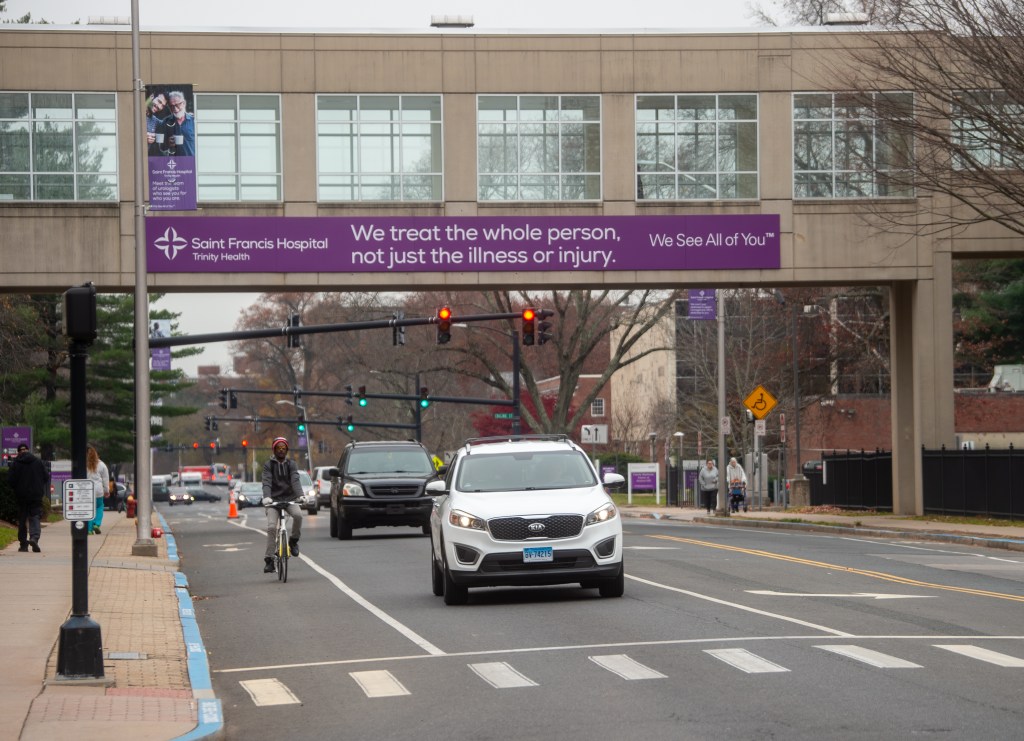
More than 40 radiologists from Advanced Imaging Specialists are leaving Saint Francis Hospital in less than two months after the group sued the hospital for mismanagement and lack of equipment.
“This is not something that you can solve with one or two people,” said one of the radiologists, who asked to speak on anonymity and works at the hospital. “I can’t imagine coming up with a solution for coverage in less than three months. They aren’t looking out or serving the best interests of the community.”
The radiologist said that it takes weeks for radiologists to become credentialed and trained in a hospital system and that the current time frame is too tight for a smooth transition. The radiologists are expected to leave on March 20. AIS confirmed to the Courant that once it has fulfilled its obligations under an agreement reached during mediation, it will no longer be providing radiology services at the hospital.
The hospital has struggled over the last several years with inadequate staffing — linked to two patient deaths and fines from the state Department of Public Health. Last year 15 hospitalists left Trinity Health of New England, the majority from Saint Francis, after the health system required them to shift their employment to California-based Vituity within 90 days or risk losing their jobs. An unknown number of nurses has also left the hospital.
Several lawmakers have raised concerns about staffing at the hospital, saying that more oversight is needed from the state Department of Health and that legislation may be warranted.
“This should be on the radar for DPH as, if this does not move forward as planned, patient management of a large segment of patients in the Hartford area could be impacted,” said State Sen. Saud Anwar, the co-chair of the state’s Public Health Committee and a medical doctor. “DPH should be watching along with the governor’s office as the care in this region is critical for vulnerable communities and must continue to function.”
He said the departure of the radiology group could lead to a crisis in the hospital and that he is hopeful the hospital can find an urgent solution to address the problem.
“Lack of radiology would make the health system non-functional,” he said. “Radiologists are one of the most important parts of timely diagnosis and critical management and follow-up. Having no radiologists would place timeliness and time management at risk.”
The departure of the radiology group follows a lawsuit AIS filed against Trinity Health last November. The lawsuit alleges Trinity Health breached a contract, claiming that the hospital’s radiology department was “significantly mismanaged” and that critical radiology equipment was not available as the “equipment did not exist, was in disrepair or was at the end of its service life.”
Under an agreement for the period from March 2024 to September 2029, AIS was to be the exclusive radiology services provider for Saint Francis, Johnson Memorial, and Mount Sinai hospitals, according to the suit.
Per the agreement, Trinity Health was to provide “adequate facilities space, supplies and equipment for AIS to perform the radiology services,” as well as staff to support it, including “an adequate number of nurses, radiology technicians and administrative support staff,” the suit says. AIS also claimed it was falsely assured “Trinity Health had sufficient volume of patient services for physician provider groups to generate sustainable revenue,” among other things.
However, AIS claims, it discovered that Trinity Health’s radiology department was allegedly “significantly mismanaged” and that Trinity Health had made “material misrepresentations to AIS regarding the operation of its facilities,” the suit says. It also claims “equipment failures, staffing shortages and lack of management and/or supervision” limited the group’s ability to provide services and that a pre-existing agreement with its previous provider for all outpatient radiology as well as its patient volume “was not substantial enough to support a radiology practice group.”
Stephanie Valickis, regional communications manager for Trinity Health of New England, which owns Saint Francis Hospital, said in an email that radiology services will be uninterrupted and that the organization is “actively and carefully managing the radiology transition as we have handled other past transitions of medical providers to ensure there will be continuity of care for our patients and community.”
Trinity did not respond to additional questions from The Courant concerning a potential new radiology provider.
Sen. Jeff Gordon, R-Woodstock, also a medical doctor, said the issue at Saint Francis is a continuation “where we see the hospital system put profits over patients. Saint Francis already had a problem with ER and hospital doctors. If we have a problem with radiologists what it is going to do is it is going to slow down needed care and it is going to create a massive problem.”
Gordon said there are times when the Office of Health Strategy and the state Department of Public Health are “wishy washy.”
“Then we wait when things fall apart like with Prospect Medical,” he said. “These are things that we shouldn’t wait. We might have to start ramping up some laws to have much stronger oversight over these things.”
In response to the Courant’s questions about the radiology group departing, a spokesman for the Department of Public Health said in an email that “questions regarding possible future staffing concerns at Saint Francis Hospital should be addressed to the hospital directly or to the staff group involved.” DPH did not answer questions about whether staffing was increased at the hospital.
Trinity Health in Livonia, Michigan, a nonprofit faith-based health care system, oversees numerous hospitals across 25 states, including Saint Francis Hospital and Saint Mary’s Hospital, which is overseen by its regional partner Trinity Health Of New England.
“We have not had a good experience as a state with out-of-state entities who do not give financial and management independence to our Connecticut hospitals,” said Anwar, referring to Prospect Medical Group, a private equity company in bankruptcy that state and federal officials claimed drained profits at the expense of patient care.
The company owned Waterbury Hospital, Manchester Memorial and Rockville General hospitals before selling the properties after years of decline. Last month, the Connecticut Office of Health Strategy approved Hartford HealthCare’s emergency certificate of need application for the transfer of Manchester Memorial Hospital, including the Rockville campus, and other assets. UConn Health has won the bid to acquire Waterbury Hospital for $13 million and is working through the certificate of need process.
Gordon expressed similar concerns.
“These big entities somewhat are too big to fail and they seem to get away with doing these things and the patients are ones who suffer,” he said.
Another nurse said that the hospital is tripling assignments in the ICU. While travel nurses are being used, their contracts don’t last long enough to hire and train more staff, the nurse said.
“]
More than 100 pages of inspections from DPH over the last year that were reviewed by The Hartford Courant highlighted violations of health regulations including failing to follow physician orders that directed continuous monitoring of patients’ cardiac rhythm; nursing staff administering oxygen without a physician; incidents of patients not receiving medications as directed by a doctor; failing to ensure isolation precautions with patients with illnesses that required such protocols; among others.
This follows more than a dozen reports from an independent monitor overseeing Saint Francis Hospital that The Hartford Courant obtained through a Freedom of Information request spotlighting two patient deaths related to inadequate staffing at the hospital.
The most recent inspection from the state Department of Public Health in November of last year continued to note problems at the hospital, citing violations of health regulations including the hospital’s failure to ensure critical medication was administered timely.
In an incident documented on Aug. 20 of last year, the inspection report said that the “hospital failed to ensure that a defibrillator that was connected to a patient was disconnected from the patient when performing an equipment check, resulting in an unintended electrical shock delivered to the patient that subsequently led to cardiac arrest.”
“The hospitals must have appropriate ratios, oversight and management to provide the best care to patients,” Anwar said. “The data is concerning and I’m hopeful DPH remains laser-focused on the hospital’s ability to address these concerns immediately.”
Valickis said in an email that the hospital is “continuing to review, revise and implement processes to continue to ensure high-quality safe care.”
Some of those processes include reinforcing roles and responsibilities, timely escalation expectations, completion of training on the chain of command, monitoring and auditing clinical performance and patient documentation on an ongoing basis, Valickis said.