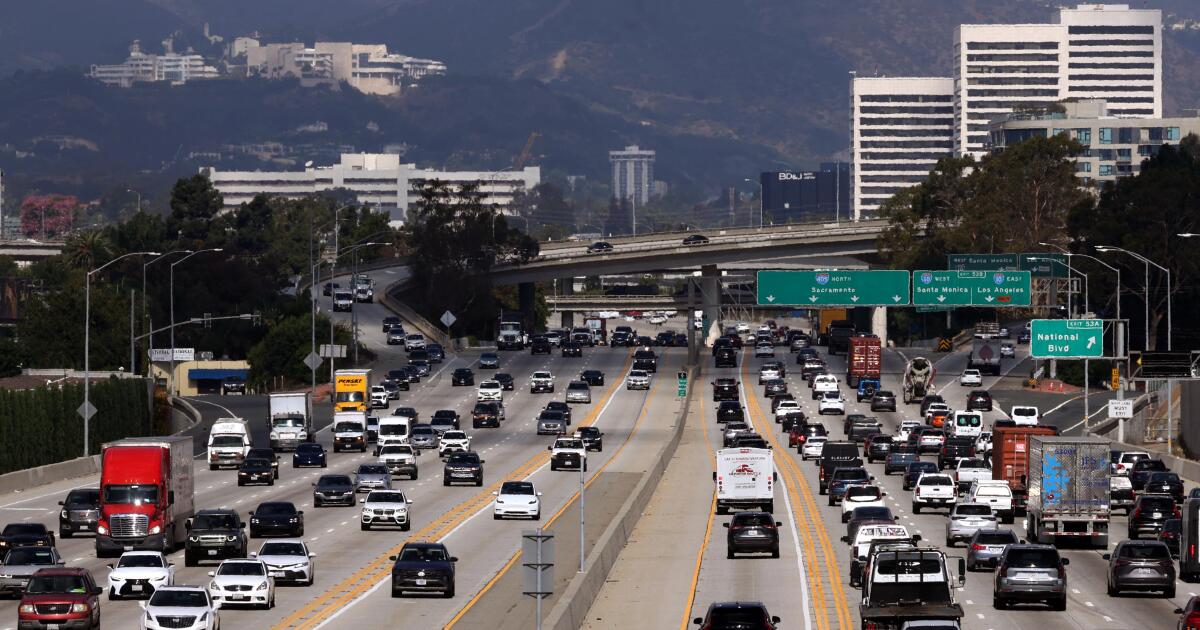
One of the most heavily traveled and congested corridors in Los Angeles County could finally get some relief.
L.A. Metro’s board of directors unanimously approved an underground heavy-rail option of the multibillion-dollar Sepulveda Transit Corridor project, which offers an alternative to the increasingly crowded 405 Freeway.
You’re reading the Essential California newsletter
The option, which was pushed forward by Metro’s planning and programming committee last week, would go from Van Nuys to Sherman Oaks, pass under the mountains and Bel-Air, stop at UCLA and ultimately end at the E Line’s Expo/Sepulveda Station.
Although it is considered one of the most significant transit projects in the country, billions of dollars have yet to be secured, and questions remain about its timeline.
Support for the project
Despite the project being the subject of multiple Metro community meetings and eliciting thousands of remarks for and against various proposals, public comment was overwhelmingly supportive when Metro’s board approved the plan last week.
The busy corridor and solutions to improve it have been under discussion for decades, The Times’ Colleen Shalby wrote. Ethan Elkind, a rail expert and director of the climate program at the Center for Law, Energy and the Environment at UC Berkeley, told her that a variety of political and logistical factors have slowed the project’s progress: a focus on downtown transit, opposition to high-capacity transit in the San Fernando Valley and geological challenges in the Sepulveda Pass.
“It’s a lot of land,” Elkind said. “And the more land you have to go through, the more expensive it is, the more logistically challenging it is.”
But L.A. County leaders have been supportive of the project.
Lindsey Horvath, L.A. County supervisor and Metro board member, said the project would be a historic development for the Los Angeles region, affecting drivers who commute through the Sepulveda Pass along the 405.
Los Angeles City Councilmember Nithya Raman said that construction for the project would create hundreds of thousands of jobs and that revenue from ridership would help local businesses.
“We don’t have to accept sitting in traffic as our only choice,” she said, “and this is our pathway forward.”
Concerns over funding
The Sherman Oaks Homeowners Assn., which has been a vocal critic of some of the project’s routes, ultimately supported the current recommendation.
The association’s vice president has expressed concerns over funding of the project, however.
“We still have not heard from Metro how they’re going to pay for this thing,” Bob Anderson told The Times. “We don’t need to know every financial detail, but we do need to know where they’re going to get the funding stream that feeds it and how much the financing is going to cost us.”
The estimated cost of the project has ballooned since 2016, when Los Angeles County voters approved transit improvements between the Valley and the Westside under Measure M.
The project was slated as $6 billion, then grew to an estimated $9.4 billion to $13.8 billion with a completion goal of 2033. Metro does not have an estimate for the current modified proposal.
The transit agency cited the need for reliance on state, local and federal funding to fill the shortfall and has raised the idea of private-public partnerships — similar to proposals for the state’s underfunded high-speed rail project.
But it did not have a specific plan for how that money would be obtained or how it would affect the project’s schedule.
Today’s top stories 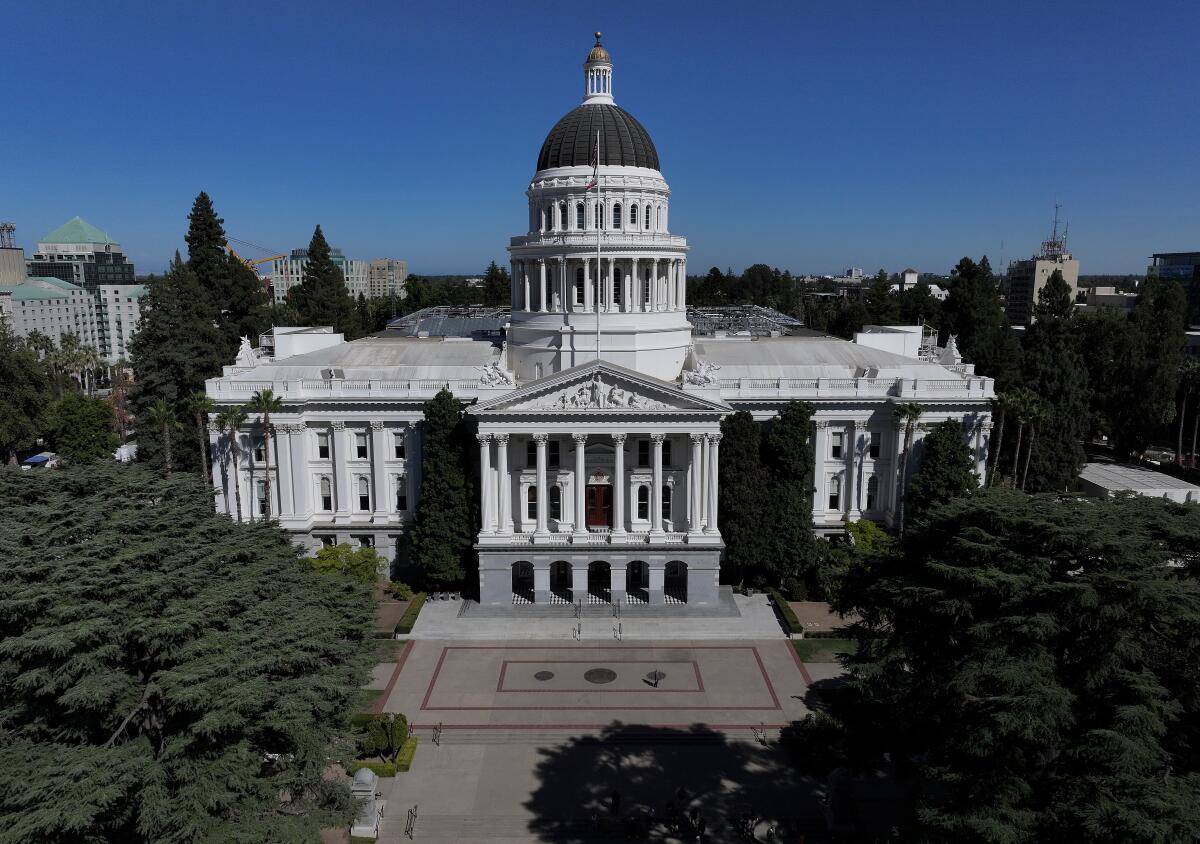
A proposed ballot measure seeks to impose a wealth tax on California billionaires. Above, the state Capitol.
(Justin Sullivan / Getty Images)
Is California’s proposed billionaire tax smart policy?
- California’s proposed billionaire tax would impose a one-time 5% levy on residents whose worth is north of $1 billion.
- Critics cite failed European wealth taxes as cautionary tales, while the measure’s architects argue they’ve designed a stronger version that addresses past pitfalls.
- Among critics is San José Mayor Matt Mahan, a tech-friendly Democrat who is contemplating a run for governor.
How the two parties propose fixing housing costs
- California says it needs to add 180,000 housing units annually to keep up with demand.
- President Trump has endorsed a $200-billion mortgage bond stimulus, which he said would drive down mortgage rates and monthly payments.
- Here is a closer look at their competing plans for expanding housing and reining in costs.
ICE chaos in Minneapolis
- Demonstrators in Minnesota and cities across the country are calling for justice after federal agents shot and killed Alex Pretti, a 37-year-old nurse, in Minneapolis.
- Hundreds gathered Sunday amid a weekend of protests in downtown Los Angeles and other areas of Southern California, demanding an end to the immigration crackdown.
- The crisis response from President Trump’s top Homeland Security officials followed a familiar playbook from an administration eager to project grit and resolve, particularly on immigration, in the face of inconvenient facts.
Sundance Film Festival 2026What else is going onCommentary and opinionsThis morning’s must readOther must readsFor your downtime 
Eddie Izzard’s touring solo production of “Hamlet” is now at the Montalbán Theatre.
(Amanda Searle)
Going outStaying inA question for you: What’s your biggest recycling gripe?
Tom King said: On packaging, recycling symbol “[t]riangles that are so small or have so little relief that they cannot be read.”
“Companies using the wrong type of plastic when an easier to recycle plastic could be used. Companies could really energize their customers to use their reusable cups if they wanted to.”
Email us at essentialcalifornia@latimes.com, and your response might appear in the newsletter this week.
And finally … your photo of the day 
Giselle Bonilla, director of “The Musical,” stopped by the Los Angeles Times 2026 Sundance Film Festival studio in Park City.
(Christina House / Los Angeles Times)
Today’s great photo is from Times photographer Christina House at the 2026 Sundance Film Festival, where filmmakers, actors and directors came together to support some of the year’s strongest independent cinema.
Have a great day, from the Essential California team
Jim Rainey, staff reporter
Hugo Martín, assistant editor, Fast Break desk
Kevinisha Walker, multiplatform editor
Andrew Campa, weekend writer
Karim Doumar, head of newsletters
How can we make this newsletter more useful? Send comments to essentialcalifornia@latimes.com. Check our top stories, topics and the latest articles on latimes.com.