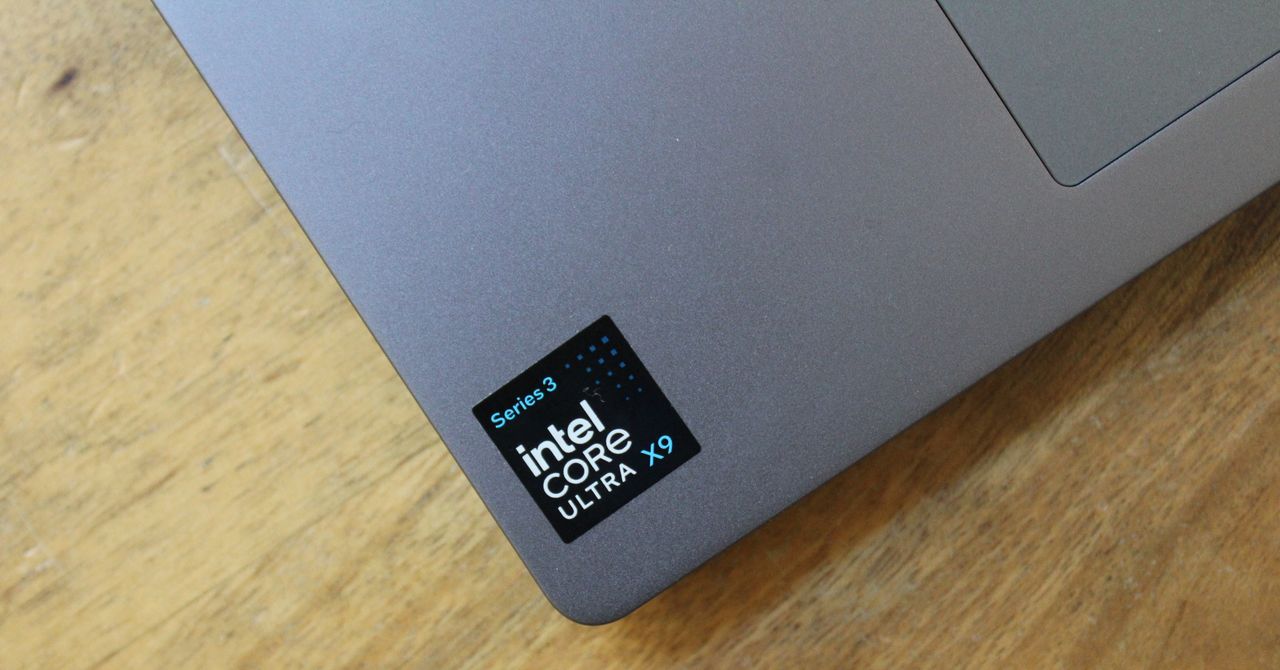
Here’s the thing: this is a fairly large laptop. While I don’t have official specs on it yet, the Lenovo reference device is around the same size as the 16-inch MacBook Pro, but the slight wedge shape makes it thicker by the hinge. It is already the size of a machine that could squeeze in a discrete graphics card, and as powerful as the Core Ultra X9 388H is, it’s still a solid 25 percent behind even an older graphics card like the Nvidia RTX 4050, as well as Apple’s M4 Pro.
I love the idea of not needing a dedicated gaming device to play games, and this device sells that idea best over the Lenovo reference design. But as gaming laptops get trimmer and MacBooks push forward into gaming, Intel’s success here feels like less of a revelation than I thought it would. Even the top-of-the-line X9 chip is still 26 percent behind the performance of an RTX 4050 in a laptop, and that’s the lowest-tier GPU from three years ago.
Presumably, we’ll get thinner laptops that can make use of this chip, but we’ll have to see how the performance shapes up. As of now, the main benefit you’re getting here isn’t performance: it’s battery life. Laptops with discrete graphics generally get poorer battery life, while this larger Lenovo machine got well over 20 hours of local video playback. For the first time, it finally feels like Apple has a competitor within striking distance of its MacBook Pro—at least when it comes to not having to always make a trade between performance and battery life.
Why This Matters So Much
A lot of what makes the performance of these chips so important is how they were made. They’re built on Intel 18A, the latest process node manufactured in the company’s new fab in Arizona. The facility isn’t just another chip plant. It was hailed as an attempt to bring back advanced chip manufacturing to the states, largely funded by the CHIPS Act. And don’t forget an $8.9 billion investment in Intel from the US government, which gained a 10 percent equity stake in the company.
Intel 18A is also a return to form in that the previous-gen Core Ultra Series 2 was partially manufactured by TSMC. This was a big deal at the time—an admission of just how far behind Intel had fallen versus the competition, especially in battery life. While it allowed those chips to be more competitive with Apple and Qualcomm in terms of efficiency and battery life, it was a bitter pill to swallow, no doubt. Notably, they didn’t move the needle in performance from the Core Ultra Series 1 chips.
The Core Ultra Series 3 reverses that water-treading trend for Intel, positioning itself well against the likes of Qualcomm and Apple. Based on the number of laptops embracing the new chips announced at CES, the company hasn’t lost its dominance and remains the primary choice for Windows laptops. In that way, 18A and Core Ultra Series 3 feel like a success so far, at least in terms of delivering competitive performance in consumer laptops.