
The loss of insurance for Green Haven condos and a $900,000 settlement resulting from a 2024 class-action lawsuit were announced at the San Diego Country Estates Home Owner’s Association board meeting on Jan. 16.
The debris in an overgrown creek bed — a potential fire hazard — prompted Farmers Insurance to drop the master policy for the association of Green Haven condos, said Doreen Smith, a Green Haven resident.
“The Villas HOA notified residents of all 115 condo units on Jan. 13 that they had received a non-renewal notice from the insurance company,” she said about the policy that ends in April. “We are considering numerous options as we continue to seek a new insurance policy.”
Residents of the San Vicente Country Villas II, also know as the Green Haven condos for one of the streets they are on, have voiced health and safety concerns for years about the overgrown creek bed located between their homes and the SDCE golf course.
Keeping the creek bed clear from the 20- to 30-foot-tall trees, dead weeds and debris is necessary for residents of the 115 condo units to be able to keep their insurance.
At least 30 condo units are located within feet of the wall of vegetation.
At the Dec. 16 HOA general meeting, Smith told the board that the former general manager, Carl Weise, said he sent the condo HOA board a letter from the association asserting he had submitted an application for a permit to clear the creek bed.
She alleged that Weise had never actually sent the application. If not submitted by Dec. 31, the permit could not be expedited and the months-long application process would have to be restarted.
Weise stepped down from his role “by mutual agreement” during the Nov. 18 closed session of the HOA board meeting.
Condo residents have their own HOA, but all fall under the auspices of the Master Association, or SDCE HOA. The creek bed is located on SDCE property.
Pete Smith (not related to Doreen Smith), consultant on special projects for the HOA board, and new general manager Matt Brumbaugh were tasked by President Jodi Taylor to look into the allegations.
At the January meeting, Pete Smith said they found no evidence that Weise had applied for the permit, despite his letter to the condo HOA board starting it had been done.
Since the discovery was made prior to the Dec. 31 cutoff date, the board submitted the permit application to the state Department of Fish and Wildlife. The Department verified they had received it before the cutoff date, Smith said.
“The permit allows for removal of approximately 1.9 acres of overgrowth, and the department should have a plan for the removal by the end of February,” he said.
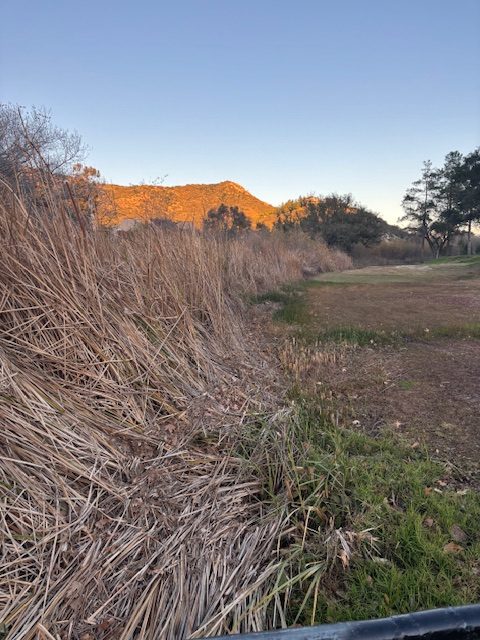 These reeds have grown from a creek bed located between the San Vicente Country Villas II, or Green Haven, condominiums and the San Diego Country Estates golf course. (Doreen Smith)
It is unknown how long removal will take, because when a permit is issued, there are conditions on the time of year the work can be done, removal method and other factors, he said.
“The first step is to make sure the permits are in place, then we need to know how to implement the removal and then we to find out how much it will cost,” Smith said. “It’s a great deal of work and very expensive.”
He added that the board will be exploring available grants to fund the brush removal.
Silt at the bottom of the creek bed, which is concrete in some areas, allows the weeds to grow, but will have to be removed at a later date.
Steven Franck has lived in the Estates since 1997, in an older home next to the golf course where he frequently plays. Previously, he lived in the condos.
Franck said the creek bed has been an issue for at least the past five years, if not longer.
The unchecked foliage has taken away the golf course views for condo units, he said. In addition, the weeds are a fire hazard and create a breeding ground for mosquitoes. Their growth takes up a lot of water, he said.
“It makes the golf course on holes #11 and #16 much more difficult to play, as well as ugly,” Franck said. “It’s horrible; some of the reeds have moved outside the creek bed and stretch 30 to 40 feet across.”
Franck, who doesn’t attend the HOA meetings, said he surprised to learn the removal permit had been granted.
“The new board is the best board we’ve had in some time, but I’m still skeptical that what is best will be done,” he said. “I have a wait-and-see attitude.”
In an information-only segment on another matter, Josh Carlon, attorney for the Estates HOA, reported that the HOA had reached a $900,000 settlement in a 2024 class-action lawsuit filed by Brandon L. Smith, a former SDCE employee on behalf of all SDCE hourly employees.
Smith alleged in the lawsuit that the association wasn’t paying proper wages or overtime, was not allowing proper breaks and was not properly reimbursing employee expenses, Carlon said.
Although state law requires the exact terms of the suit to remain confidential, Carlon said that the original request was estimated to be “in the millions of dollars.”
The association immediately sent the case on a resolution tract, and a final remediation settlement was approved by the court on Jan. 2.
Terms of the settlement were much less than the original proposed amount, Carlon reported.
The court approved the association’s request to pay the amount in three installments; the first in June 2026, the second in December 2026 and the third in June 2027, he said.
Questions concerning the lawsuit were referred to general manager Brumbaugh.