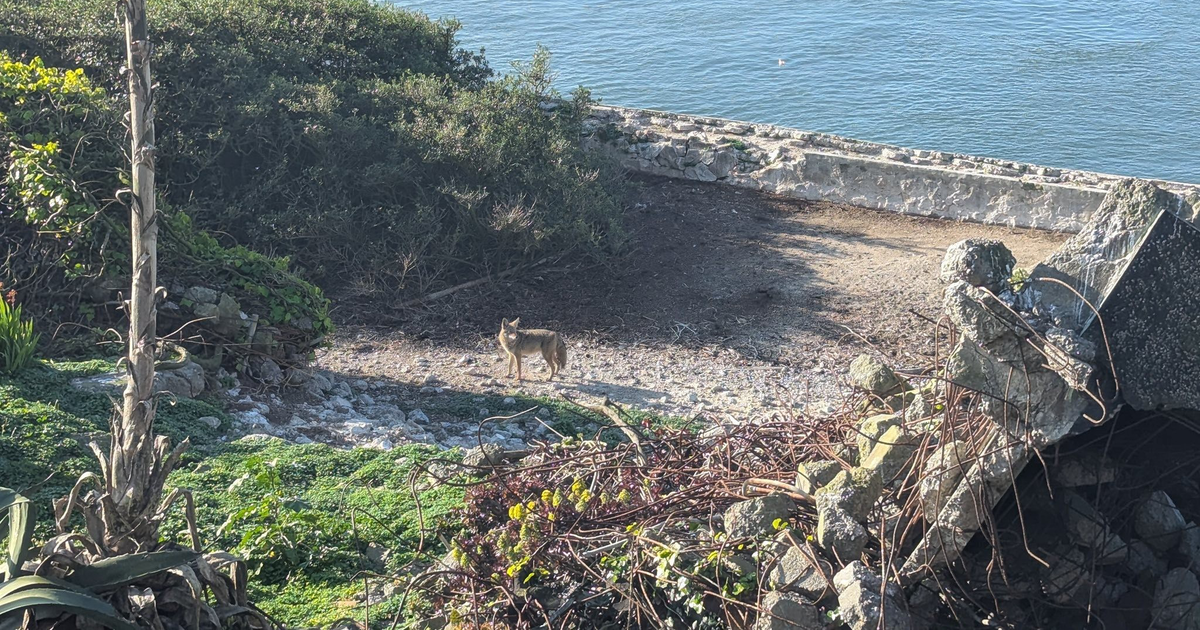
A coyote that made a daring swim across San Francisco Bay to Alcatraz Island this month appears to be living its best life, according to wildlife observers tracking the unlikely journey.
The soaking-wet, shivering coyote can be seen struggling onto the rocky shore of the former federal prison in a video (opens in new tab) shot in early January by an anonymous tourist.
It’s a 1.25-mile journey from Aquatic Park through frigid, current-swept waters to reach the tourist attraction.
Janet Kessler, a “self-taught naturalist” who has documented San Francisco’s urban coyote population for years, shared concerns about the animal’s odds of survival. The swim would have drained the coyote’s body heat and energy reserves, she said, leaving it in desperate need of food, water, and warmth on an island with limited resources.
But a photograph taken by another unnamed visitor (opens in new tab) and shared online Saturday by Kessler shows what she described as a healthy coyote on Alcatraz nearly two weeks later.
“So he not only survived, but he is well and thriving,” Kessler wrote.
Alcatraz spans about 22 acres, far smaller than typical coyote territories. The National Park Service says (opens in new tab) coyote families maintain territories that “can span several miles.”
Aidan Moore, who works for Alcatraz City Cruises, said the coyote has been holed up near the parade grounds, where birds frequently nest. Bird carcasses have recently been found around the island, Moore said.
“He’s certainly much fatter than when he arrived,” said Moore. “We don’t know how long he’s going to be a resident here, because if he interferes with the nesting birds he might get relocated to the mainland.”
It is the first documented coyote on Alcatraz since the island was transferred to the National Park Service in 1972.
“Park biologists and staff are actively monitoring the coyote to better understand how it is surviving on the island and to assess any potential impacts to the seabird breeding colony,” the NPS said in a statement.
Kessler urged the agency to let the coyote remain on Alcatraz.
“He expended a huge amount of effort to reach the island,” Kessler wrote on social media. “If he can survive there, we should allow him to.”
Kessler and a UC Berkeley researcher said the coyote likely left the mainland due to territorial pressure from the city’s approximately 20 coyote family groups, each of which defends its turf against outsiders. With limited options for dispersing young coyotes — about 30 are killed by cars in San Francisco each year — this one apparently decided to strike out across the water.
Christopher Schell, an assistant professor at UC Berkeley who studies how carnivores adapt to urban environments, said coyotes rarely display this type of swimming endurance, but it’s not unprecedented. He recalled reports of coyotes swimming up to three miles to islands from Seattle and Tacoma, Washington.
“We’re just now coming to the realization of their swimming and navigation prowess,” he said.
Schell said the coyote’s successful crossing likely reflects intense competition for territory on the San Francisco Peninsula. Research conducted by his lab, in collaboration with Kessler, the California Academy of Sciences, UC Davis, and community science groups, has confirmed that the area is saturated with coyotes.
“High territoriality and competition may have pressured the animal to seek new opportunities or open niches that could have resources to sustain a population,” Schell said. “The gamble was likely made because competition on the peninsula was too stiff.”
He said a hands-off approach could allow the coyote to help regulate prey populations on the island, potentially increasing biological diversity.
But if it must be relocated, Schell said, authorities should consider if the animal could survive a move without hurting its health, then establish a viable domain elsewhere and avoid conflict with humans.
“That animal may be just as likely to get hit by a car if it is relocated, as it tries to cross a road that is unfamiliar,” he said.
“They have been able to successfully colonize so many different types of urban environments, habitats, and biomes across the North American continent that it is no surprise that one of their superpowers is also being able to have the necessary nautical navigation skills and stamina to successfully swim to nearby islands,” he added. “We still have a lot to learn about coyote flexibility, social ecology, and their intersections with the urban interface.”