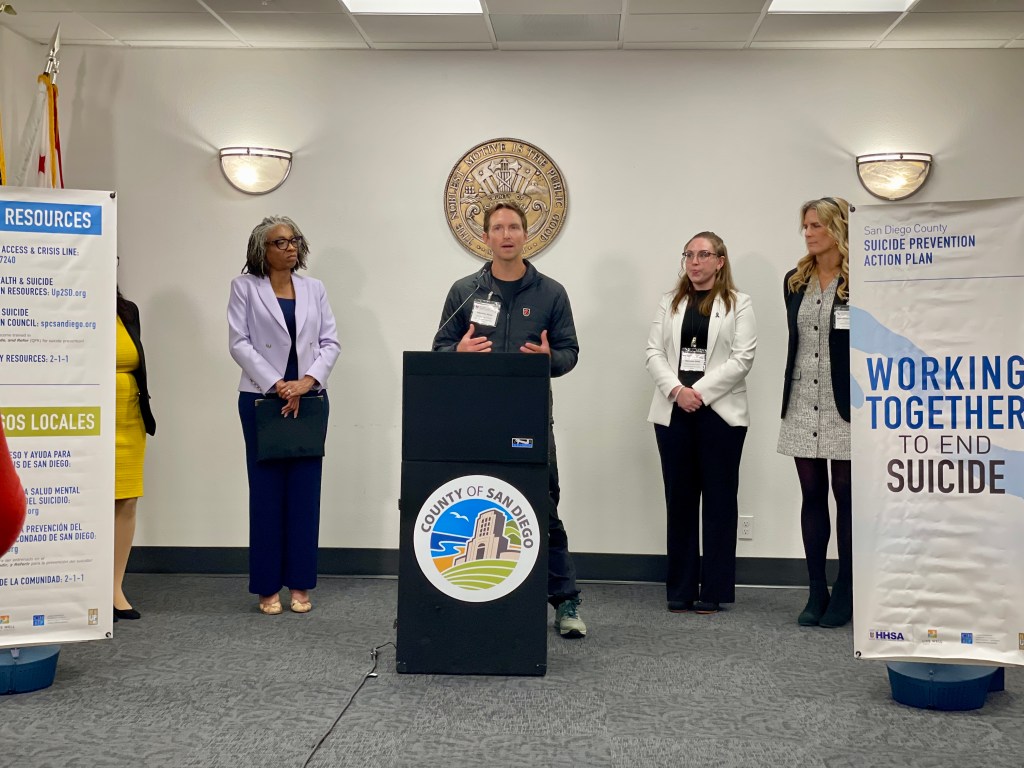
For the third consecutive year, San Diego County’s suicide rate increased slightly, continuing a trend that is gradually returning the region to rates of self-harm seen before the COVID-19 pandemic.
The San Diego County Suicide Prevention Council released its annual report Tuesday, which records 377 suicides in 2024, a 3% increase over the 363 documented cases in 2023.
There were 11.4 suicides per 100,000 residents, according to the council’s calculations, in 2024. While higher than it was in 2021, that number remains significantly lower than it was in 2018 when 435 suicides occurred, a rate of 13.1 per 100,000.
The local picture continues to look better than the nation’s. According to the U.S. Centers for Disease Control and Prevention, there were 14.2 suicides per 100,000 residents nationwide in 2023, the most recent year for which data is available. San Diego County’s rate was 11 per 100,000 that year, slightly greater than the statewide rate of 10.8.
Suicide deaths, according to the report, were most common among white men age 70 to 79. Firearms and asphyxia are the most common methods of suicide. Local communities with the highest suicide rates in 2024 include: Valley Center, Santee, Ramona, Lakeside, Central San Diego and Oceanside. Those communities are said to have per-capita rates ranging from 14.1 to 17.3 per 100,000 residents, though specific numbers were not included in the report.
A significant drop in the suicide rate was seen nationwide in 2020, when the pandemic hit. Other communities returned to pre-pandemic suicide rates more quickly than has been observed in California.
Much has been made of this counterintuitive trend. While many might have expected curtailed mobility, international contagion and widespread job losses to increase the suicide rate, researchers say that some factors in play during the pandemic may have been protective.
The most grim, one report indicates, is that pandemic deaths skewed the numbers, “because people who would have otherwise died by suicide died instead of COVID-19.”
But more positive explanations are also in play. Researchers hypothesize that the expansion of access to electronic mental health counseling, more attention paid to mental health symptoms and family members checking on each other more frequently contributed to the drop.
Yeni Linqui Palomino, vice president of community health and engagement for the prevention council, said the group is working to keep that communal feeling from the pandemic from disappearing.
“During the pandemic, because everybody was feeling like their mental health was, you know, somewhat compromised, they were supporting each other; we had these little bubbles where people were checking in on each other,” Palomino said. “When you talk about preventing suicide, you know, staying with that person, not giving them judgment, those are important.”
The council works on many fronts to lower the local suicide rate, offering free “question, persuade and refer” training to the public aimed at increasing trainees’ ability to recognize the signs of self-harm early.
But, beyond training, many are working to push back the traditional factors that keep people from discussing suicide with each other.
Sebastian Slovin, executive director of Nature Unplugged, a nonprofit that helps young people put down their smartphones and engage with nature as a way of promoting mental health, shared his own story during Tuesday’s report presentation.
His father, he said, took his own life when he was just six years old. He recalled how reluctant everyone around him was to discuss what happened.
“I had all of these questions about what happened to my dad: Is there something wrong, like, is that gonna happen to me? Is there something wrong with me genetically, or, do I have a choice in the matter?” Slovin said. “But, because of the kind of shame or the stigma around it, I felt like I couldn’t talk about it.”
His organization, he said, is an example of people pushing back against those stigmas. Making a friend whose father had also committed suicide, and talking about the experience, he said, made a massive difference.
“It didn’t really take away the pain or heal me instantaneously, but it was that (conversation), I think, that planted the seed of not avoiding anymore,” Slovin said.
Going forward, he said, finding conversation is the answer to driving the suicide rate lower.
“I learned the hard way that mental health challenges and suicide thrive on being in the shadows,” Slovin said. “Avoiding the topic does not work, but addressing it does.”
Volunteers are available to talk on the San Diego Access and Crisis Line 888-724-7240 or by visiting Up2SD.org.