
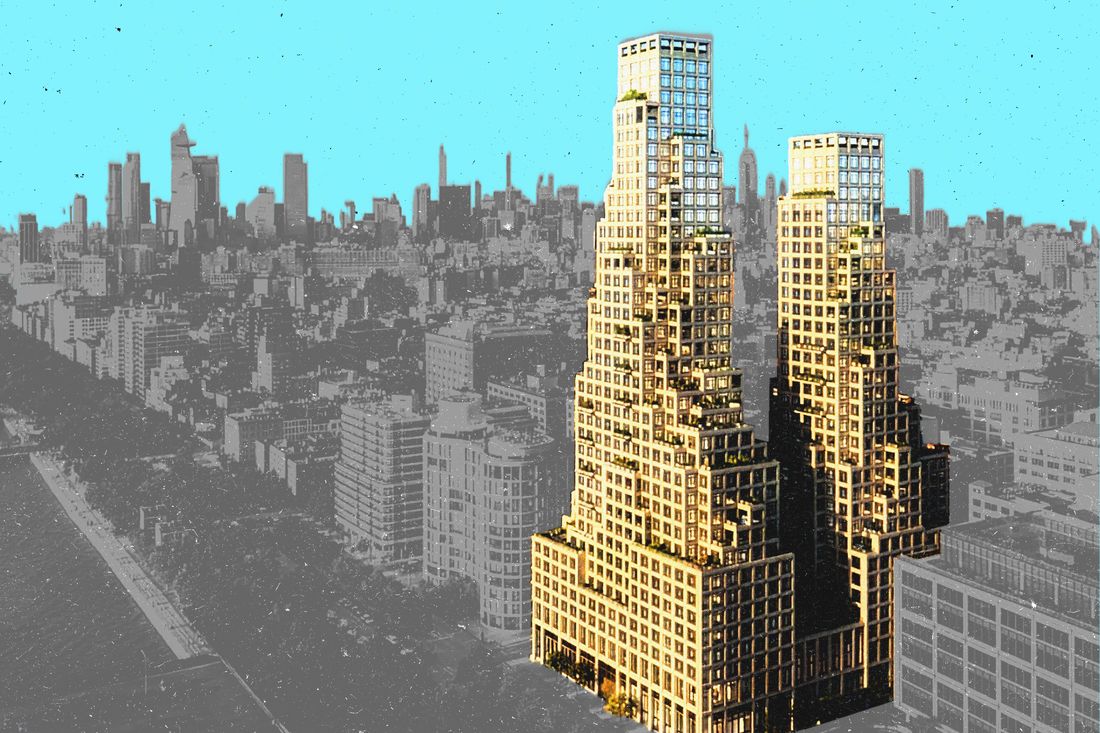
Is 80 Clarkson the second coming of ‘Limestone Jesus,’ the Zeckendorfs’ mid-aughts sales miracle 15 Central Park West? Or just another downtown luxury condo?
Photo-Illustration: Curbed; Photo: DBOX
The first closings at 80 Clarkson aren’t expected to happen until the end of the year, but its limestone-clad frame, rising along the West Side Highway across from Pier 40, already dominates the string of high-end condos that line the downtown waterfront. Its two towers topped out at 45 and 37 stories last summer, more than twice the height of most of its neighbors, and it now looms over 160 Leroy to its north, making the bow-fronted, 15-story Herzog & de Meuron building next door look like a shiny little bonbon. Height isn’t the only thing it’s lording over the competition: 80 Clarkson’s developers, Zeckendorf Development and Atlas Capital Group with the Baupost Group, have been doing everything they can to make their development the spiritual and financial successor to 15 Central Park West, a.k.a. “Limestone Jesus,” the Zeckendorf family’s runaway hit of the early aughts that set off the craze for ultra-high-end supertall condos. The Lincoln Square condo, which combined a prewar aesthetic and prime location on the park with all the advantages of a new-construction condo, turned the clubby, co-op-centric world of New York real estate into a speculative game for global billionaires. Apartments at 15 CPW, considered absurdly priced when sales started, proved so in demand that they routinely fetched double or triple the amount on resale.
At 80 Clarkson, the Zeckendorfs are once again building a pair of limestone towers in a last-of-its-kind location — what the developers describe in marketing materials as “the largest remaining Hudson River waterfront property” in the West Village — with locked-in views and unrivaled development rights transferred from Pier 40, a trade-off that involved attaching 175 units of senior housing to the development’s less glamorous east side. Just as at 15 CPW, the floor plans are grand, the amenities lavish, and the finishes and overall vibe, in the words of Compass broker Leonard Steinberg, “mainstream global luxe: very beautiful, very high-end, not offensive in any way.” That is, the soul of quiet luxury (also, a little boring). They even hired the architects and designers behind the past few “It” buildings — Cookfox, which designed 150 Charles, and Thierry Despont, who did the interiors at 220 Central Park South (where Ken Griffin bought a record-setting $238 million condo). The marketing, in the manner of 220 CPS, is nonexistent: The developers have released no interior renderings, no public listings, and no sales figures. The building has a projected sellout of over $2 billion — a huge sum, particularly for downtown, making the stakes on this project notably high — but how much has actually been sold is a matter of hearsay and speculation. A broker familiar with sales there tells me that it’s at least 60 percent, but Donna Olshan, who tracks the Manhattan luxury market and publishes a weekly report on contracts signed over $4 million, refuses to include deals at 80 Clarkson because the sales team won’t confirm them. “If they won’t give you the details, it’s hard to know the truth,” she says. The extreme secrecy has made some brokers suspicious: Is 80 Clarkson really the Second Coming of Limestone Jesus? Or is it just really good at faking it?
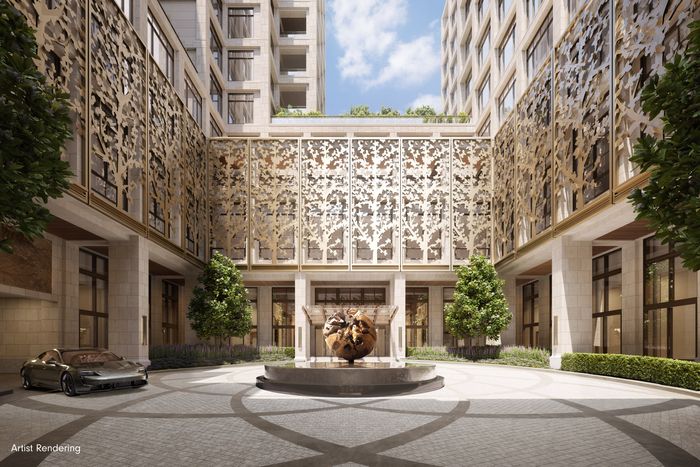
The motor court of 80 Clarkson. There will also be a waiting room for drivers.
Photo: DBOX
One of the things we do know about 80 Clarkson: the prices. They are, everyone agrees, somewhere between really high and exorbitant, around $6,500 per square foot. Since the developers filed the offering plan with the attorney general last February, they have submitted amendments to raise prices five times. “Clad any building in limestone and they’ll come running!” says Steinberg. The apartments range from two-to-seven-bedrooms, most with unique layouts: duplexes, penthouses, full- and half-floors. Prices start at just under $8 million. Half the apartments have private-elevator access, and three-quarters have private outdoor spaces. Still, purchasing a unit in the building won’t get you access to some of its most-prized features. The building has 112 apartments but just 18 accessory apartments for staff, which are available only for full-floor units, which start at $25.5 million and $41.25 million, depending on the tower. “My client really wants one, but they won’t let them buy it,” Danielle Nazinitsky, the founder of Decode Real Estate, tells me; their purchase of a $12.8 million three-bedroom doesn’t cut it. The parking spaces and wine cellars are also meted out sparingly, according to brokers, with preference going to the buyers of the larger units.
In December, The Real Deal reported that a buyer had gone into contract on a $129 million high-floor combo, a deal that would wipe out the previous downtown record. It’s more than $40 million over the next-highest sale, a penthouse at 140 Jane Street, which went into contract in August asking $88 million. The buyer of the Clarkson condo was said to be represented by Michael Balanevsky, a broker at Accent Holdings who, “according to his website,” was described as having “established a strong Russian clientele,” sparking rumors that the buyer might be an oligarch, unlikely though that would seem at the moment. The website belongs to a development firm where Balanevsky appears not to have worked for at least a decade, back when Russian oligarchs were still buying up Manhattan trophy apartments.
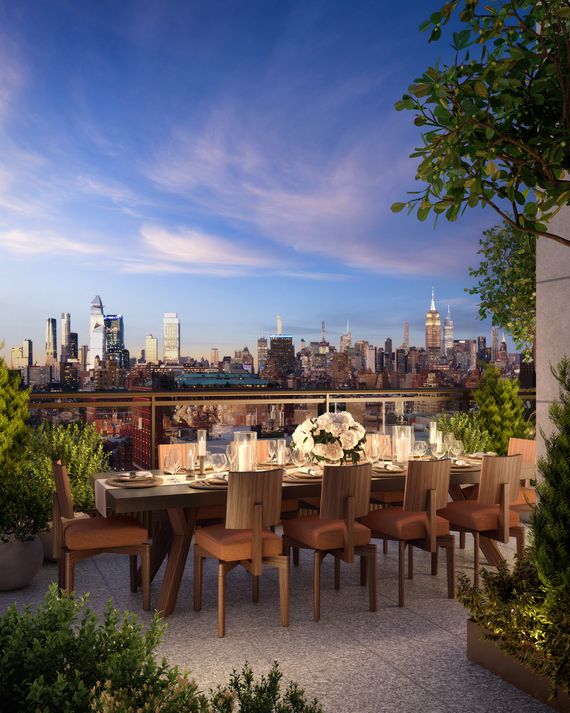
Three-quarters of units in the building have private outdoor spaces.
Photo: DBOX
Nazinitsky tells me she was surprised by how many units had already been sold when she took a client to the sales gallery this past fall. “I don’t think they have any two-beds left. Basically, all the three-beds with views were gone, and there were still some $20 million four-beds and $30 million full-floors,” she says. That client decided not to buy there because all the three-beds with open kitchens had been spoken for. But after Nazinitsky saw how fast the development was selling, she alerted another client, who managed to nab the last three-bedroom with a view, albeit one with a closed kitchen, to be used as a pied-à-terre.
So who’s buying at 80 Clarkson? Clayton Orrigo, an agent at Compass who has sold a number of units in the building, tells me that the buyers are “coming from all the best buildings in the city: 150 Charles, the Shephard, the Greenwich Lane, 15 Central Park West, 220 Central Park South.” He won’t say how many units he has sold, although it’s been reported that the team he leads, the Hudson Advisory Team, has done over $100 million in sales there. Another high-end broker who does a lot of downtown deals describes the buyers as “New Yorkers who have been around a while and understand the nuances of New York.” It’s people who already own in downtown trophy buildings, like Superior Ink and 150 Charles, that were all the rage when they went up ten or 15 years ago. Another says he hasn’t heard of any big names yet, “but there are a lot of families — Greenwich, Rye, Westchester people. I would expect 80 percent of the buyers have two or three homes.” There is no dominant industry or age group, brokers say, “but whoever it is is at the top of their game.” And the building is said to be younger than uptown condos like 15 CPW, 220 CPS, and 432 Park, where there are virtually no families with young children.
It can be a little hard to suss out how much brokers know and are being discreet versus how much they don’t know and are not willing to admit. So much of what happens at 80 Clarkson is shrouded in mystery, and that’s by design. When I ask one broker if she knows of any high-profile buyers in the building, she asks if we could go off the record. I agree. “Yes, there are high-profile buyers,” she says. I wait for more, but that is all she will say. Appointments with the sales team, brokers Dan Tubb and Amy Williamson, are tightly guarded, and I am told that “at the beginning, they were so inundated that you couldn’t get an appointment unless you knew Dan’s or Amy’s cell phone.” The sales site is just a “Contact us” form, though one broker describes 80 Clarkson’s sales strategy as open compared with 220’s famously opaque process. For those who gain entry to the sales gallery, 80 Clarkson puts on an impressive, full-fledged show with full-size renderings, an Imax-like presentation screen, and a walk-through of a model kitchen, bathroom, and even an indoor terrace with realistic lighting and patio flooring. Whereas “220 had watercolors.” And while Steven Roth is said to have curated 220’s buyers like an old-school co-op, the Zeckendorfs aren’t vetting buyers based on social desirability, even if they’re playing hard to get.
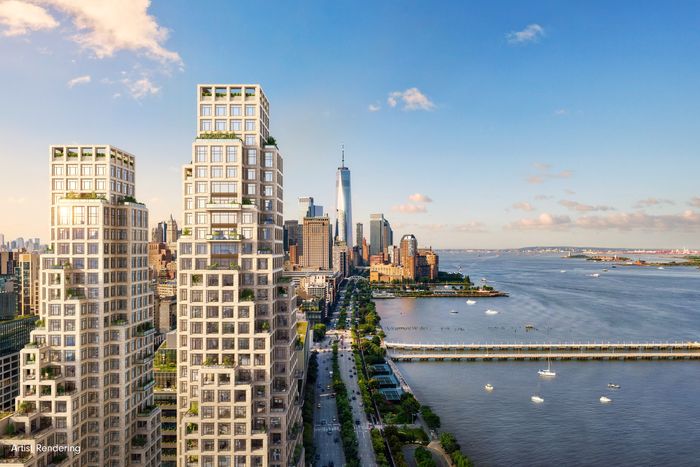
The building, with air rights from Pier 40, looms over its luxury neighbors on the West Side Highway.
Photo: DBOX
There are some indications that sales may have slowed, at least slightly, now that most of what’s left are the bigger apartments. A broker tells me that Tubb, one of the sales directors, reached out to him in the fall. “He was behaving in a way that I wouldn’t say was desperate, but he was more accommodating.” “Like what?” I ask. “Getting into the building and seeing actual units.” Orrigo tells me that he too was a little doubtful about the project’s prospects at first: “I was like, Are they going to kill it? They have a lot of units to sell.” But after selling numerous units in the building, he calls it “a massive success.” He says buyers love open-water views and the proximity to Teterboro.
Still, several people I spoke with pointed out that the location is a little meh: it may technically be West Village, but it’s not cute West Village, and it’s on the border of Hudson Square, next to the new Google Headquarters at St. John’s Terminal. But the billionaire class does not seem to be deterred by slightly off-piste locations in the era of private jets and motor courts — 80 Clarkson has one, of course, with intricate metalwork, so drivers needn’t unload on the street, and there’s also a waiting room for them. And most new ultraluxe downtown condos are in spots that are a little weird. The success of similar downtown projects like 70 Vestry, 140 Jane and 150 Charles have also made buyers more eager to sign contracts. “There just aren’t that many units downtown,” says Orrigo.
For the Zeckendorfs, who are known for high-quality, tasteful buildings — “They think of themselves as Hermès, Gary Barnett as Bloomingdale’s, everybody else is Macy’s,” a source familiar with the family told The Real Deal last summer — 80 Clarkson is their first building in decades to come close to capturing the zeitgeist like 15 CPW. In 2015, the family completed 50 UN Plaza, a glassy Norman Foster tower on the far East Side whose last penthouse finally sold this December, for $28.5 million, after first listing for $70 million in 2013. Another development, 520 Park, a limestone tower that they went back to Robert A.M. Stern Architects for, “did just okay,” in the estimation of one broker. No matter how well 80 Clarkson sells, however, it will not be another 15 CPW, which was not just a buzzy building in its own right — it created a new category of luxury real estate, launching lesser imitations across Manhattan and around the world.
But in their downtown building, they seem to have landed on a winning formula. Vickey Barron, an associate broker at Compass who led sales at Walker Tower, the “it” building of a decade ago on W. 18th Street in Chelsea, says that there are a lot of things that have to click for an “it” building to happen. Eighty Clarkson has all the pre-requisites, she says: top-tier finishes, a sophisticated design that just hits right — moneyed without being over-the-top — and entry-level price points that are high enough to make it feel exclusive. It’s also big enough to offer amenities like a squash court, a swimming pool and a private restaurant, without being so big that it feels impersonal or hotel-like. But beyond finishes and amenities, there’s also an elusive quality that isn’t entirely under a developer’s control. What happened with Walker Tower is that it started selling via word-of-mouth among a certain circle of buyers. “Walker Tower was not a great location, but once we got one celebrity in, it just took off. And we never lowered prices, we just kept on increasing them,” she says. “The buyers go to the same events, the same restaurants, the same vacation spots, and they tell their friends: Oh, I just signed a contract there. The buyers call the brokers, not the other way around.” In other words, something about a building captures the fancy of an elite crowd, a few key people buy there, giving it their seal of approval, and a frenzy ensues.
But what, exactly, is it that makes 80 Clarkson distinctive? That, as it turns out, isn’t really the right question to ask when it comes to the real estate preferences of the ultrawealthy. When a broker finally shared interior renderings with me, I could see what others had been saying about the towers. The finishes are very well-executed and very forgettable: pale oak herringbone floors, marble baths and countertops, white cabinetry, large windows. It’s bright, it’s airy, and its rooms are designed to maximize views while leaving ample wall space for hanging art — as close to a blank canvas as you can come while still being a fully-finished luxury product. And that, brokers say, is exactly what buyers in the market for $20 million-plus apartments downtown want. “I’ve even heard that people are upgrading in the building,” one told me. “People who bought three beds are buying four beds now, and people who got half-floors are going to full-floors.”
Sign Up for the Curbed Newsletter
A daily mix of stories about cities, city life, and our always evolving neighborhoods and skylines.
Vox Media, LLC Terms and Privacy Notice
Related