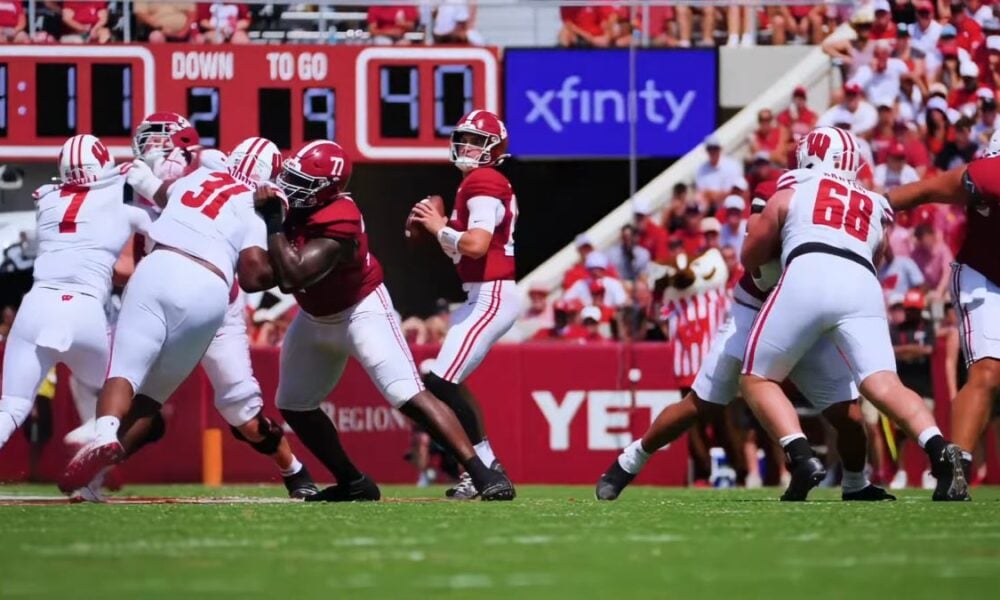
From now until the 2026 NFL Draft, we will scout and create profiles for as many prospects as possible, examining their strengths, weaknesses, and what they can bring to an NFL franchise. These players could be potential top 10 picks, down to Day 3 selections, and priority undrafted free agents. Today, a scouting report on Alabama QB Ty Simpson.
#15/QB TY SIMPSON – 6’2 208 POUNDS. (REDSHIRT JUNIOR)
MEASUREMENTS
THE GOOD
– Excels in working through his pre- and post-snap reads
– Mental processing to work through multiple progressions consistently
– Wants to work over the middle of the field as much as possible
– Doesn’t settle for checkdowns and screens when his first read isn’t open
– Able to rotate his hips and plant to throw quickly
– Compact release on most of his throws and shows good upper body mechanics
– Sets his base well to drive through the ball
– Quick release with plenty of velocity on short-intermediate throws
– Stands in the pocket and delivers throws with pressure in his face
– Good anticipation on comebacks and curls
– Really impressive anticipation on intermediate routes, especially backside digs
– Can hit the sideline throws with zip and accuracy
– Layers the ball well between the second and third levels
– Nice touch on back-shoulder and red zone fade throws
– Can escape pressure with his feet when he has to
– Really nice play action game and comfortable throwing on the move
– Doesn’t put the ball in harm’s way as a thrower often
– Promising production for a guy with just 15 starts
THE BAD
– Frequently retreating from the pocket with pressure
– Doesn’t step up in the pocket enough to extend the play
– Holds the ball too long on non-schemed throws
– Has to learn to throw the ball out-of-bounds instead of taking a sack
– Lean frame that took a lot of damage on dropbacks
– Doesn’t protect himself consistently
– Attempts to create something from nothing, leading to turnover-worthy plays
– Needs to make quicker decisions when under pressure
– 10 passes batted at the line of scrimmage
– Seven fumbles lost, showing he has to protect the ball better
– Doesn’t utilize pump fakes often to move or freeze defenders
– Lacks the arm strength to make accurate deep passes consistently
– Inconsistent leading receivers on vertical routes over 30 yards
– Occasionally overestimates athleticism
– Significant receiver drops and inconsistent offensive line play muddies the blame pie
– Lack of starting experience
– Multiple injuries obtained this year that could have impacted his play for the last 5 games
STATS
– 15 career starts (all in 2025) and played in 31 total games
– 2025: 3,567 yds., 64.5% comp., 28 TD’s, 5 INT’s, 90 rushing attempts for 93 yds. (2 TD’s)
– 75% adjusted completion (30 drops by receivers), 6.0 BTT (big-time throw) %, 3.0% TWP (Turnover-Worthy Plays), 10 batted passes according to PFF stats
– 30 sacks taken, 18.3 % pressure-to-sack (164 pressures), 2.95 TTT (Time-to-Throw), 11 passes thrown away
– 237.8 YPG, 145.2 passer rating, 7.5 YPA, 8.25 AY/A according to Sports Reference stats
INJURY HISTORY
– 2025: Dealt with elbow bursitis, gastritis, and had a lingering lower back injury
– 2025: Suffered a cracked rib in the Rose Bowl game against Indiana
BACKGROUND:
– Born on 12/21/2002 (23 years old)
– Grew up in Martin, TN, where he attended Westview H.S.
– 2025 2nd Team All-SEC
– Team captain for the 2025 season
– Started all 15 games for the Crimson Tide
– 2024 played in 6 games with 25 passing attempts
– 2023 played in 6 games with 20 passing attempts (team won national championship)
– As a freshman, he played in 4 games as a freshman with 5 passing attempts
– Committed to Alabama as an early-enrollee in Jan. 2022
– Five-star recruit coming out of H.S. according to 247Sports
– 2022 named the Tennessee Gatorade Player of the Year
– Westview won the 2A Tennessee State Championship
– 2,827 yds., 41 TD’s, 3 INT’s, 92 carries for 862 yards (9 TD’s) in his senior year
– His father, Jason Simpson, has been the head coach for the UT Martin Seahawks since 2006
– Enjoys hunting, fishing, grilling, and building LEGO’s
TAPE BREAKDOWN
Ty Simpson came into the 2025-2026 college football season with no starts. In fact, he had only a few instances of coming in when other quarterbacks were taken out in previous years for Alabama. He bided his time and waited behind others before it was his turn this year to take the helm. Simpson had a productive year, and he helped lead his team to the College Football Playoff. They ultimately lost to the eventual national champion, Indiana.
There was a lot of mystery around whether he would go back to school for another year, enter the transfer portal, or become draft-eligible. He ultimately decided to declare for the NFL draft. This past season was a mixed bag of real flash-in-the-pan moments for him. You can see the captivating potential that he showed early on, and equally, some hard-to-watch concerns that surfaced toward the latter part of the season.
Simpson’s best attribute as a thrower is his accuracy to so many different parts of the field. He consistently places the ball in an area that only his receiver can make the catch. He does a great job leading them and giving them room to run after the catch. Simpson really suffered this past season from his pass catchers dropping a lot of passes (30, tied for third most in the country).
His accuracy on all throws was ranked in the top 20-30 quarterbacks with at least 50 percent of their team’s attempts in the Power Four, according to PFF. He was particularly excellent at making tight-window intermediate (10-19 yds.) throws and wasn’t afraid to push the ball down the field. Watch his arm confidence against Missouri. He had the checkdown for the first down in front of him, but instead opted for the much more difficult throw when he had a clean pocket.
Simpson is #15 for Alabama in all of the following clips:
— Happy Days (@Jh86Guy) January 27, 2026
Simpson shows great zip on the ball on dig routes, mesh/crossing routes, working the seams, and switch route concept throws in the intermediate portion of the field. I also liked his touch and loft on back-shoulder throws, like this one against Oklahoma for a perfect throw, spanning 43 air yards.
— Happy Days (@Jh86Guy) January 27, 2026
Alabama used a significant amount of motion and pre-snap misdirection to identify coverage and force defensive adjustments. That’s something Simpson does a great job of: making pre-snap reads and setting protections well. He would excel in a West Coast offense or quick-game system due to his ability to fit the ball in tight spaces on short and intermediate routes.
As for his mechanics, he has a strong over-the-top delivery and good follow-through. He has solid footwork on delivery and follow-through. He keeps the ball high and does not let it drop, even when moving in the pocket. Simpson throws from his shoulder alignment, and it’s apparent when the nose of the football is often parallel to the field of play.
There are questions about his ability to push the ball upfield in the vertical passing game. He took plenty of shots downfield and had decent accuracy (T-19th in the country with 62, with a 41.9 percent completion rate). But they also tended to be underthrown, and his receivers had to stop or jump. Others were erratic or out of reach. He also has difficulty knowing how much air to put under the ball on deep throws, as shown below.
— Happy Days (@Jh86Guy) January 27, 2026
Another big reason why he struggled with passes of 30 or more air yards is that if he didn’t have enough time in the pocket to make throws, his mechanics (especially his footwork and base) really broke down. In fact, his production dipped significantly when pressured (48.7 percent completion rate), and he would try to leave the pocket too quickly. This was where his mechanics would noticeably start to break down. He would get “happy feet” and try to evade the pressure instead of climbing or navigating to find guys downfield.
It didn’t help matters that Alabama’s offensive line had players either underperforming in pass protection. They were also rotating guys in and out of the lineup. What I did like about Simpson was that he was often poised and ‘looked down the barrel’ as he was being hit, making big-time throws. To be able to hit this out route from that distance in the opposite direction of the field is high-level stuff.
— Happy Days (@Jh86Guy) January 27, 2026
It was also really noticeable that his eyes would speed up with pressure. This often led to quick checkdowns, staring down his first read, or forcing throws to guys to get the ball out as fast as possible. He has to learn to throw the ball out of bounds more frequently and live to fight the next down. That was evident on plays like this, where he has to feel the outside pressure and get rid of the ball more quickly.
— Happy Days (@Jh86Guy) January 27, 2026
His lack of elite agility forced him to stay in the pocket more than he wanted to, but he does have some athleticism to run if he sees daylight or move around horizontally. I don’t foresee him creating plays with his feet often, though. What comes with this concern is his propensity to hang on to the ball too long, which has led to him fumbling (seven times this season). Simpson also has a tendency to drift back in the pocket too often and take unnecessary hits. He has to work on moving up in the pocket when he’s feeling outside pressure and know where his safety valves are. With experience, he’ll be able to recognize blitzes and sim pressures more. But on plays like this, he has to make better decisions than staying stationary in the pocket.
— Happy Days (@Jh86Guy) January 27, 2026
With only 15 starts, he has limited experience, but I thought he played pretty well considering that. The only quarterbacks who have that many or fewer starts who have been drafted in the first round are few and far between (Dwayne Haskins, Mitch Trubisky, and Anthony Richardson). That’s the list for the past decade. There are historical outliers as well, with Cam Newton, who had 14 starts at Auburn, but also started in junior college. Mark Sanchez had 16, Kyler Murray had 17, and several others had under 20 starts.
This is all to reinforce the point that there isn’t much precedent for a college quarterback with as few starts as Ty Simpson has to come in and play at a high level in the NFL.
Another concern that I have for him is his extensive list of ailments and injuries he sustained while playing over the past year, and how much it affected his play. It was disclosed after the season that he had been reportedly playing with elbow bursitis since the Georgia game (12/6) and gastritis before the game against Auburn (11/29). He obtained that from taking medication for lingering back pain that had been occurring for multiple games leading up to the Iron Bowl. Simpson then fractured a rib in the Rose Bowl game against Indiana. His production and play took a noticeable dip over the last five weeks of the season, which could certainly be affected by pain and injuries.
It begs the question if he can hold up as a potential NFL starting quarterback with his size limitations, tendency to hold on to the ball too long, and lack of elite athletic traits. He needs to avoid getting hit as much as he did this past year. A total of 22 percent of his dropback pressures and 9-of-30 of his sacks were attributed to him, according to PFF. His time-to-throw statistic also reinforces that he needs to get rid of the ball faster, especially when his strengths are more aligned with utilizing quick game concepts and the intermediate portion of the field.
CONCLUSION
Ty Simpson has a lot of upside and promise to be a potential NFL starting quarterback. I love his ability to make a lot of high-level throws and give receivers good ball placement to make plays. His mental processing ability, whether it’s pre-snap or post-snap, was impressive for most of the season. He has a quick release, good velocity on his throws, and didn’t put the ball in harm’s way, often avoiding interceptions. Simpson has adequate foot speed to escape pressure, extend plays, and have quarterback-designed runs called sparingly for him.
With many strengths, he has just as many concerns and unanswered questions. The lack of starting experience, difficulty handling pressure, lack of arm strength on deep throws, and the litany of injuries he dealt with just in one season. It’s fair to wonder if he should have gone back for another year to get more experience, but he chose to enter the 2026 draft instead.
It’s abundantly clear that the Pittsburgh Steelers need a franchise quarterback for their future. With a new coaching staff led by Mike McCarthy now set to take over as head coach, it’s difficult to tell what they may or may not be looking for in that position. Simpson presents with many traits that McCarthy may be intrigued by, coming from his background. The concerns will have to be delved into more during the pre-draft process. Teams must also determine how much development he still may need before he’s ready to play.
With only one starting season under consideration, it’s difficult to find direct resemblances for Simpson. My NFL comparisons from a playing style and build for him would be a Marc Bulger ceiling if a lot of things come together, and a Jimmy Garoppolo floor as an above-average backup quarterback that could come in and be a capable starter when necessary.
NFL Projection: Late Day 1-Early Day 2
Steelers Depot Draft Grade: 8.4 (Long-Term Starter)
Grade Range: 7.6-8.9
Games Watched: 2025 at Missouri, 2025 at South Carolina, 2025 vs. Oklahoma, 2025 vs. Georgia