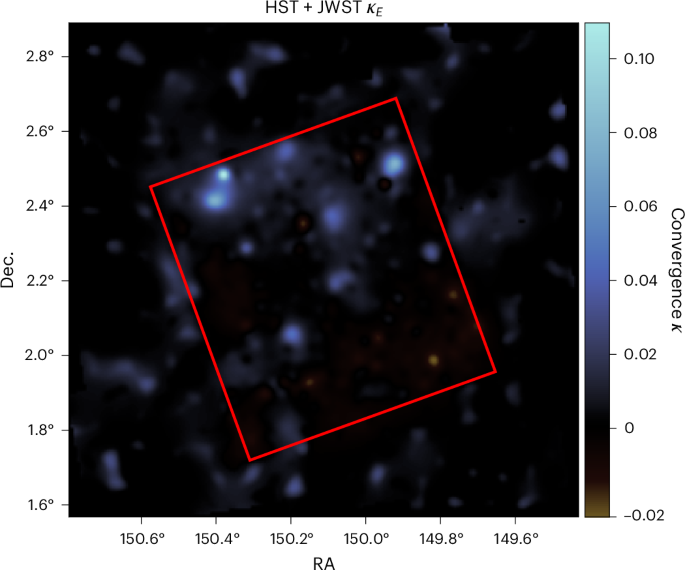
Massey, R. et al. The Shear Testing Programme 2: factors affecting high-precision weak-lensing analyses. Mon. Not. R. Astron. Soc. 376, 13–38 (2007).
Oguri, M. et al. Two- and three-dimensional wide-field weak lensing mass maps from the Hyper Suprime-Cam Subaru Strategic Program S16A data. Publ. Astron. Soc. Jpn 70, S26 (2017).
Martinet, N. et al. KiDS-450: cosmological constraints from weak-lensing peak statistics—II: inference from shear peaks using N-body simulations. Mon. Not. R. Astron. Soc. 474, 712–730 (2018).
Scoville, N. et al. COSMOS: Hubble Space Telescope observations. Astrophys. J. Suppl. Ser. 172, 38–45 (2007).
Finoguenov, A. et al. The XMM-Newton wide-field survey in the COSMOS field: statistical properties of clusters of galaxies. Astrophys. J. 172, 182–195 (2007).
Massey, R. et al. Dark matter maps reveal cosmic scaffolding. Nature 445, 286–290 (2007).
Laigle, C. et al. The cosmos2015 catalog: exploring the 1 < z < 6 universe with half a million galaxies. Astrophys. J. Suppl. Ser. 224, 24 (2016).
Smolčić, V. et al. The VLA-COSMOS 3 GHz Large Project: continuum data and source catalog release. Astron. Astrophys. 602, A1 (2017).
Liu, D. et al. Automated mining of the alma archive in the cosmos field (A3COSMOS). I. Robust ALMA continuum photometry catalogs and stellar mass and star formation properties for ~700 galaxies at z = 0.5–6. Astrophys. J. Suppl. Ser. 244, 40 (2019).
Casey, C. M. et al. COSMOS-Web: an overview of the JWST Cosmic Origins Survey. Astrophys. J. 954, 31 (2023).
Franco, M. et al. COSMOS-Web: comprehensive data reduction for wide-area JWST NIRCam imaging. Preprint at https://arxiv.org/abs/2506.03256 (2025).
Shuntov, M. et al. COSMOS2025: the COSMOS-Web galaxy catalog of photometry, morphology, redshifts, and physical parameters from JWST, HST, and ground-based imaging. Preprint at https://arxiv.org/abs/2506.03243 (2025).
Harish, S. et al. COSMOS-Web: MIRI data reduction and number counts at 7.7 μm Using JWST. Astrophys. J. 992, 45 (2025).
Kaiser, N. & Squires, G. Mapping the dark matter with weak gravitational lensing. Astrophys. J. 404, 441 (1993).
Seitz, C. & Schneider, P. Steps towards nonlinear cluster inversion through gravitational distortions II. Generalization of the Kaiser and Squires method. Astron. Astrophys. 297, 287 (1995).
Bartelmann, M. & Schneider, P. Weak gravitational lensing. Phys. Rep. 340, 291–472 (2001).
Hamana, T., Shirasaki, M. & Lin, Y.-T. Weak-lensing clusters from hsc survey first-year data: mitigating the dilution effect of foreground and cluster-member galaxies. Publ. Astron. Soc. Jpn 72, 78 (2020).
Jeffrey, N. et al. Dark Energy Survey Year 3 results: curved-sky weak lensing mass map reconstruction. Mon. Not. R. Astron. Soc. 505, 4626–4645 (2021).
Wright, A. H. et al. The fifth data release of the Kilo Degree Survey: multi-epoch optical/NIR imaging covering wide and legacy-calibration fields. Astron. Astrophys. 686, A170 (2024).
Jarvis, M. et al. The DES Science Verification weak lensing shear catalogues. Mon. Not. R. Astron. Soc. 460, 2245–2281 (2016).
Schrabback, T. et al. Evidence of the accelerated expansion of the Universe from weak lensing tomography with COSMOS. Astron. Astrophys. 516, A63 (2010).
Amara, A. et al. The COSMOS density field: a reconstruction using both weak lensing and galaxy distributions. Mon. Not. R. Astron. Soc. 424, 553–563 (2012).
Ilbert, O. et al. Accurate photometric redshifts for the CFHT legacy survey calibrated using the VIMOS VLT deep survey. Astron. Astrophys. 457, 841–856 (2006).
Arnouts, S. & Ilbert, O. LePHARE: photometric analysis for redshift estimate. Astrophysics Source Code Library https://www.cfht.hawaii.edu/~arnouts/LEPHARE/lephare.html (2011).
Starck, J.-L., Moudden, Y., Abrial, P. & Nguyen, M. Wavelets, ridgelets and curvelets on the sphere. Astron. Astrophys. 446, 1191–1204 (2006).
Bond, J. R., Kofman, L. & Pogosyan, D. How filaments of galaxies are woven into the cosmic web. Nature 380, 603–606 (1996).
Nightingale, J. W. et al. The cosmos-web lens survey (COWLS) I: discovery of >100 high redshift strong lenses in contiguous jwst imaging. Mon. Not. R. Astron. Soc. 543, 203–222 (2025).
Mahler, G. et al. The COSMOS-Web Lens Survey (COWLS) II: Depth, resolution, and NIR coverage from JWST reveals17 spectacular lenses. Mon. Not. R. Astron. Soc. 544, L8–L14 (2025).
Hogg, N. B. et al. The COSMOS-Web Lens Survey(COWLS) III: forecasts versus data. Mon. Not. R. Astron. Soc. 544, 782–798 (2025).
Schneider, P., Waerbeke, L. & Mellier, Y. B-modes in cosmic shear from source redshift clustering. Astron. Astrophys. 389, 729–741 (2002).
Gozaliasl, G. et al. Chandra centres for COSMOS X-ray galaxy groups: differences in stellar properties between central dominant and offset brightest group galaxies. Mon. Not. R. Astron. Soc. 483, 3545–3565 (2019).
Weaver, J. R. et al. Cosmos2020: a panchromatic view of the universe to z10 from two complementary catalogs. Astrophys. J. Suppl. Ser. 258, 11 (2022).
Madau, P. & Dickinson, M. Cosmic star-formation history. Annu. Rev. Astron. Astrophys. 52, 415–486 (2014).
Wechsler, R. H. & Tinker, J. L. The connection between galaxies and their dark matter halos. Annu. Rev. Astron. Astrophys. 56, 435–487 (2018).
Capak, P. et al. The first release cosmos optical and near-IR data and catalog. Astrophys. J. Suppl. Ser. 172, 99 (2007).
Franco, M. et al. Unveiling the distant Universe: characterizing z ≥ 9 galaxies in the first epoch of COSMOS-Web. Astrophys. J. 973, 23 (2024).
Bushouse, H. et al. JWST calibration pipeline. Zenodo https://doi.org/10.5281/zenodo.6984365 (2024)
Koekemoer, A. M. et al. CANDELS: The Cosmic Assembly Near-infrared Deep Extragalactic Legacy Survey—the Hubble Space Telescope observations, imaging data products, and mosaics. Astrophys. J. Suppl. Ser. 197, 36 (2011).
Rhodes, J. D. et al. The stability of the point-spread function of the advanced camera for surveys on the Hubble Space Telescope and implications for weak gravitational lensing. Astrophys. J. Suppl. Ser. 172, 203–218 (2007).
Rhodes, J., Refregier, A. & Groth, E. J. Weak lensing measurements: a revisited method and application tohubble space telescope images. Astrophys. J. 536, 79 (2000).
Leauthaud, A. et al. Weak gravitational lensing with COSMOS: galaxy selection and shape measurements. Astrophys. J. 172, 219–238 (2007).
Bertin, E. & Arnouts, S. SExtractor: software for source extraction. Astron. Astrophys. 117, 393–404 (1996).
Berman, E. & McCleary, J. ShOpt.jl: a Julia package for empirical point spread function characterization of JWST NIRCam data. J. Open Source Softw. 9, 6144 (2024).
Bertin, E. Automated morphometry with SExtractor and PSFEx. In Astronomical Society of the Pacific Conference Series (eds Evans, I. N. et al.) Vol. 442, 435 (Astronomical Society of the Pacific, 2011).
Perrin, M. D. et al. Updated point spread function simulations for JWST with WebbPSF. In Society of Photo-Optical Instrumentation Engineers (SPIE) Conference Series (eds Oschmann, J. et al.) Vol. 9143, 91433 (Society of Photo-Optical Instrumentation Engineers, 2014).
Harvey, D. et al. Reconciling galaxy cluster shapes, measured by theorists versus observers. Mon. Not. R. Astron. Soc. 500, 2627–2644 (2021).
Harvey, D. R. & Massey, R. Weak gravitational lensing measurements of Abell 2744 using JWST and shear measurement algorithm pyRRG-JWST. Mon. Not. R. Astron. Soc. 529, 802–809 (2024).
High, F. W., Rhodes, J., Massey, R. & Ellis, R. Pixelation effects in weak lensing. Publ. Astron. Soc. Pac. 119, 1295–1307 (2007).
Massey, R. et al. Origins of weak lensing systematics, and requirements on future instrumentation (or knowledge of instrumentation). Mon. Not. R. Astron. Soc. 429, 661–678 (2013).
Pires, S. et al. FAst STatistics for weak Lensing (FASTLens): fast method for weak lensing statistics and map making. Mon. Not. R. Astron. Soc. 395, 1265–1279 (2009).
Pires, S. et al. Euclid: reconstruction of weak-lensing mass maps for non-Gaussianity studies. Astron. Astrophys. 638, A141 (2020).
Starck, J.-L., Pires, S. & Réfrégier, A. Weak lensing mass reconstruction using wavelets. Astron. Astrophys. 451, 1139–1150 (2006).
Benjamini, Y. & Hochberg, Y. Controlling the false discovery rate—a practical and powerful approach to multiple testing. J. R. Stat. Soc. B 57, 289–300 (1995).
Aoyama, S. D., Osato, K. & Shirasaki, M. Denoising weak lensing mass maps with diffusion model: systematic comparison with generative adversarial network. Preprint at https://arxiv.org/abs/2505.00345 (2025).
Cha, S. et al. Weak-lensing mass reconstruction of galaxy clusters with a convolutional neural network. II. Application to next-generation wide-field surveys. Astrophys. J. 981, 52 (2025).
Leroy, G., Pires, S., Pratt, G. W. & Giocoli, C. Fast multi-scale galaxy cluster detection with weak lensing: towards a mass-selected sample. Astron. Astrophys. 678, A125 (2023).