BURLINGTON, Vt. (WCAX) – It’s been a proper winter here in Vermont and the North Country. December brought well-below-average temperatures, and despite a brief January thaw, this month has been abnormally frigid. What does that mean for Lake Champlain ice cover?
The long stretch of cold has caused shore ice along Lake Champlain to steadily grow and expand recently. Parts of the lake are already frozen, though the broader lake remains open. With arctic air in place for the remainder of the week, the question becomes: will the lake freeze solid?
Historical trends are not encouraging. Before the 1940s, Lake Champlain froze completely almost every winter. Between the 1940s and 1970s, the lake still froze more often than not. Since the 1970s, however, a complete freeze has become increasingly rare. In fact, the 2020s have not yet seen the lake freeze solid in a single winter.
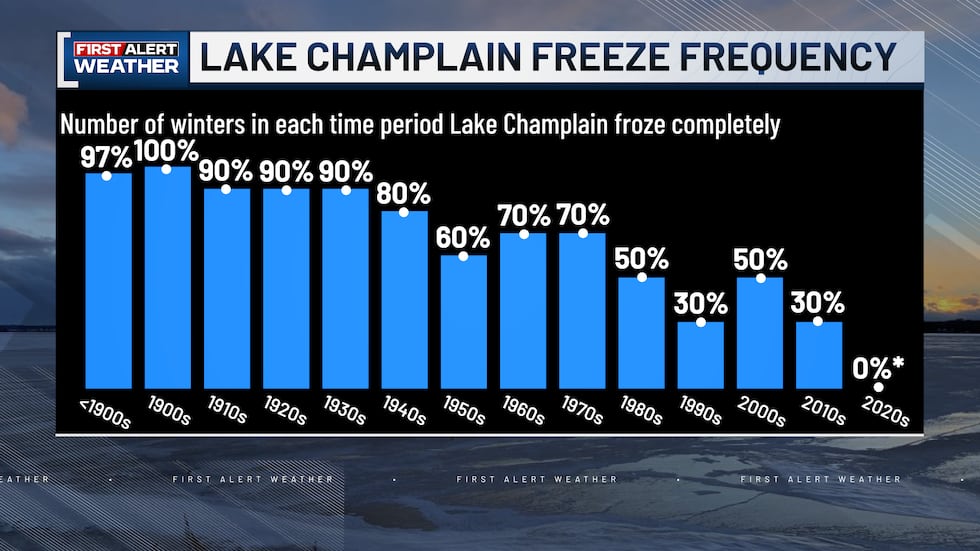 The number of years each time period Lake Champlain froze completely(Gunnar Consol)
But the decreasing frequency doesn’t mean it can’t happen. This winter is shaping up to be a likely candidate. It’s finally the kind of proper winter Lake Champlain needs to freeze over.
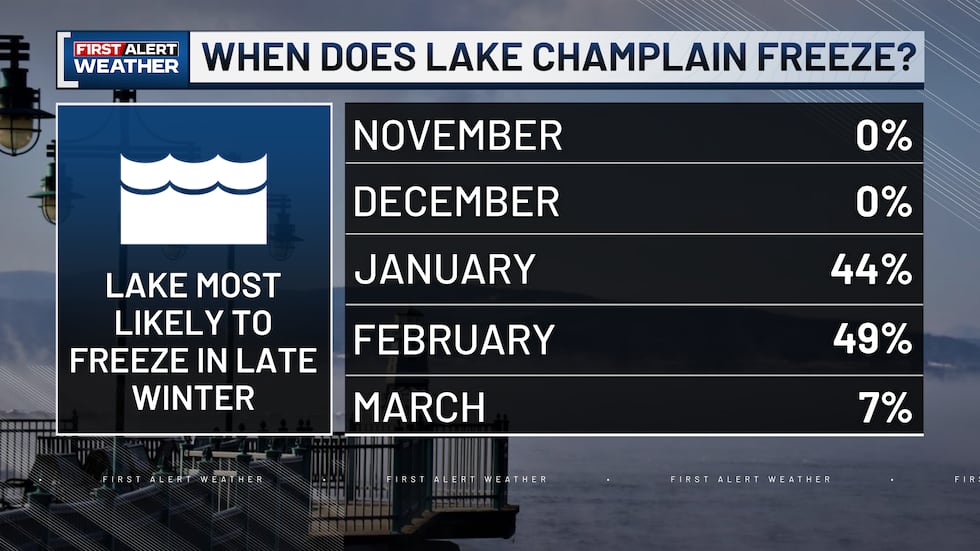 The frequency each month that the lake freezes over(Gunnar Consol)
There’s an interesting pattern worth noting: when the lake does freeze, it typically happens after January. That timing could still work in favor of a complete freeze this year.
Lake ice is expanding, and with arctic cold gripping the Northeast for the next week, we’re closely monitoring Lake Champlain to see if it finally freezes solid.
Tomorrow, we’ll look at the most recent years the lake froze, track this winter’s ice expansion, and share our outlook on whether a completely frozen lake is likely this winter.
Copyright 2026 WCAX. All rights reserved.