The morning after the national championship game, my wife asked me if things would slow down at work now.
“Not likely,” I said. “There’s always something.”
Sure enough, by week’s end, Duke sued its quarterback, and Clemson’s coach went scorched earth on Ole Miss’s coach.
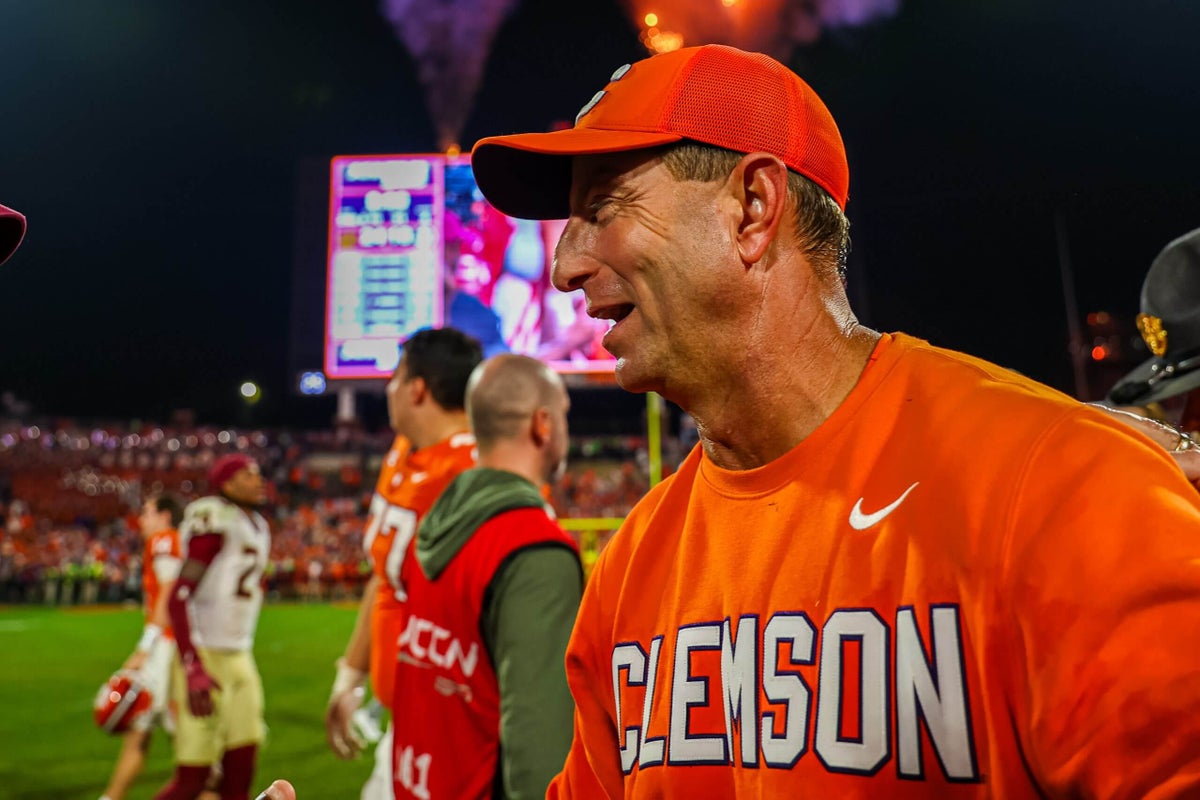
What’s the best-case scenario for Dabo Swinney’s case against Pete Golding and Ole Miss? Not for this player and transfer — like Dabo said, “This is not about a linebacker at Clemson” — but for college football? Could this finally be the straw that breaks the camel’s back for the NCAA being theoretically in charge of big-time college football? — Seth C.
Props to Dabo for becoming the rare coach to name names rather than echo his peers’ empty rants about cheating, where they don’t even bother to report anyone. There’s only one problem. Despite all the hand-wringing about tampering, the NCAA rulebook classifies it as a Level II violation, not Level I, which usually results in minor penalties. Like:
• In 2024, Iowa self-imposed a one-game suspension for head coach Kirk Ferentz and assistant Jon Budmayr for an alleged tampering violation involving then-Michigan quarterback Cade McNamara.
• That same year, the NCAA hit Southern Utah coach DeLane Fitzgerald with a one-game suspension and a two-week off-campus recruiting ban for tampering with two players.
• And two former Arkansas State football staff members got hit with one-year show causes for tampering. An assistant coach received a two-game suspension and two-week off-campus ban, while an assistant staffer received a one-week suspension from all athletic responsibilities.
However, all of those cases involved pre-revenue sharing. Luke Ferrelli had a signed NIL contract with Clemson when all this occurred, much like Xavier Lucas at Wisconsin and Darian Mensah at Duke. I understand why Dabo and the public are focused on NCAA enforcement, but the bigger issue for college sports overall is whether players’ rev-share contracts are legally enforceable. Duke and Mensah reached a settlement this week, and he committed to Miami along with former Duke receiver Cooper Barkate, so the question will remain unresolved for now.
Ultimately, I group all of these stories — along with Alabama welcoming back a basketball player who would never have been declared eligible without a local court order — under the same existential umbrella. Which is: Do you guys actually want there to be rules or not?
Coaches complain endlessly about the “Wild Wild West,” then turn around and poach a competitor’s player who is ostensibly under contract. ADs urge you to call your Congressman to save college sports, then put the entire model at risk themselves because their basketball coach needs an emergency 7-footer. And commissioners spent all that time devising the College Sports Commission in an attempt to stabilize the NIL/portal market, then sit back and let one school in their conference steal yet another star QB half an hour before the portal closes.
I realize the NCAA is not a sympathetic figure, but what is it supposed to do at this point when a local judge who’s a major Alabama donor can neuter a decades-old rule about college players turning pro with one hasty temporary restraining order?
If the schools truly want “guardrails,” they have to start applying those guardrails to themselves.
Indiana’s only losses in 2024 were to both teams in the national championship game (Ohio State and Notre Dame). Their “reward” was a preseason ranking of 20th. They finished No. 1. How do you justify placing Indiana behind a handful of teams to start this season? Why not just start them at No. 1? All Curt Cignetti seems to do is prove everyone wrong. — John C.
Indiana’s low preseason ranking a year ago was due almost entirely to the now-unfounded assumption the Hoosiers would come back to Earth with a tougher schedule. Remember, they had road games at both Penn State, a preseason top-2 team, and Oregon, which had gone 13-1 the year before; a home game against Illinois, 10-3 the year before; and a never-easy trip to Iowa. I had IU going 9-3, which, at the time, seemed perfectly reasonable.
I did not account for the possibility that Cignetti would instead develop a punishing offensive line, along with an ultra-deep defensive line, and turn Cal’s good-but-not-great quarterback into the best player in the country and go 16-0.
Forecasting Indiana in 2026 is an entirely different challenge. Now, we know the Hoosiers are a juggernaut, and I want to treat them accordingly. But I base those early rankings primarily on who the team has coming back, and unfortunately, IU is losing almost everyone who played a key role on Cignetti’s first two teams.
The Hoosiers will be replacing:
• Heisman-winning QB Fernando Mendoza
• Top two rushers Roman Hemby and Kaelon Black
• Top two receivers Omar Cooper Jr. and Elijah Sarratt
• Rose Bowl MVP center Pat Coogan
• And defensive stars Aiden Fisher, D’Angelo Ponds, Mikail Kamara and Louis Moore. (Also, D-linemen Stephen Daley and Kellan Wyatt, though neither were available in the Playoff.)
On the bright side, All-Big Ten offensive tackle Carter Smith and All-Big Ten defensive tackle Tyrique Tucker put off the NFL. Wide receiver Charlie Becker is an emerging star. They will have plenty of continuity on the offensive and defensive lines. Additionally, Cignetti secured some proven players to fill some of those holes, including TCU QB Josh Hoover, Michigan State WR Nick Marsh and Penn State CB A.J. Harris.
I never considered putting Indiana at No. 1, mainly because it feels like a changing of the guard with that core group from Cignetti’s first season (the “James Madison Crew”) moving on. I considered going as high as No. 3 and as low as No. 10, ultimately landing on No. 6. Though I already question why I had them below Texas.
To be clear, all of it is a crapshoot. If you told me Indiana is going to repeat as national champ, I’d believe you. If you told me they miss the Playoff, I’d believe that too.
The Big Ten and SEC essentially had total control over the Playoff format for 2026 and beyond because of a memorandum of understanding signed by the 10 FBS commissioners and Notre Dame AD Pete Bevacqua. Why did they cede so much power to Tony Petitti and Greg Sankey? — Colin M.
Leverage. Those negotiations took place in early 2024, shortly after the Great Conference Consolidation of 2021-23, when the Big Ten and SEC became even bigger behemoths. With the original 12-year CFP contract with ESPN about to expire, no one was guaranteed a place going forward, so technically, there was nothing stopping the Big Ten and SEC from going off and starting their own CFP. The other leagues ceded some control for the assurance they kept a seat at the table.
I get why the Group of 5 would have panicked, but in hindsight, the ACC, Big 12 and Notre Dame really should have called their bluff. Maybe the Big Ten/SEC will pull off a breakaway at some point, but they weren’t in that position yet. Sankey, in particular, would have known a national Playoff that’s not truly national would have lost credibility and negatively impacted the whole sport. (I’m not sure Petitti cared.)
And sure enough, the last two Playoffs in the original 12-year term saw a pair of non-Big Ten/SEC teams — 2024 Notre Dame and 2025 Miami — reach the championship game. Imagine if we were now going into the next season and those teams, along with Texas Tech, Arizona State, SMU, Clemson, etc., were no longer eligible. That would not be a legitimate tournament.
But all of this was a negotiation, and theoretically, all parties got something they wanted. The Big Ten/SEC received a bigger share of the revenue (twice that of the ACC and Big 12) and more control. The ACC and Big 12 got guaranteed annual berths, which, it turns out, the ACC, for one, really did need. The G5 (now G6) maintained access. And Notre Dame has assurance that a top-12 Irish team won’t get bumped for someone else’s No. 23 champion.
What was the one result this season that makes absolutely no sense given what we know about teams now? For example, last year, how did NIU beat Notre Dame? — Christopher D.
Definitely Florida State 31, Alabama 17. While I realize Alabama wasn’t a juggernaut, it did win 11 games. But managed to lose by two touchdowns to a team that finished 2-6 in the ACC.
Worth consideration, though: Syracuse winning 34-21 at Clemson in its ACC opener, then losing every game the rest of the way by at least two scores.
Of all the schools that fired coaches, are there any where you think they actually downgraded? Obviously, it is way too early to tell, but waiting is boring. Penn State maybe? — Eric W.
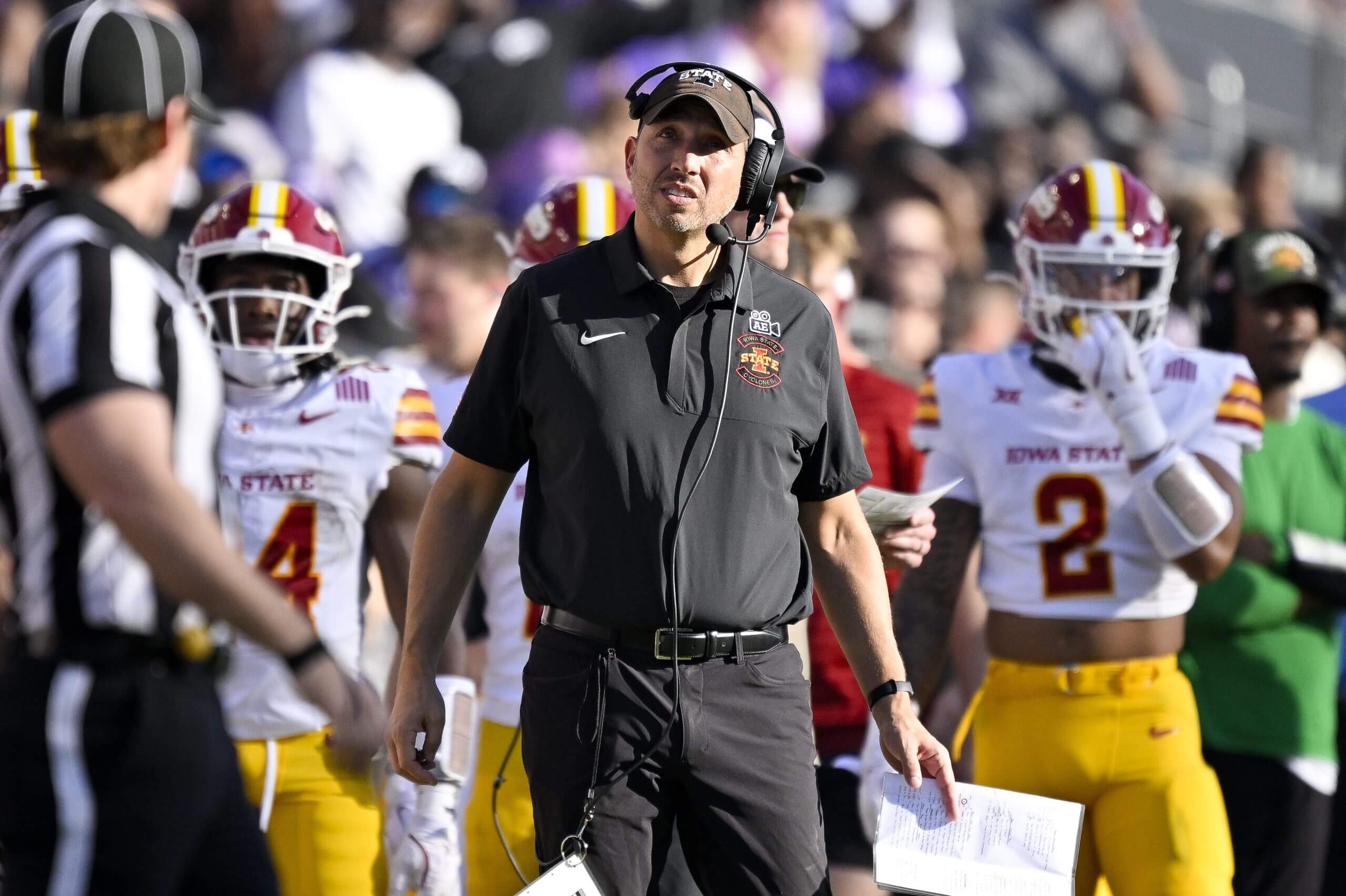
I’m puzzled by the skepticism around Matt Campbell. Are we just comparing James Franklin’s winning percentage (.698) to Campbell’s winning percentage (.556) without any context? While ignoring the fact that Penn State is a two-time national championship program that expects to compete for national championships, while Iowa State has not won even a conference championship since 1912? Or that Campbell had as many top-10 wins at Iowa State (four) as Franklin had at Penn State?
While it’s no guarantee Campbell will win 10 or 11 games a year in State College as Franklin did, I don’t believe Penn State downgraded. It managed to hire as qualified a coach as it realistically could, despite such a sloppy search.
I’m more underwhelmed by a couple of the hires in the SEC. Arkansas fired Sam Pittman five games into the season, replacing him with Memphis’ Ryan Silverfield, whose teams never finished higher than tied for third in the American in his six seasons there. This after striking out on USF’s Alex Golesh, who himself is fairly unproven (23-15 in three seasons) but hard to call a downgrade for Auburn after Hugh Freeze’s three straight losing records.
I also wonder whether Kentucky will rue the day it fired Mark Stoops, the winningest coach in school history, after two bad seasons. It’s not a knock against first-time head coach Will Stein, a 36-year-old former Louisville quarterback who shined as Oregon’s OC the past three seasons. Maybe he’ll become the Kenny Dillingham of the SEC. But Stoops set the bar awfully high with his eight straight bowl trips and two 10-win seasons. And they replaced him with someone who has zero track record.
Matt Campbell found success at a historically struggling Iowa State program before moving to Penn State. (Jerome Miron / Imagn Images)
Why doesn’t making the semifinals in the CFP have the same cachet as reaching the Final Four of March Madness? Is it the size of the field (68 vs. 12) or that the semis & championship in basketball is played on one weekend at the same site? — D.D.
I assume it hasn’t caught on yet mostly because the NCAA has “Final Four” trademarked. Football needs its own catchy name for the semifinals. Which we might need to crowdsource.
True story: The College Football Playoff brand initially got turned down for a trademark for essentially being too generic. It took nearly two years to get it approved. Which might not bode well if they ever try to register for Football Four.
Stew: A new, rebuilt Pac-12 will begin conference play next season. In terms of strength, where does it rank amongst the current G6? — Nicholas R.
Let the record show that this is the first time I’ve used the phrase “Group of 6” in a Mailbag. End of an era.
For all the trouble Oregon State and Washington State went through to preserve the shield, let’s call it what it is: The Mountain West with a different name. Which starts with the fact that those two programs crumbled faster than I would have imagined at the time. The Beavers, who went 18-8 in their last two seasons in the Pac-12 when Jonathan Smith was still the coach, fell to 5-7 in 2024 before cratering to 2-10 last season, during which Smith’s replacement, Trent Bray, got the boot. Wazzu has at least remained competitive, going 8-5 and 7-6, respectively, but has become a typical G6 springboard for players (Cam Ward, John Mateer) and coaches (Jake Dickert, Jimmy Rogers).
Boise State is clearly the premier program in its new conference, just as it was in its old conference, followed by a drop-off to a second tier with San Diego State, Fresno State and Wazzu. Then there’s a fairly steep drop-off after that to Utah State, Colorado State, Oregon State and Texas State. Ironically, two of the programs that remained in the MWC, UNLV and Hawaii, would have been considered two of Boise’s biggest threats next season if they were still in the same league.
All that being said, it is still arguably the second-best G6 league behind the American, which remains the clear-cut No. 1. And 2026 could prove to be an ideal season for the new Pac-12 to try to earn its first CFP berth, what with four of the American’s top programs — Tulane (Will Hall), North Texas (Neal Brown), USF (Brian Hartline) and Memphis (Charles Huff) — all breaking in new coaches. By contrast, the Pac-12 will only have three, and two of those schools, Colorado State (Jim Mora) and Oregon State (JaMarcus Shephard) would not have been likely contenders regardless.
Thoughts on a Northwestern Journalism Alumni-funded NIL program to bring the next Big Ten program out of the bottom tier? — Sam W.
If they’re going to rely on journalists’ salaries to fund the football team, it might take 10 years to raise enough to buy one Darian Mensah.
How poorly will 2026 need to go for Colorado to consider moving on from Deion? The school is clearly more relevant than it has been in decades, but the drop-off last season was severe, and his recruiting strategy just doesn’t seem to work. — Rob
It was striking how quickly those first two years of endless publicity seemed to go right down the drain with one 3-9 season. By the time they lost back-to-back games 53-7 (at Utah) and 52-17 (vs. Arizona), they were too out-of-sight, out-of-mind to notice.
Turns out Shedeur Sanders and Travis Hunter were that good.
But there’s still a lot of gratitude in Boulder for that 2023-24 ride, and a lot of optimism that he can turn it back around. No question, high school recruiting is not Deion’s forte. His 2026 class ranked 11th in the Big 12 and 58th nationally, though it was also the second smallest in the conference with just 16 members. He’s all in on the portal, though, signing 40-plus transfers for the second time in three years. They include proven P4 starters such as Texas receiver DeAndre Moore Jr. and linebacker Liona Lefau, Tennessee DB Boo Carter and 1,291-yard San Jose State receiver Danny Scudero.
Granted, they also lost several of their best players, such as tackle Jordan Seaton (now at LSU), leading receiver Omarion Miller (Arizona State) and cornerback DJ McKinney (Notre Dame). It’s one thing to go so portal-heavy when first coming in and flipping the roster, but I don’t think it’s a sustainable model year-in, year-out. Maybe CU improves in 2026, but where does that leave it a year from now?
Hovering over all of this is that Deion’s biggest champion, AD Rick George, recently retired. His replacement, New Mexico’s Fernando Lovo, just started on the job a couple of weeks ago. There’s no way to predict what he might do if the Buffs go 3-9 again this season. Or whether Colorado could even afford a $25 million to $30 million buyout.
There’s also the possibility Deion himself would opt to exit if things really got that bad.
How did North Carolina only go 17-9 with Drake Maye as quarterback? — Jonathan P.
Pretty simple: He couldn’t play defense.
I’m glad you brought this up, though. Given how much crap Mack Brown took over his last five years or so at Texas for whiffing on one quarterback after another, let’s give him his props for both Maye and Sam Howell (two-time All-ACC) during his North Carolina tenure.
A belated congrats to the College Football Hall of Famer.