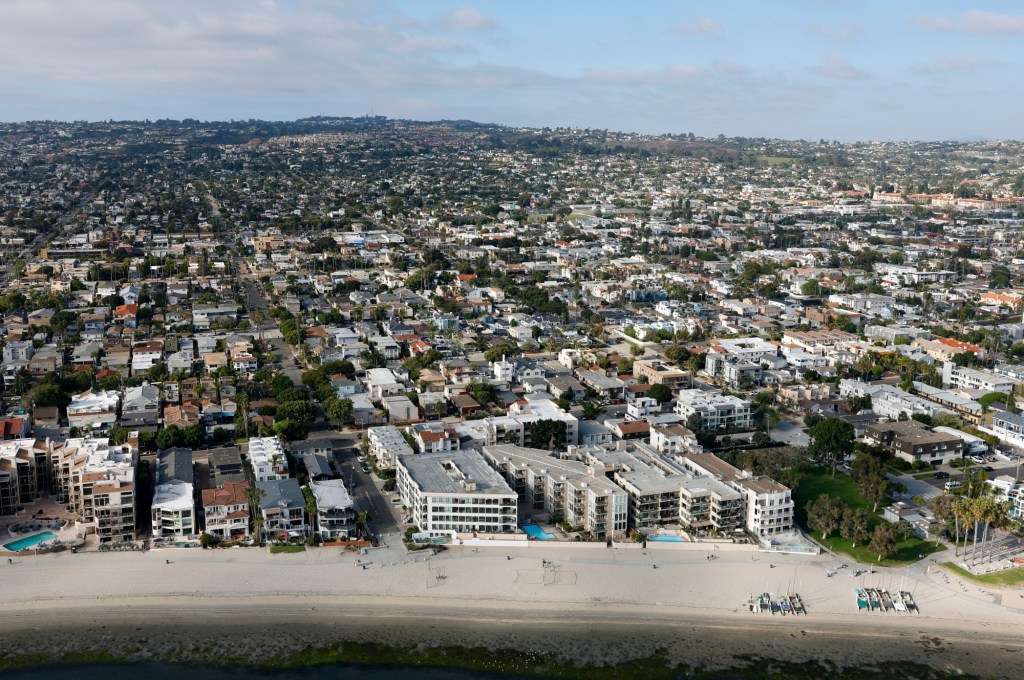
A controversial plan to impose an annual tax of as much as $12,000 on thousands of San Diego vacation homes is dead for now, after elected leaders on Wednesday declined to advance the proposed levy to the full City Council.
The 3-2 vote by the Rules Committee followed a more than five-hour, sometimes emotional hearing that drew hundreds of proponents and critics who pleaded their case, with some vacation rental hosts dissolving into tears.
Councilmember Sean Elo-Rivera, who had pushed the tax as a way to expand the city’s long-term housing inventory, had hoped the council would support his request to put the proposal before the voters in June.
The Empty Second Home and Vacation Rental Tax, as it was called, was expected to affect 11,000 homes, including 5,741 whole-home, year-round short-term rentals and 5,115 second homes that are largely empty throughout the year and aren’t being rented long term. A $4,000 surcharge also was proposed for corporate-owned rentals, as well as those with repeat code violations.
Elo-Rivera’s office had stressed that the impact would fall on only 1% of San Diego homes.
Voting no were Councilmembers Raul Campillo, Kent Lee and Vivian Moreno.
“I’m here to advocate for the middle-class San Diegans who are operating small businesses and know that this tax will completely undermine their life’s work and livelihoods,” said Campillo, who had vigorously opposed the tax proposal last October when Elo-Rivera formally proposed it. He argued that the propsed tax of $8,000 on whole-home vacation rentals would have a ripple effect on the workers like house cleaners and plumbers who are hired to maintain the rentals. He also predicted that the measure would never survive an inevitable court challenge.
“I’m here to amplify the voice of San Diegans who will be impacted by this, which is to say, every San Diegan. Twenty-five thousand workers directly and indirectly will be hurt by this tax, and everyone else will pay the higher price. And I’m not willing to harm the livelihoods of middle-class San Diegans to try and get in some revenue because our city has a budget problem. This should never have been framed as an us vs. them problem. For the vast majority of people, owning a short-term vacation rental is not a luxury side hustle. It’s how they get by.”
Elo-Rivera, whose office had worked on the proposal for months and had more recently modified by it by eliminating a per-bedroom tax of $5,000, sought to salvage his plan from the council committee dais. Because of the concerns raised around its application to short-term rentals, he suggested having it apply only to “empty” second homes and corporate-owned short-term vacation rentals.
“I heard recognition from three of us that empty vacation homes are something we could potentially get behind, and that those 5,100 homes sitting empty is a problem given the housing situation we are in,” Elo-Rivera said. “I also heard some distinguishing between mom and pops who operate short-term vacation rentals and larger corporate entities.”
But he was unable to garner support, with only Council President Joe LaCava and himself voting in favor of the amended proposal.
“San Diegans are facing a very real housing crisis and an ongoing structural budget shortfall,” Elo-Rivera said in an emailed statement after the hearing. “I remain open and eager for my Council colleagues to bring forward serious, substantive policy proposals that address these challenges … And let me be clear: this fight does not end today. If anything, the methods used by our opposition have only strengthened my resolve to keep pushing for a San Diego where homes are for people, not just for profit, and where powerful corporations are held accountable when they undermine our communities.”
The decision not to advance the proposal, while highly divisive, came as something of a surprise, with Lee going so far as to criticize Airbnb for the campaign it led to kill the proposed tax. Some speakers in favor of the proposal claimed that the mega home-sharing platform had paid some opponents to appear at the hearing and had bused them to City Hall.
“I couldn’t care less about defending Airbnb as they oppose this measure, and in fact, I have not appreciated their tactics and misinformation on this item,” Lee said. “And frankly, our office has refused to take meetings from them in the run-up to this vote.”
Lee’s concerns were a bit more nuanced than Campillo’s. He said he felt the goal of the original proposal had shifted slightly, from raising revenue for the cash-strapped city to restoring up to 11,000 units of housing stock. Elo-Rivera’s office had estimated that the tax would generate as much as $90 million in revenue, while the city’s Independent Budget Analyst said it might be closer to $32 million to $57 million.
“My concern is not only whether we can achieve both the revenue and the housing but also what we do achieve compared to what the public perceives they are voting for,” Lee said. “There is a risk we would have a net loss of revenue.”
Airbnb, as well as a large coalition of opponents, cheered the outcome of Wednesday’s hearing.
“Thanks to the thousands of engaged local hosts and public safety, labor, and business leaders who have reached out to the City Council,” said Justin Wesson, senior manager of Public Policy for Airbnb. “Today Councilmembers acknowledged this tax does more harm to San Diegans than good. We are grateful to the Council’s consideration of residents’ concerns and remain committed to being part of a collaborative solution to help bolster affordability in the city.”