In her first semester at the University of Texas at Arlington, Rezina Dhakal pointed to the mannequins and simulations at UTA’s Smart Hospital as a major stepping stone for her education.
“It’s actually really helpful, because if we just jump right into the nursing at the hospital and react with a real patient without any experience, that would be too much,” Dhakal said. “But in the Smart Hospital, with all those mannequins, we get to have a real experience.”
In 2005, the university created the Smart Hospital — then a small facility across campus — in order to give nursing students the simulated experience needed to prepare them for actual hospital work.
In 2021, the Smart Hospital started the process of expansion in a very literal sense. UTA began building the School of Social Work/College of Nursing and Health Innovation Smart Hospital Building, a 150,000-square-foot facility meant to truly immerse students in hospital settings with state-of-the-art simulations, virtual reality resources and extremely lifelike mannequins.
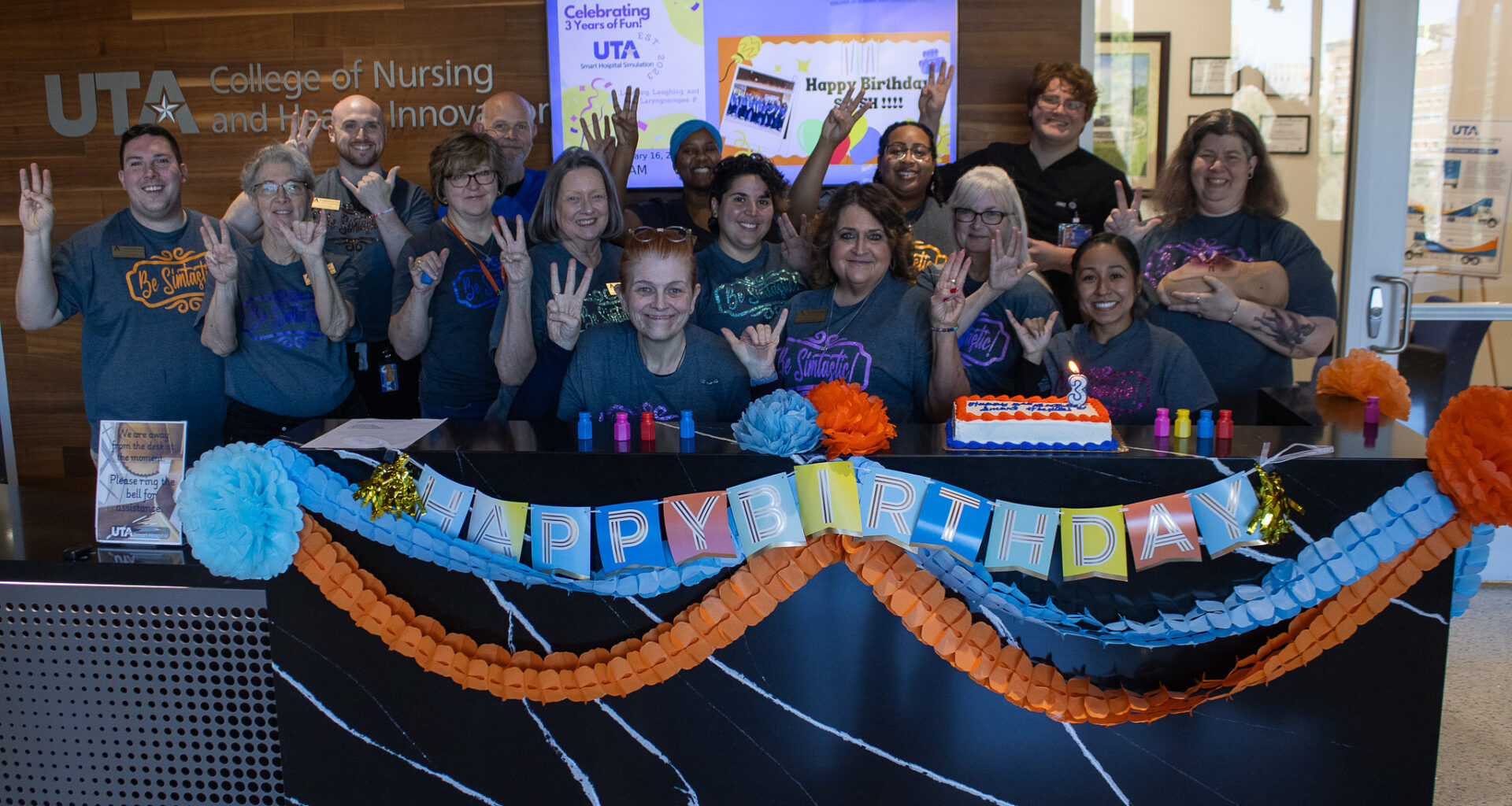
On Jan. 16, the Smart Hospital, which opened its doors in January 2023, hosted its three-year anniversary. The celebration was small — an aptly-colored white, orange and blue cake was served alongside some bubbles — but the occasion heralds the likelihood the school sees more expansion.
Part of the impetus for potential growth is need. Jennifer Roye, assistant dean for simulation and technology at UTA’s College of Nursing and Health Innovation, said that a lot of the Smart Hospital’s design was decided 10 years in advance. That’s why most of the space at the 3-year-old building is already filled out.
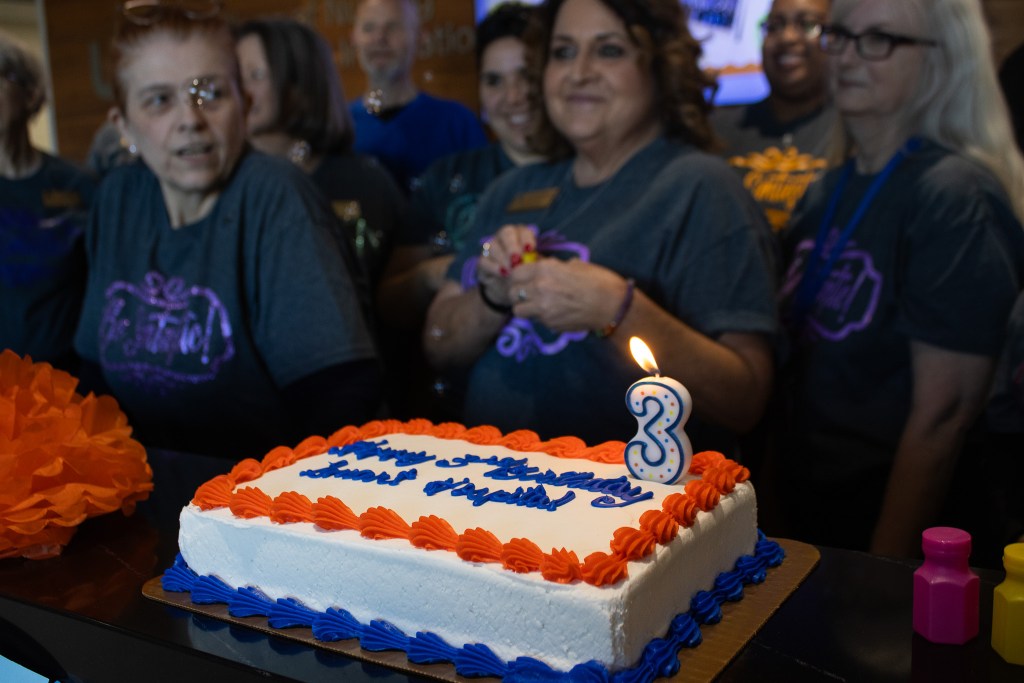 The cake purchased to celebrate UTA Smart Hospital’s third birthday is adorned with the school colors. (Ismael M. Belkoura | Fort Worth Report)
Alongside running out of space, the Smart Hospital increased the amount of simulation hours offered to students. In the semester before the new building opened, the facility provided about 16,000 learner hours to nursing and social work students, said Lucas Farris, the simulation operations and education manager at the Smart Hospital.
In fall 2025, the hospital provided 22,000 learner hours.
“It’s all about experiential learning,” Roye said. “That’s the whole kind of theory behind simulation.”
Why simulation?
A lot of the simulation provided involves mannequins — expensive $45,000 mannequins that can simulate giving birth or throwing up — but the Smart Hospital also provides education through virtual reality and the Igloo Vision Immersion Room, a small space that can provide simulated situations to students. First-year students also interact with standardized patients — actors who pretend to be patients — in order to get them more comfortable with human interaction in a hospital setting.
The immersion room, mannequins, virtual reality and actors pretending to be patients are not viewed as an extra addition to the education provided at UTA. Nursing students spend half of their three years of school in simulations, with the other half dedicated to clinicals in the hospital setting.
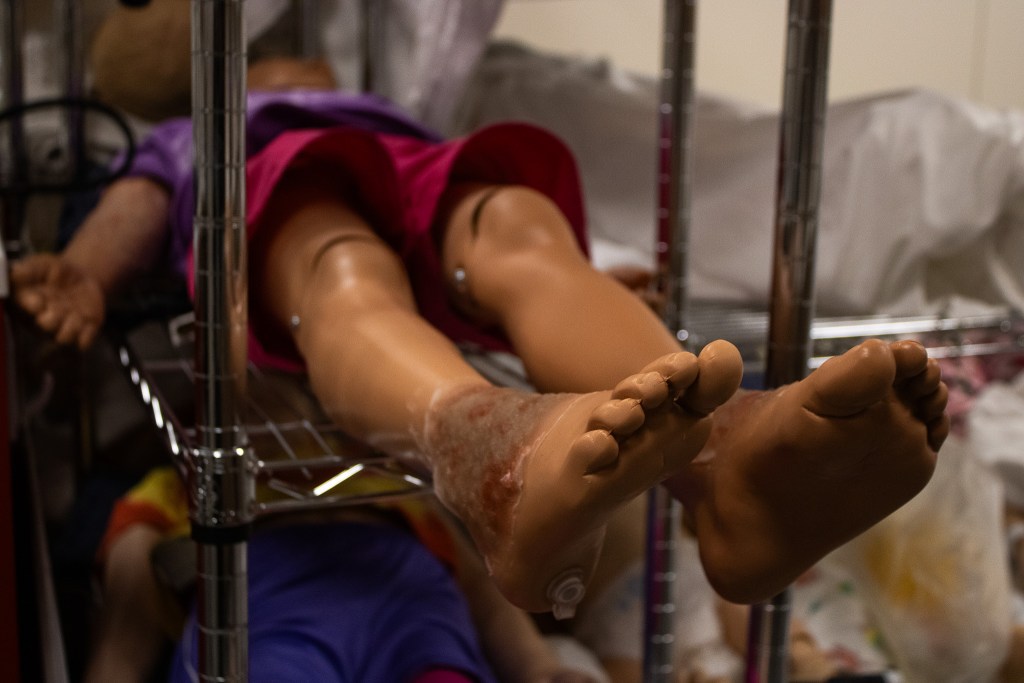 The legs of a child mannequin at UTA’s Smart Hospital. The marks on its feet are faux eczema made by someone on staff. (Ismael M. Belkoura | Fort Worth Report)
Experiential learning is essential to the student’s learning, Farris said, because it provides an easier road map to follow.
“If we can instill a type of comfort and safety in their learning space and their day-to-day work life, that is going to help them as they transition to practice,” Farris said.
The work done by the Smart Hospital has been noticed in the nursing simulation world. The UTA facility is one of 40 in the country to be endorsed by the International Nursing Association for Clinical Simulation and Learning.
Before 2025, when Texas Christian University received an endorsement, the Smart Hospital was the only accredited program in North Texas.
“That’s important, because anybody can do simulation, that does not necessarily mean that it’s good simulation,” said Erica Hinojosa, simulation technology manager at the Smart Hospital.
Finding room to grow
UTA has slowly grown its nursing program. In the 2022-23 school year, 2,481 students graduated with nursing undergraduate degrees. In the 2024-25 school year, there were 2,607 graduates.
The College of Nursing also saw an enrollment jump of 11.5% in the fall of 2025.
The increase reflects a current gap in health care: Texas is set to face a deficit of over 57,000 full-time registered nurses by 2032, according to the Texas Hospital Association.
The Smart Hospital is looking at different ways to accommodate this growth, Roye said.
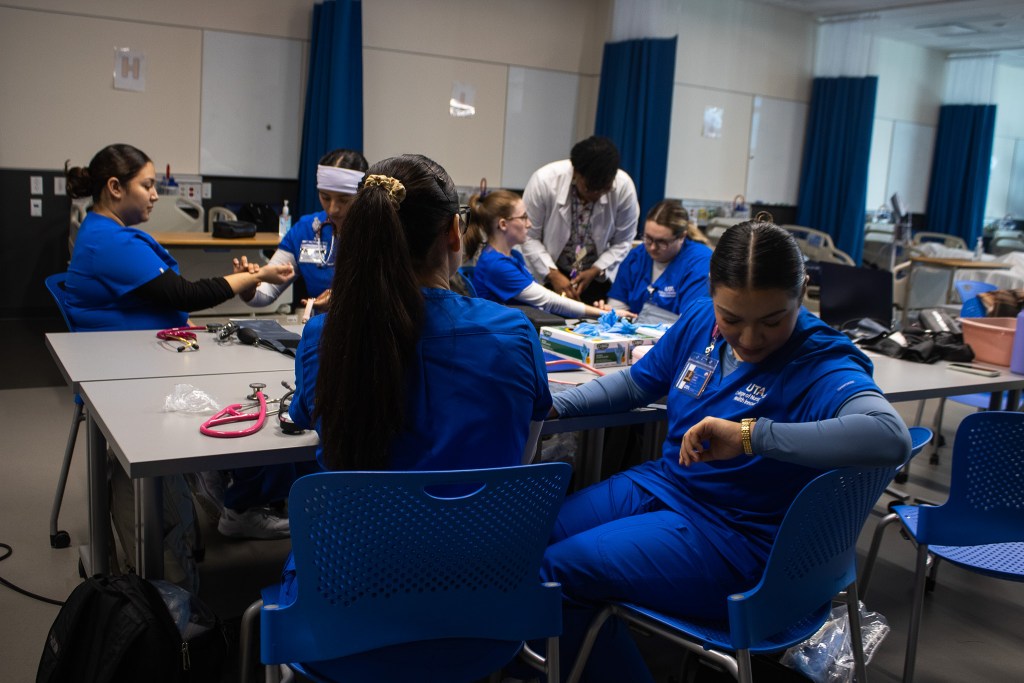 First-year nursing students at UTA measure each other’s heart rates on Jan. 16, 2026. (Ismael M. Belkoura | Fort Worth Report)
UTA West, which is set to open in 2028, gives them additional opportunities. The school plans to open a large simulation lab on the campus, Roye said, with a goal to grow the nursing program.
Another plan is to increase the amount of virtual reality resources available for students. New software the facility recently acquired will allow for new opportunities for online nursing students, Farris said.
The online nursing program is also set to grow. Roye said online students from across the state will be given more opportunities to work with partner hospitals.
Ismael M. Belkoura is the health reporter for the Fort Worth Report. Contact him at ismael.belkoura@fortworthreport.org.
At the Fort Worth Report, news decisions are made independently of our board members and financial supporters. Read more about our editorial independence policy here.
This <a target=”_blank” href=”https://fortworthreport.org/2026/01/28/utas-smart-hospital-celebrated-its-third-anniversary-how-is-it-set-to-grow/”>article</a> first appeared on <a target=”_blank” href=”https://fortworthreport.org”>Fort Worth Report</a> and is republished here under a <a target=”_blank” href=”https://creativecommons.org/licenses/by-nd/4.0/”>Creative Commons Attribution-NoDerivatives 4.0 International License</a>.<img src=”https://i0.wp.com/fortworthreport.org/wp-content/uploads/2021/04/cropped-favicon.png?resize=150%2C150&quality=80&ssl=1″ style=”width:1em;height:1em;margin-left:10px;”>
<img id=”republication-tracker-tool-source” src=”https://fortworthreport.org/?republication-pixel=true&post=386790&ga4=2820184429″ style=”width:1px;height:1px;”><script> PARSELY = { autotrack: false, onload: function() { PARSELY.beacon.trackPageView({ url: “https://fortworthreport.org/2026/01/28/utas-smart-hospital-celebrated-its-third-anniversary-how-is-it-set-to-grow/”, urlref: window.location.href }); } } </script> <script id=”parsely-cfg” src=”//cdn.parsely.com/keys/fortworthreport.org/p.js”></script>