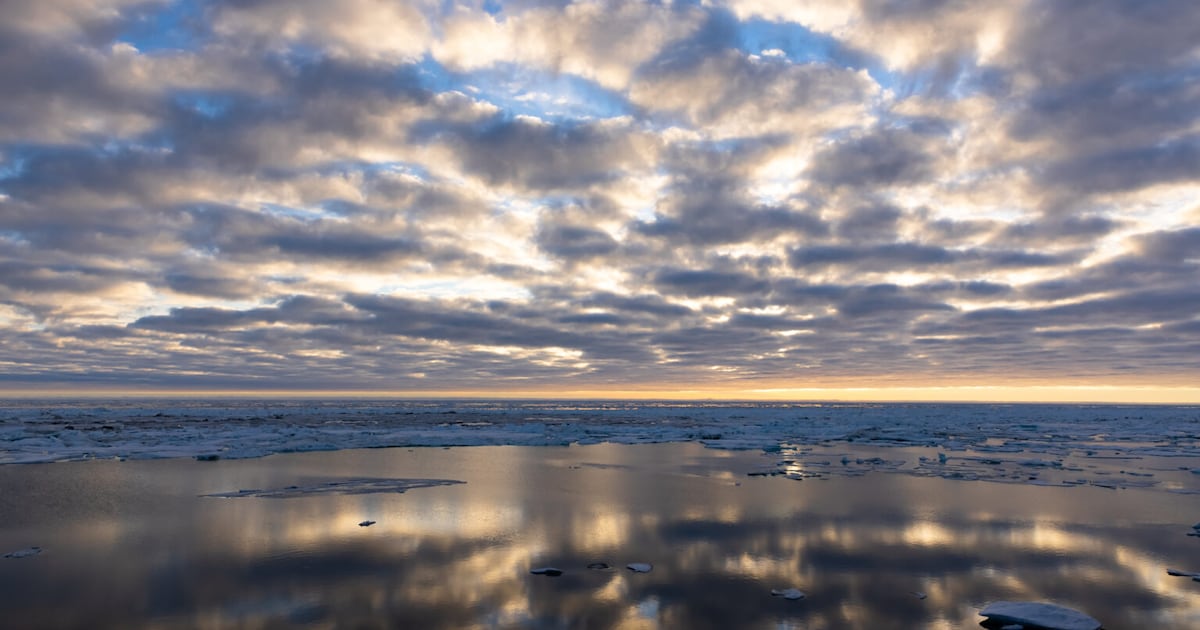
 Cloud patterns and the midnight sun reflect on the surface of the Chukchi Sea on July 10, 2021. The U.S. Outer Continental Shelf extends over much of the Chukchi Sea. The Trump administration is floating the idea of seafloor mining in Alaska’s Outer Continental Shelf. (Photo provided by the U.S. Fish and Wildlife Service)
The Trump administration is floating the idea of mining the seafloor off Alaska’s coast.
The U.S. Department of the Interior’s Bureau of Ocean Energy Management said Tuesday it will soon release a formal “call for information” about possible sales of leases for minerals mining in federal waters off Alaska. The call for information will kick off a 30-day public comment period allowing industry to express interest in such a lease sale.
“Alaska’s offshore holds strategic potential for the minerals that drive American industry, defense and next-generation technologies,” Matt Giacona, BOEM’s acting director, said in a statement. “This Request for Information is a practical first step to gauge interest and identify areas where development could make sense for jobs, investment and national supply chains.”
The push for offshore minerals mining “supports the Trump Administration’s focus on strengthening domestic supply chains and advancing American energy and resource leadership,” the BOEM statement said.
There has never been a minerals lease sale in Alaska’s Outer Continental Shelf, BOEM said.
Some parts of Alaska’s Outer Continental Shelf are relatively shallow, but some are deep enough to fit the International Union for the Conservation of Nature’s 200-meter threshold that defines deep-sea mining.
There is a history of offshore gold mining in shallow state waters in one area of Alaska: the Nome region. It is managed by the Alaska Department of Natural Resources’ Division of Mining, Land and Water and conducted through suction dredging, a mechanized process that vacuums up sediments from which gold is sifted.
The Nome offshore mining activity has become famous through a reality TV show called “Bering Sea Gold.” But that type of mining can be controversial. There is widespread opposition in the Nome area to a proposal to expand underwater mining, and DNR last year denied a permit sought by the company pushing that proposal.
The idea of underwater mining in federal waters drew quick opposition from environmentalists.
“This step toward offshore mining shows that the Trump administration only sees Alaska’s vibrant seafloor as an extraction zone for corporate profit,” Cooper Freeman, Alaska director at the Center for Biological Diversity, said in a statement. “The health and vitality of Alaskan coastal communities are deeply tied to a healthy ocean. Destroying the seafloor by mining puts the entire marine food web in grave danger, from walruses and bearded seals to crab and halibut.” That, in turn, threatens Alaska traditions and economies, he said.
Becca Robbins Gisclair, Ocean Conservancy’s senior director of Arctic and northern waters, also issued a statement.
“This proposal targets the very waters that make Alaska’s fisheries world class. Deep-sea mining in the proposed areas — many of which are protected habitat — should not even be on the table. We cannot trade Alaska’s food, cultures and economy for the new and risky endeavor of deep-sea mining, which we know threatens species both on the seafloor and throughout the water column,” she said in the statement.
There are international implications, Gisclair added. “Deep-sea mining in the Central Arctic Ocean is unprecedented and unworkable. This would be the starting gun for an international scramble to exploit this pristine sea. Deep sea-mining is a losing proposition for Alaska, America and the world,” she said.
BOEM last year suggested leasing for deep-sea mining in two other U.S. regions: American Samoa and the Northern Mariana Islands. The agency last year issued requests for information on underwater mining in those areas. The comment periods have now expired.
The American Samoa deep-sea mining idea drew over 76,000 comments, and nearly 9,000 of them have been published by BOEM. The published comments expressed vigorous opposition to the idea.
“For the life that grows on and around areas targeted for deep-sea mining, the resulting destruction will be comprehensive and irreversible. The deep sea is Earth’s least understood ecosystem — with new species discovered every year — and it is also among its most fragile,” said one of the comments.
But a California-based company called Impossible Metals said BOEM should proceed with a lease sale off American Samoa.
“The United States sits atop an estimated billion‑ton reserve of polymetallic nodules that can underwrite a century of industrial leadership, yet today those resources lie fallow while China races to secure global supply,” said the company’s July 16, 2025, comment letter.
Originally published by the Alaska Beacon, an independent, nonpartisan news organization that covers Alaska state government.