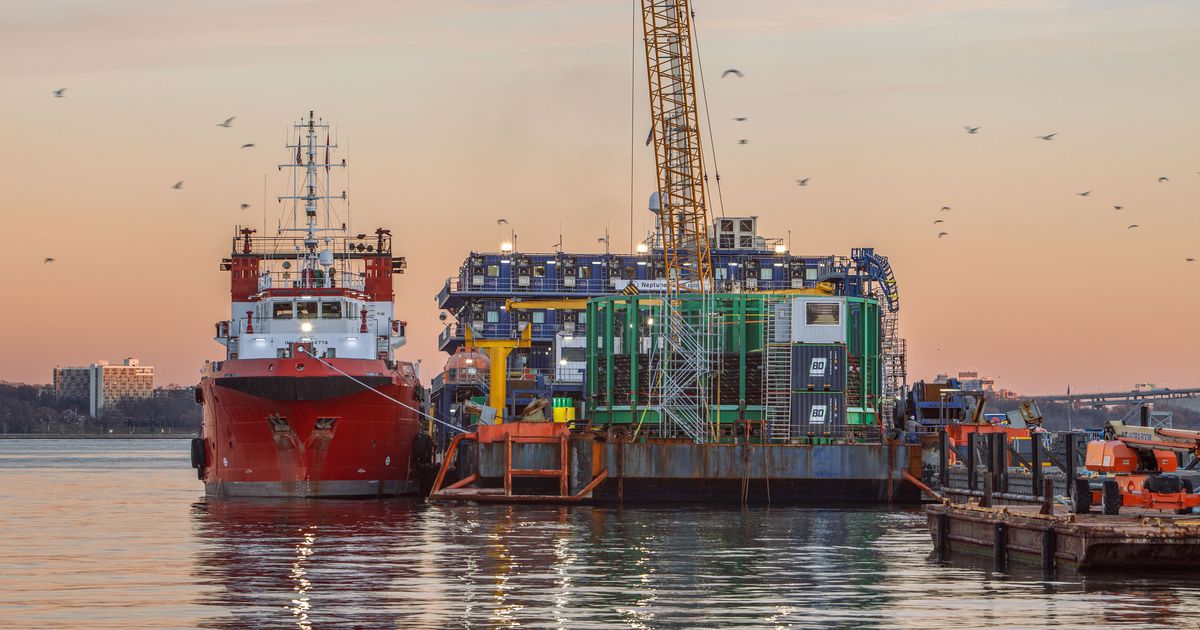
The cable-laying barge used to construct a wind farm more than a dozen miles out to sea.
Photo: David S. Allee
For more than a year, thousands of unionized ironworkers, carpenters, and operating engineers have been constructing a colossal wind farm in an 80,000-acre expanse of ocean south of Long Island. A football-field-size barge, ushered along by tugboats, has been installing the cable that will connect Empire Wind 1 to the grid along the seafloor, a power line so massive that Hugh McElroen, an electrician working on the project, compares it to a “tree trunk.” The turbines themselves will be nearly 900 feet tall; though barely visible from the shoreline — they’ll poke from the horizon like matchsticks — it will take the world’s second-largest crane to help assemble them. The project could eventually supply the city with enough energy to power nearly half the homes in Brooklyn.
Despite its hulking size and ambition, the building of Empire Wind 1 has been something of a covert operation. The Trump administration is openly hostile to wind projects, and EW1 has so far survived only because of delicate negotiations.
This past April, the federal government froze construction on the project for several weeks — until Governor Kathy Hochul reportedly made a Faustian agreement to grant permits to a natural-gas pipeline Trump wanted built in New York. In December, the Feds ordered another construction halt of Empire Wind 1, along with four other offshore wind projects, arguing the turbines could warp government radar readings. Equinor, the Norwegian energy company behind EW1, swiftly sued and won an injunction on January 15 to continue construction. “You’re all over the map on this,” the judge in the case told a government lawyer after his justifications for the pause kept shifting. Three of the other four offshore wind projects have also successfully restarted construction thanks to court orders.
If Empire Wind 1 reaches completion next year as planned, it will help the city solve an impending energy crisis, meet climate goals, and build demand for thousands of union jobs. As a result, the effort is backed by an unlikely coalition: city- and state-government types, NIMBY-ish Brooklynites, a $65 billion energy company, and a blue-collar workforce represented by a cluster of different unions. Organized labor, in particular, is gambling that EW1 is just the first of a generation’s worth of contracts — that building green infrastructure could be what car manufacturing or coal mining was for past unions.
“We have invested a lot of resources, funding, and energy into training our membership for this,” Danny Bianco, the regional manager of LIUNA, a massive construction-workers union in New England, tells me. One required training session simulates a helicopter crash at sea; the trainees have to escape from a mocked-up fuselage after it’s dropped into a giant pool. McElroen’s union, the International Brotherhood of Electrical Workers Local Union No. 3, was mulling acquiring its own helicopter-escape facility, but the government’s war against wind makes it impossible to know where to invest long-term.
The story of Empire Wind 1 starts on 73 acres of crumbling, city-owned parking lot in waterfront Sunset Park. In the 2010s, the city’s Economic Development Corporation solicited proposals for the land. Locals were nervous. Overbuilding in Williamsburg, another formerly industrial waterfront neighborhood in Brooklyn, had rendered it unrecognizable to its longtime residents.
“EDC sucks,” says Carlos Menchaca, the City Council member who represented Sunset Park at the time. “They come with zero vision. They’re just like, ‘Well, we wanna be able to do anything.’” So stakeholders in Sunset Park started a task force that would articulate terms necessary for local buy-in.
According to Elizabeth Yeampierre, a member of the task force and the director of a Sunset Park–based environmental-justice organization called UpRose, there were two main conditions residents had for development: “They wanted to retain the industrial character of the community,” she says, “but they didn’t want it to kill them” with pollution. Red Hook Terminals, which off-loads shipping cargo landing at Brooklyn’s ports, was the industrial partner. Its president, Mike Stamatis, began his career as a dock worker off-loading imported bananas into Newark. He was also a surprising environmental voice.
On October 22, 2012, the night Hurricane Sandy hit New York City, Stamatis was asleep in his office, a converted trailer surrounded by shipping containers at the Red Hook docks. He had begun the night “watching Netflix reruns of Columbo,” he says, and ended it being rescued from his flooded office. It convinced him that the future of waterfront industry in Brooklyn needed to be sustainable.
In 2015, the task force delivered a list of conditions to EDC, including organized-labor requirements and caps on levels of vehicle exhaust. The corporation signed. Four years later, the State Assembly mandated the development of 9,000 megawatts’ worth of offshore wind by 2035. Already planning offshore developments in the U.S., Equinor stepped forward with a $5 billion offer to transform the Sunset Park lot into a port terminal to serve future fields of offshore turbines.
Because EDC signed the agreement with the Sunset Park Task Force before Equinor was involved, potential sticking points in negotiations with the Norwegian company — including a requirement that the bulk of workers be local — weren’t even up for debate. Even so, Yeampierre found an easy partner in Equinor: “They were open.” She recalls the first meetings between Equinor and the community, which included visible efforts to appease local sensibilities. “Of course, they had hired a Latina to come and talk to us,” says Yeampierre.
When ground broke in 2024, both city business developers and longtime residents rejoiced: Sunset Park would be the home of one of the nation’s largest renewable-energy projects.
Trump’s personal vendetta against wind farms started around 2011, when one was built off the coast of his Scotland golf course and, in his opinion, marred the view. Since returning to the White House, he has worked to squash wind development in the U.S. Because offshore wind projects are in federal waters — the government leases the real estate to developers — they are the perfect target for the president’s meddling.
There’s no clear winner yet. The injunctions are keeping the wind projects alive, but only while developers and the federal government continue duking it out in courts. If the Trump administration succeeds in killing Empire Wind 1 or the other wind farms currently in construction, it would waste billions of dollars, shred a decade of planning, and eliminate thousands of prospective jobs.
But it won’t stop wind, which is “not going anywhere,” says former IBEW 3 chairman Christopher Erikson Sr. The only real question is “the rate of how quickly it’ll scale up” and whether the money from renewable investment goes into the American economy — or elsewhere. To prevent the return of rolling blackouts and outrageous utility bills, New York City needs to vastly increase energy to its grid in just a few years. Wind is an attractive solution because its construction can employ much of the same labor used by the fossil-fuel industry.
It also has bipartisan support. Offshore green-energy construction is seen as an answer to energizing an atrophied shipbuilding industry along Louisiana’s Gulf Coast. One of the vessels needed for Empire Wind 1 was built there. The shipbuilder, Gary Chouest, is a conservative megadonor who contributed more than $2 million to the GOP, including $130,000 to the Trump campaign during the last election cycle. (Sharon Landry, the wife of Louisiana’s right-wing governor, served as the boat’s “godmother” during its christening ceremony.) In other words, despite Trump’s disdain for wind energy, his allies are among some of its greatest beneficiaries. In the New York area, some of wind’s biggest boosters are GOP members of Congress from Long Island who are eager to see their blue-collar constituents paid good money to produce infrastructure that will lower utility costs.
Right now, American companies and unions have to rely on the help of international developers from countries like Denmark and Norway, where the wind industry is established. But Empire Wind 1 is an opportunity, as Erikson puts it, to “develop the training here in the United States, for our members, to be able to perform the work into the future.” If workers and manufacturers can’t get wind contracts now, they won’t have the skills they need when energy crises force the nation’s hand. With American workers left behind, it could be Scottish workers on Danish ships using Chinese parts to build the Empire Wind 2’s and 3’s.
“This is all U.S. investment,” says Stamatis of Red Hook Terminals. “There’s thousands of union laborers working on the nation’s first and greatest offshore wind port in the heart of New York City.” They will be fighting for their jobs. “Everybody wants this place to be here,” Stamatis adds. “It’s too important to fail. Not too big, but too important.”