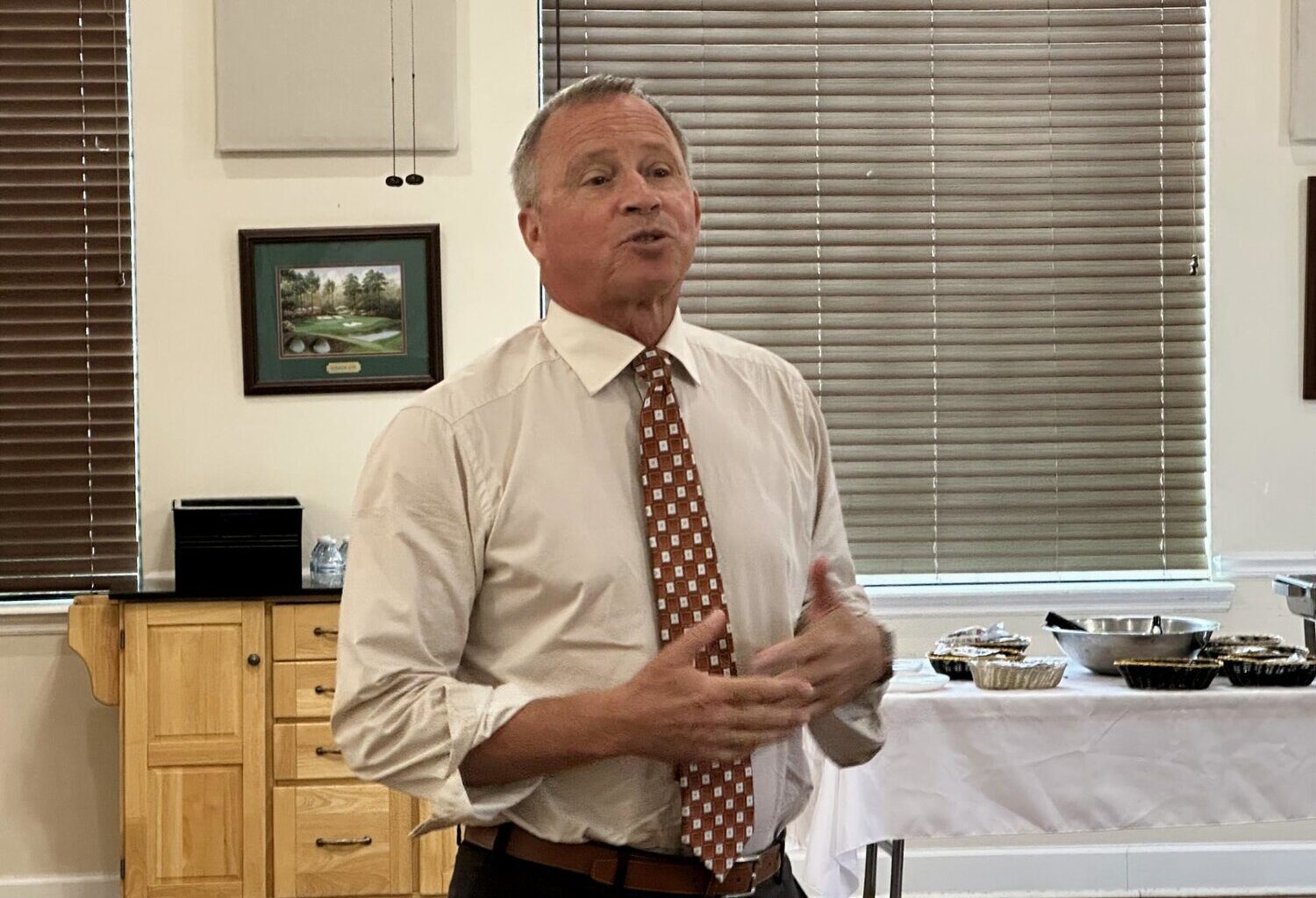
PENNEY FARMS – Of all the tools at Mike Buresh’s disposal, it became clear his most effective was common sense.
The acclaimed Action News Jax meteorologist captivated the Rotary Club of Green Cove Springs Monday afternoon by talking about the weather. He was informative, unpretentious and fascinating, making something as innocuous as the weather interesting.
The 2024 Federal Alliance for Safe Homes National Weather Person of the Year started by quizzing club members on the record low and high temperatures for Jacksonville. The answers: seven and 104 degrees.
“A lot of people are surprised when it’s 104 because most people think it would be hotter,” Buresh said. “It’s Florida, right? Well, keep in mind we get that sea breeze just about every day during the summer and that keeps it a little bit more tolerable, if you want to call it that.”
Buresh isn’t swayed by modern trends or social media. He prefers studying history and he refuses to over—or underreact—to approaching systems.
He reminded everyone that understanding hurricanes will never be an exact science.
“Hurricane season, are we overdue? And by that, I mean a direct hit (on the Northeast coast),” Buresh asked. “Jacksonville and Northeastern Florida, we are lucky in that we’re one of the areas in Florida, oh, knock on wood, that doesn’t typically get a direct hit from a significant hurricane. Now, having said that, we’ve had many storms in just the last 20 years that have done plenty of damage.
“Clay County will always remember Hurricane Irma, of course, as it moved up western Florida with tremendous flooding and very heavy rain. And we saw flooding in parts of Clay County, water in places that there was never flooding before.”
Buresh said statistics show the average number of hurricanes have increased since the 1960s, partially because technology is better at collecting data.
He said the water temperature is favorable in the Pacific for an El Niño this summer. An El Niño forms in unusually warm surface temperatures and moves across the country to create unusual weather in the South. It generally triggers a greater risk for an increased number of hurricanes.
“In 1992 there was an El Niño,” Buresh said. “Also, there was Hurricane Andrew in South Florida, so be careful with that.”
Buresh has some pet peeves, like talking about “normal” temperatures or those who say the recent cold snap proves there is no global warming.
“I say we need to get rid of ‘normal’,” he said. “There is no normal. There never has been, never will be. Nobody in this room is normal. We’re all very different, right? You get normal mathematically by taking the number of people or the number of subjects or applications and then dividing it by that number, that becomes your average. It’s an average, but it isn’t normal per se, and normal weather is just baloney.”
While Buresh said the oceans are indeed getting warmer, he said there isn’t any real evidence that sea levels are rising in Florida. He also said Earth is in perpetual flux, from hot and cold, wet and dry.
“Just remember, weather is what you get, climate is what you expect – two very different things,” he said. “So, of course, we had, for lack of a better term, fools last week saying, ‘Oh, it’s a snowstorm, the planet can’t be warming.’ Last week was weather. The last 20 years are climate. The last week was just a weather day. This is like today’s sunny day. It’s just the weather today.”
He also said weather is always changing. In fact, it’s up to mankind to adapt to the ebbs and flows of weather, not for humans to attempt to control Mother Nature.
“This is why weather is always going to be like wild, crazy, extreme, changeable, all that,” Buresh said. “The day that doesn’t happen is when [we] cease to exist.
“Here’s the thing: it’s going to change on the drop of a dime. Change quickly, very suddenly, and it’s up to us to be prepared. Mitigation is what we really should talk about when we talk about weather and dealing with it and how we can change it.”
Should we build on the ocean?
“Maybe not,” he said. “There are things that we can do better.”
He also emphasized the importance for residents to use their common sense as a storm approaches. Don’t wait until it’s too late if you need to evacuate. Put a coin on top of a cup of frozen water in the freezer if you’re going to be gone. When you return, if the penny is on the bottom, that means the power was off, the water thawed and refroze and everything in the freezer needs to be tossed.
Buresh then wanted everyone to remember one thing:
“Weather is what you get.”