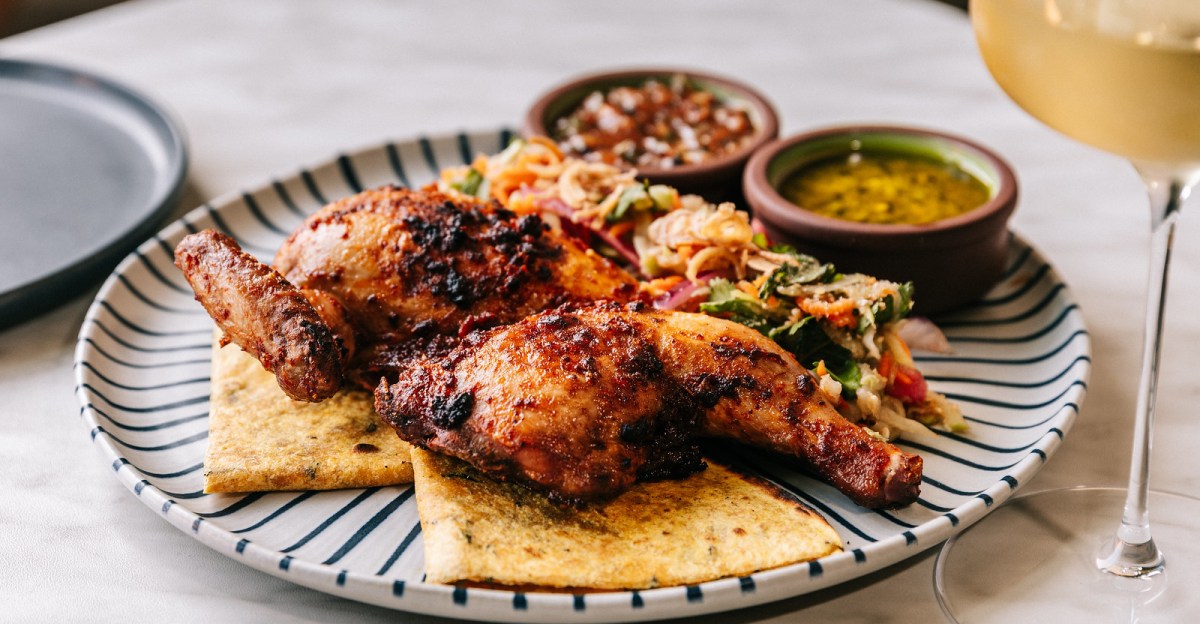
Walking into Mirra cold, it might be hard to guess what kind of food will show up on your plate. Earthy colors and organic materials might suggest South Asia or perhaps Mexico, but only if you can decode the quiet hints: the painting on Oaxacan amate by the entrance, nodding to Diego Rivera’s famous “Mujer con Alcatraces.” The soundtrack is a Bollywood melody that fades into a song by Peso Pluma.
And then, there’s the menu: An aguachile meets the tangy Indian yogurt-based chaas and biryani captures barbacoa’s soul in a small clay Mexican pot that is sealed with a bread crust. None of this feels performative or forced; the melding of techniques and flavors is a smooth cross-cultural handshake.
Fusion food gets a bad rap, thanks to poor executions of forced combinations. But long before chefs began deliberately experimenting with Mexican fusion, Mexico’s complex culinary identity had already been shaped by centuries of migration, trade, and upheaval. With colonization came the Spanish culinary traditions that had themselves been transformed under Moorish rule and influenced by trade routes that went as far as Asia. Many of the plates we might recognize today as the most representative of Mexican cuisine — mole, carnitas, pambazos, pan dulce (inspired by Viennoiserie), and even the chamoy on your margarita glass — are the result of a collision of worlds.
“The world is becoming smaller.”
And in cities from Los Angeles to Chicago and Milwaukee, an increasing number of restaurants are exploring the intersections of seemingly geographically disparate cuisines. Restaurants such as Mirria, Tzuco, and Casa Madai have found success delving into blends like French Mexican cuisine and Indian Mexican food, drawing on their personal interests and experience to develop grounded menus that feel rich with surprises for diners that are more exposed to global flavors — and more curious — than ever.
For Tzuco’s celebrated chef Carlos Gaytán, food is a medium to share a story of transformation. After arriving in Chicago in 1991 from Huitzuco, a city in Guerrero, Mexico, Gaytán worked his way up from a dishwasher to cook at the Sheraton North Shore and the Union League Club. Later on, his love for French technique took hold at Bistro Margot under chef Dominique Tougne.
In 2008, Gaytán opened Mexique. Gaytán’s French Mexican fine dining restaurant pushed forward the conversation around upscale Mexican food in Chicago. “I was both the Mexican kid from Guerrero and the chef trained in upscale, fine dining French kitchens,” Gaytán says. “Mexique became the place where those two parts of my story finally met.” The restaurant earned its first star in 2013, and by proxy Gaytán became the first Mexican-born chef to lead the kitchen at a Michelin-rated restaurant. (Restaurants in Mexico only began receiving Michelin Guide ratings in 2024) That same year, Gaytán appeared as a contestant on Top Chef.

Chef Carlos Gaytán describes Tzuco’s mussels — served with saffron beurre blanc, dried chorizo, pickled jalapeños, and masa madre bread — as emblematic of his approach to Mexican and French cooking. Neil Burger/Tzuco
The restaurant closed in 2018, and a year later, Gaytán opened Tzuco in River North, describing it as a celebration of his roots and the landscapes that shaped him. Among his fusion dishes, one stands out: “The mussels with saffron, chorizo, and jalapeño peppers capture exactly who I am — a Mexican heart expressed through French technique,” Gaytán says.
For chef Ismael Lucero, fusion cuisine is a reflection of how he lives and cooks. A Mexico City native, he began his career at Mirai Sushi in 1999, where he gained admiration for the Japanese culinary tradition under the mentorship of chef Junzan Ichikawa. He went on to refine his skills in Chicago and later in New York, working in leading kitchens such as the renowned Japonais, the Michelin-starred Omakase Yume, and Kissaki Omakase in SoHo.
Pilsen’s Casa Madai, which opened in 2024, brings Lucero’s life experience full circle through an omakase menu that features ingredients “that may not belong to Japanese cuisine in a traditional sense.” Take for example Casa Madai’s zucchini blossoms — a common Mexican ingredient that gets reinterpreted through Lucero’s lens. The chef stuffs each bloom with Japanese red snapper and ginger, and tops it with corn cream and togarashi, resulting in a combination Lucero describes as something akin to the flavor of “biting into corn on the cob.” There’s also a tuna and salmon tostada with a nutty, oily salsa macha, a pairing so seamless it’s hard to remember these points of view belong to different worlds.
Patrons asked for sushi rolls, so Lucero added Madai at West Loop’s now-shuttered Time Out Market Chicago. The stall served sushi that incorporated ingredients such as jalapeño, lime, and chile de árbol oil — options that remain available through takeout ordering from Casa Madai. In Lucero’s hands, the Mexican Japanese blend lands like a surprising nod to life between worlds.
For chefs Zubair Mohajir and Rishi Kumar, there was already a rich culinary tradition of crossover between Mexican and Indian cuisines both in Mexico and in the U.S. (particularly California) to draw from when they set out to open Mirra.

Tacos at Mirra. Garrett Sweet/Eater Chicago
Kumar is of Indian descent, raised in Singapore, but as a chef came to Chicago to learn Mexican cooking from Rick Bayless at institutions like Frontera Grill, Topolobampo, and later Bar Sótano. It was at that last stop in 2022, that Kumar met and worked with Mexico City’s Chefs Table-famous Masala y Maíz; the restaurant was doing a pop-up in collaboration with Bar Sótano, sharing the owners’ brand of Mexican Indian cuisine. As Eater Chicago reported at the time, Kumar took the opportunity to reinterpret his heritage through the lens of the Mexican cuisine he had practiced under Bayless — a tamale melded with an Indian dhokla (fermented rice cake). In 2024, Kumar would revisit that palette with a pop-up at Mohajir’s fine dining Indian restaurant Coach House, with a menu called Mirra. That pop-up laid the foundation for Mohajir and Kumar’s eventual restaurant.
Mirra’s name references the 17th-century story of Mirra, later called Catarina de San Juan. Born in India and kidnapped and enslaved by Portuguese pirates, Mirra was eventually removed to the Philippines and then Mexico. Her experience reflected the complex exchanges that shaped Mexican culture — including its food — for centuries. Mirra’s story resonated deeply with Mohajir and Kumar as Southeast Asian transplants to the U.S.
With Mirra, they explore the intersection of cuisines and techniques, recreating Mexican dishes through their unique perspectives. The tamal colado, a Mayan specialty, evokes a bit of nostalgia for Kumar. His take on this dish uses chickpeas instead of corn, and adds in quintessential Mexican ingredients like huitlacoche and serrano. He further reimagines the plate with ginger, garlic and yogurt, transforming it into a Yucatecan Gujarati delicacy.
Fascinated by similar executions of dishes at opposite ends of the world, Kumar explores sauces and their preparation. His mole chichilo is subtly infused with Indian spices, but he preserves the traditional technique of roasting chiles over fire to render them with a smoky flavor. With mole being deeply personal, Kumar’s interpretation feels at the same time global, and uniquely Chicago: “My goal is to make guests feel that they went for dinner at the homes of two different friends at the same time.”
The menu also includes roti quesadillas, a reference to a popular staple at El Ranchero, a Punjabi Mexican restaurant in California that opened in 1954 and ran for more than 40 years.
Ninety miles north of Chicago, a similar split-screen of the Midwest experience is served at Milwaukee’s Tauro Cocina. The family-run Italian Mexican restaurant was Ahidé and husband Alberto Valdepeña’s dream. After decades of cooking in Italian kitchens, Alberto was ready to build something of his own.
The result is a surprising, yet thoughtful menu that blends Alberto’s experience with the flavors of his family’s culture with a base in Italian cooking. Pizzas like the asada pie topped with tomatillo sauce and a blend of mozzarella and Oaxaca cheese sit alongside pastas such as the risotto birria, a nod to Ahidé’s heritage. The birria’s Sinaloa-style preparation is slightly drier than the Jaliscan version, allowing it to pair with the risotto’s creaminess.
The beverage program, which is led by Alberto Valdepeña Jr., follows the same philosophy, leveraging spirits infused with ingredients such as clove, cardamom, and guava. There are Mexican and Italian wines. The family is particularly proud that Tauro is the first establishment in Milwaukee to serve Mexican wine.
The restaurant finds its place in the natural convergence between the cuisines and cultures. Their creations are thought out with respect for technique, tradition, and ingredients.
“Our food is like the U.S.,” says Ahidé’s son, Alberto Jr. “A great mix of different cultures.”
For Kumar, diners are very much driving the shift towards chefs digging into international cuisines and the ways they mingle with diasporic communities. “The world is becoming smaller,” he says. “People travel, and they are excited and educated about food.”
Mirra’s chefs carry a unique pedigree and a shared passion for the intersection of cuisines. Singapore-born Rishi Manoj Kumar cooked for Rick Bayless at Bar Sótano, while Top Chef alum Zubair Mohajir, grew up in Qatar. Together, they channel their South Asian heritage and love of global cuisine into a thought-provoking interpretation of Mexican food. Their approach blends South Asian and Mexican flavors with a bold and deeply educated ease — a perspective rarely explored with such curiosity and respect, which is exactly what makes Mirra one of Chicago’s most exciting openings in recent years. Feast on an array of seafood dishes, including an aguachile cured in buttermilk, and a biryani with lamb barbacoa. Kumar draws on what he learned from Bayless, but the intriguing combinations are unmistakably his own. Mirra serves brunch and dinner, but the standout is the chefs’ counter tasting menu, now with pescatarian and vegetarian options.