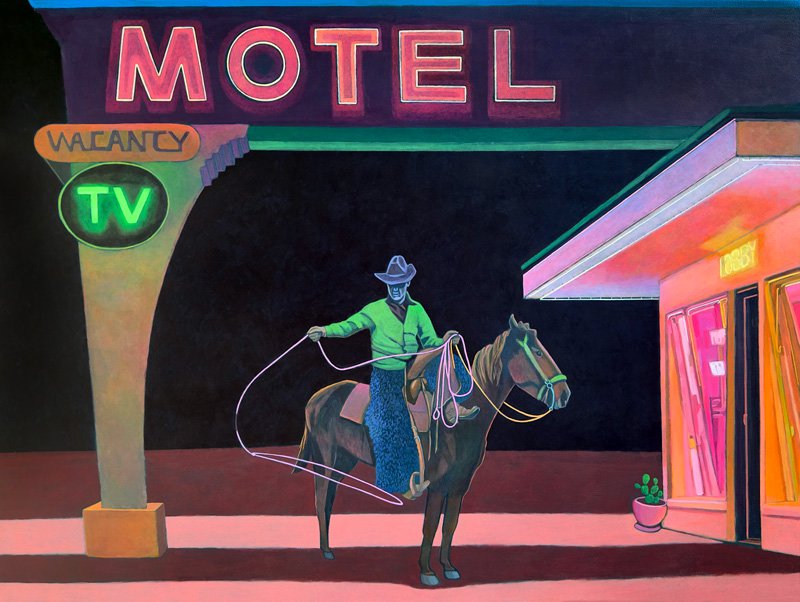
Fort Worth is about to experience a collision of music, imagery, and Western spirit when Fort Worth Opera presents “Cowboys & Culture” on Feb. 5, at 6:30 p.m. in the Kimbell Art Museum’s Renzo Piano Pavilion. The event lands during the final week of the Fort Worth Stock Show & Rodeo, promising an evening that’s part operatic showcase, part visual narrative, and all heart.
At the center of the performance is Clifton Forbis, the internationally acclaimed dramatic tenor and chair of voice at SMU’s Meadows School of the Arts, returning to a city that shaped his early career. On stage with him will be the Fort Worth Opera 2025–26 Hattie Mae Lesley Resident Artists — soprano Melissa Martinez, mezzo-soprano Madeline Coffey, tenor Coleman Dziedzic, and bass-baritone José Olivares — a quartet of voices poised to carry the next chapter of opera. The program spans Puccini’s “La Fanciulla del West” to Craig Bohmler and Steven Mark Kohn’s “Riders of the Purple Sage” and Héctor Armienta’s “Zorro”, alongside traditional songs that evoke the enduring pull of the American West.
But this isn’t opera as usual. Projected across the Kimbell walls will be the work of Fort Worth-born contemporary Western painter Kevin Chupik, whose pieces overlay mid-century Americana and Southwestern landscapes with a wink of surrealism. In one recent painting, “The Moment”, a lone cowboy contemplates directions under a disembodied neon sign — a scene part myth, part modernist dream. “I find that it’s compelling to try and reinvent a contemporary West that really isn’t being done by too many people,” Chupik says, describing how he pairs architecture, iconic figures like James Dean, and classic Western motifs into one cinematic frame. “James Dean is definitely the prototype for the look that I like using. It’s almost like a rebirth of cowboy sentiment, which appeared in the 1800s with cattle drives; it reappeared in the mid-20th century, and now, in our current times.”
Chupik’s connection to the West has been lifelong. “One way or the other, the Southwest has been in my blood since the beginning,” he says. “I used to be a backcountry enthusiast, subsequent mountain bike guide, canyon-year backpacker; anyway, I could get out to remote places.” That intimate knowledge of desert and canyon informs every brushstroke, even as he nods to mid-century Hollywood icons. His paintings are, in a sense, a time machine, bridging eras with an ironic but affectionate lens.
Fort Worth Opera Producing Director Kurt Howard saw the perfect fit immediately. “We saw his actual works and saw what was currently on exhibit at the William Campbell Museum, and we realized that a lot of his artwork is storytelling. You look at the art and see a complete story. It’s an interesting mix of styles between what would be a traditional Western with more contemporary objects.” Howard and his team deliberately paired specific pieces with the program’s music. “Rather than just sort of doing ‘here are Kevin’s works,’ we sort of did like a food and wine pairing of what is the song and what is the music that’s being performed, and how does that connect to his images?”
Preparation for the evening was meticulous. Howard said that the music had been sent to the artists six or seven months in advance, with the company’s music coach working with the resident artists over the last couple of months. Meanwhile, Forbis was preparing independently in Dallas and had coordinated his parts with the pianist during a single rehearsal before the full ensemble would gather to shape the performance.
“The reason I’m involved with the project is not just as a producing director with Fort Worth Opera, but I do have some rodeo experience in my past as a competitor, even though I grew up in a Southern California metropolis, not on a ranch or a farm,” Howard said. “I used that background to sort of think about what the aesthetic of these very lone cowboys that you see in this art is, what the stories are with them, and how the physical nature of it gets sort of reflected in these very still moments.”
Those still moments Howard described were partly inspired by Chupik’s upbringing. “I’m a child of Fort Worth. I was born here, and I grew up here,” Chupik says. His family’s history is woven into the Stock Show & Rodeo itself: “My grandmother was for 30-something years a founding member of the stock show. She was bringing in these classic acts like Roy Rogers and Gene Autry, and my mother grew up playing in the president’s office.”
Beyond the local, Chupik has made his work part of broader pop culture. His artwork has even appeared on “Landman”, a testament to his ability to blend Americana and surreal narrative. “Somehow my work has made the rounds quite heavily on the internet and places other than Fort Worth, so Fort Worth is just now kind of discovering what I’ve been doing,” he says. Yet his work remains deeply rooted in the Southwest. “I tend to seek things out if I can find them and use them in a tasteful way without being overpowering or cliché.”
For Howard, the collaboration represents a philosophy he holds dear: “I think it’s important that cultural institutions also connect with artists that live in their community or are of their community. We are not a completely separate entity from them, but have a connection to them.” By pairing Chupik’s visual storytelling with operatic voices, Fort Worth Opera creates an immersive experience—one that feels alive, immediate, and distinctly Texan.
As the performance unfolds, audiences will encounter cowboys who could have walked the plains in the 1800s, strutted onto screens in the 1950s, or are quietly contemplating their place today. “This is a homecoming in a lot of ways,” Chupik says, “both the way I work and how it’s being received, and the timely nature that it’s happening right now.”