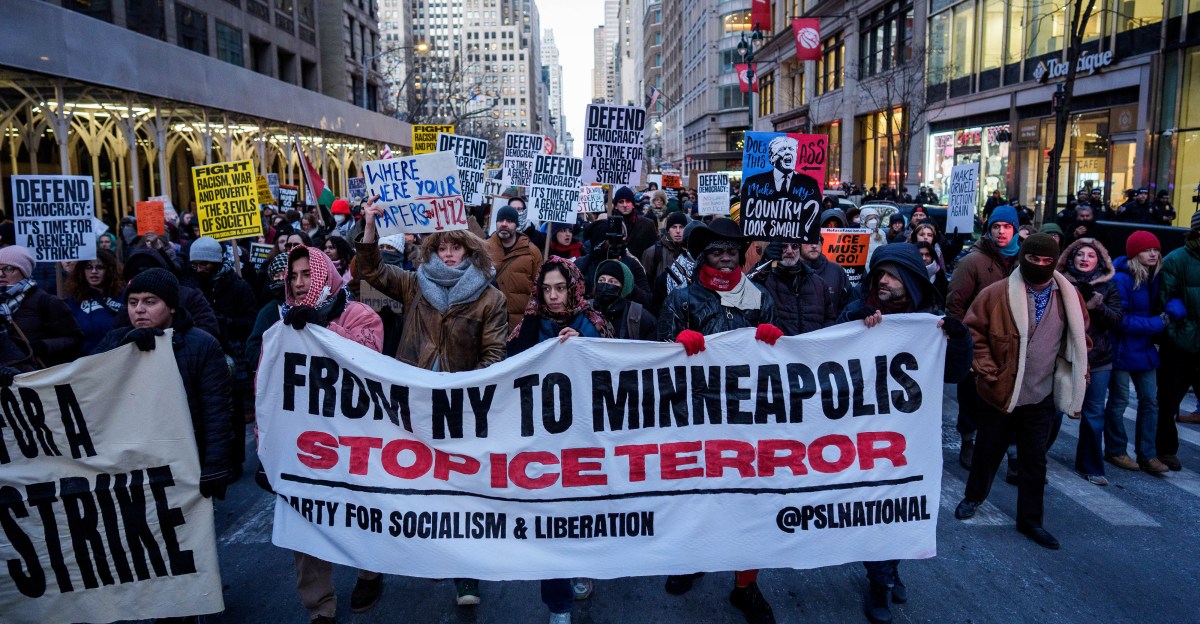
As Immigration and Customs Enforcement (ICE) continue their raids across America, activists and celebrities are calling for a general strike on Friday, January 30, to end the federal agency’s actions in Minnesota and elsewhere in the country. Many restaurant owners and workers in New York plan to join the cause.
In recent months, ICE and Border Patrol agents have killed Alex Pretti on January 24 and Renee Nicole Good on January 7 in Minneapolis; Silverio Villegas González on September 12 in Chicago; Isaias Sanchez Barboza in Texas on December 11; Keith Porter in Los Angeles on New Year’s Eve; and many others, along with injuries and wrongful detainments.
Strike participants are pledging that they won’t work, go to school, or shop, in a major act of disruptive solidarity to pressure the federal government pull back on the aggressive mass ICE raids and decrease funding for the agency.
Many New York City restaurant, cafe, and bar owners are choosing to close in solidarity with the strike on Friday, including Williamsburg coffee shop Land to Sea. Owner Emily Shum says she decided to shut down for the day because it’s her part in making an effort for the greater good. “We believe we must disrupt ‘business as usual’ and local commerce in order to affect change and help bring attention to the violence and injustice brought on by ICE and our federal government,” she says.

Land to Sea. Land to Sea/Official
Bed-Stuy vegan cafe Toad Style is taking its cues from Minneapolis restaurant Modern Times (which is collecting donations for food instead of ringing up checks — “we refuse to generate taxes” — until ICE is gone from Twin Cities). It’ll be closed for business service, but will offer free chili and grilled cheeses from noon to 2 p.m.
Chef Evan Hanczor is closing his restaurant Little Egg between Crown and Prospect Heights. “The financial consideration of closing a small independent restaurant is also significant,” he says.”We’ll lose money we can scarcely afford to lose.”
Hanczor knows that closing the restaurant for the day greatly affects the staff, especially the hourly workers. Some will use paid time off, “but we are also planning to offset some of the lost hours from the restaurants’ (limited) funds” to pay them, “but the impact is still there,” he says.
Chef and author Eddie Huang tells Eater over on Substack that he’s not going to go to work at Lower East Side bar the Flower Shop, where he’s currently the executive chef.
Clinton Hill coffee shop and wine bar Prima owner Daryl Nuhn calls participating in the general strike “simultaneously a difficult and easy decision.” She explains that January was a tough month: “I spiraled for half a day, and then the privilege came into focus and made the decision easy.”
It’s not just in New York City: Up in Catskill, 27 Cafe is closing. Owner Grace Brannigan tells Eater they’re doing this “because that is what has been asked of businesses by those who are central to the work of protecting the people targeted by ICE, to increase pressure, tension, and friction with the powers responsible for maintaining this apparatus, labor and its stoppage.”
Brannigan doesn’t take 27 Cafe’s temporary closure lightly, but they believe it will cause an impact. “Closing for a day is a drop in the bucket for tangible consequences to myself as a business owner, to the business itself, and to the community we serve,” they say. “Action collectivized can have outsized effects.”
Nuhn understands that not every small business can just shut down for the day, especially during the slow January period, coupled with the negative impact recent snowstorms have had on business. “Being a business owner and also being politically minded is weird and isolating, and you are often torn between what you feel is right and what you have to do for your business to survive (as well as keep your team employed),” she says.

Whoopsie Daisy. Whoopsie Daisy/Official
Some NYC restaurants and businesses that aren’t closing are helping efforts in other ways. Crown Heights wine bar Whoopsie Daisy and wine shop Fiasco will open up their spaces to people who want to “gather if you need, to organize, and to resist,” per the Instagram post, for free. People who do want to buy drinks and food are encouraged to use cash with a 10 percent discount. It’ll also donate one dollar from everything sold to the Immigrant Defense Project.
Greenpoint restaurant Gator is donating all drink sales for the day to legal services nonprofit New York Immigrant Family Unity Project.
Greenpoint cookbook store and cafe Archestratus is organizing a “Crush ICE” bake sale with no sign-up sheets. “As cooks and bakers, our instincts are to nurture, feed, and protect,” owner Paige Lipari tells Eater. “We have seen many times over at this shop that we are not alone, we are not helpless, and that when we come together, we are stronger and more effective. People have a tendency to write off bake sales as silly, and I would ask them to question why and how they were told that lie.”
People are encouraged to stop by Archestratus on Friday, January 30, from 10 a.m. to 7 p.m. and Saturday, January 31, before noon to drop off their baked goods. The sale runs from 2 to 6 p.m. on Saturday, January 31. All funds will be donated to Stand With Minnesota Donation Directory.
Bed-Stuy’s Frog Wine Bar is donating “a large amount of profit” from sales on Thursday, January 29, from 5 p.m. to midnight to the American Civil Liberties Union and Immigrant Defense Project. “We hate what this country is turning into and love it at the same time,” co-owner Charles Gerbier tells Eater. “We defend what is at the essence of this nation: immigration.” He and co-owner Alexandra McCown will “keep enough to leave the lights on and pay our employees,” and the rest of the sales will be donated, he says.
Eight Ridgewood restaurants, such as Salty Lunch Lady’s Little Luncheonette and Salvos, are getting together to donate a portion of each of their proceeds from Friday, January 30, through Sunday, February 1, to the Comunidad Primero and Immigration Defense Project.
During times of crisis and need, the restaurant, food, and beverage industry is often one that steps in to support localcommunities. “It’s an evergreen frustration that small restaurants are often the ones acting most decisively in these situations, and making the largest sacrifices to do so,” Hanczor says.
“In the F&B industry, we’re held up by immigrants, many of us being immigrants or children of immigrants ourselves, myself included,” Shum says. “This fight is in our DNA, and it seemed much easier to participate than to not.”