
Listen to this article
Estimated 4 minutes
The audio version of this article is generated by AI-based technology. Mispronunciations can occur. We are working with our partners to continually review and improve the results.
Two days after receiving a standing ovation at the World Economic Forum in Davos, Prime Minister Mark Carney made an address in Quebec City that caused an uproar among Quebec’s political class.
Speaking on Jan. 22 from the Plains of Abraham in Quebec City, Carney described the site’s 1759 battle, which saw British troops defeat the French, as symbolizing the start of a partnership between two founding peoples.
It was where “Canada began to make its founding choice of accommodation over assimilation, of partnership over domination, of building together over pulling apart,” he said.
But for many francophones, the site is “associated with national humiliation and a durable loss of agency,” writes Daniel Béland, political science professor and director of the McGill Institute for the Study of Canada, in a Policy Magazine article published Saturday.
At 30 minutes, Carney’s speech lasted roughly as long as the battle itself.
Alexandre Boulerice, the only New Democrat MP in Quebec, called it a “reinterpretation of history that makes absolutely no sense to the vast majority of Quebecers” while Bloc Québécois Leader Yves-François Blanchet called on Carney to apologize for his “deplorable mistake.”
Parti Québécois Leader Paul St-Pierre Plamondon rebuked Carney’s account in a speech of his own at the sovereignist party’s convention in St-Hyacinthe, Que.
“Mr. Carney, Quebec does not exist because of Canada. In fact, Quebec has survived in its difference and specificity despite Canada,” St-Pierre Plamondon said.
Months out from the provincial election and after François Legault’s resignation as premier, St-Pierre Plamondon and the PQ maintain a commanding lead in the polls .
Carney stands by comments
Jean-François Roberge, Quebec’s French-language minister and a Coalition Avenir Québec MNA, invoked Carney’s acclaimed Davos speech to criticize what he said in Quebec’s capital.
“Two days ago, Mark Carney reminded us of Václav Havel’s famous speech, inviting us to stop ‘living within a lie’ and that the ‘power of the powerless’ begins with honesty,” Roberge wrote in a social media post Friday. “I suggest he go back and read his own speech from the day before.”
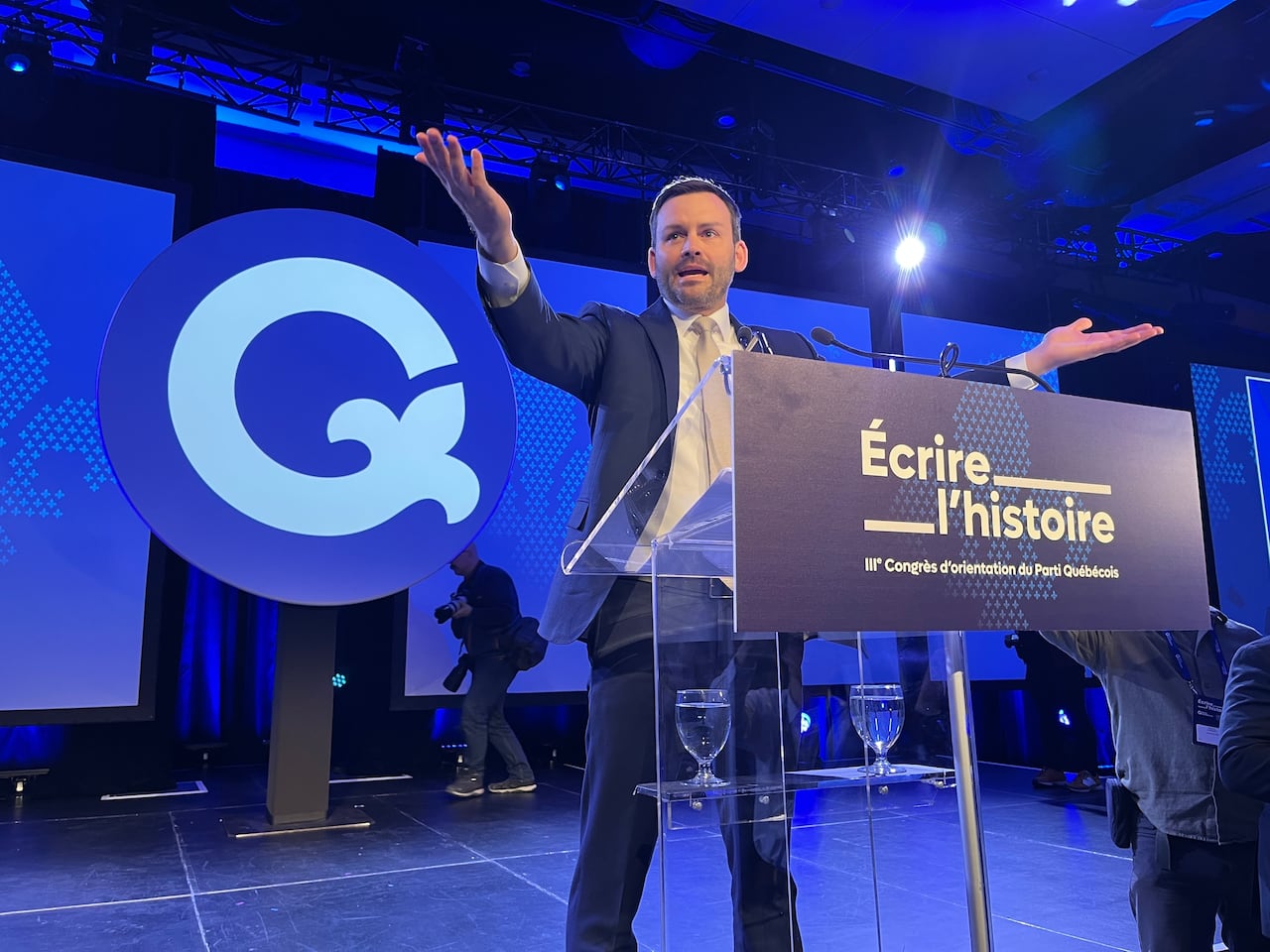 The leader of the Parti Québécois, Paul St-Pierre Plamondon, addresses party members during a convention in St-Hyacinthe on Sunday. (Thomas Laberge/The Canadian Press)
Tuesday, Marc Tanguay — interim leader of the Quebec Liberal Party — said Carney is contradicting a historical fact by describing the conquest of New France as the start of a partnership.
“Mark Carney’s speech was clumsy,” Tanguay said.
However, as the interim leader of a historically federalist party at Quebec’s National Assembly, Tanguay stopped short of demanding an apology from Carney.
“I think he needs to revisit some parts of our history,” Tanguay said.
The speech was a glaring blunder, according to journalist and political commentator Chantal Hébert.
“Perhaps Mr. Carney wasn’t paying attention in his history classes, or maybe the history he learned doesn’t quite align with reality,” she told Radio-Canada on Friday.
She noted that “it would be a grave mistake for Mr. Carney and his team to think that the backlash to these remarks is limited to sovereignist circles.”
Hébert also took issue with Carney mentioning in passing significant events, such as the Great Deportation of Acadians, which saw thousands of Acadians deported for refusing to swear allegiance to the Crown, and the Durham Report of 1839, which argued for the assimilation of French Canadians.
Carney “just gave the Parti Québécois its best day — its best weekend — since he became prime minister, especially considering it was during a party convention,” Hébert said.
Asked on Monday about the outcry, Carney stood his ground.
The speech credited “the resilience of the French-speaking people” with Canada’s creation, “a Canada that recognizes two founding peoples and, after a certain period of time, three founding peoples, including Indigenous people,” he said during an announcement in Ottawa.