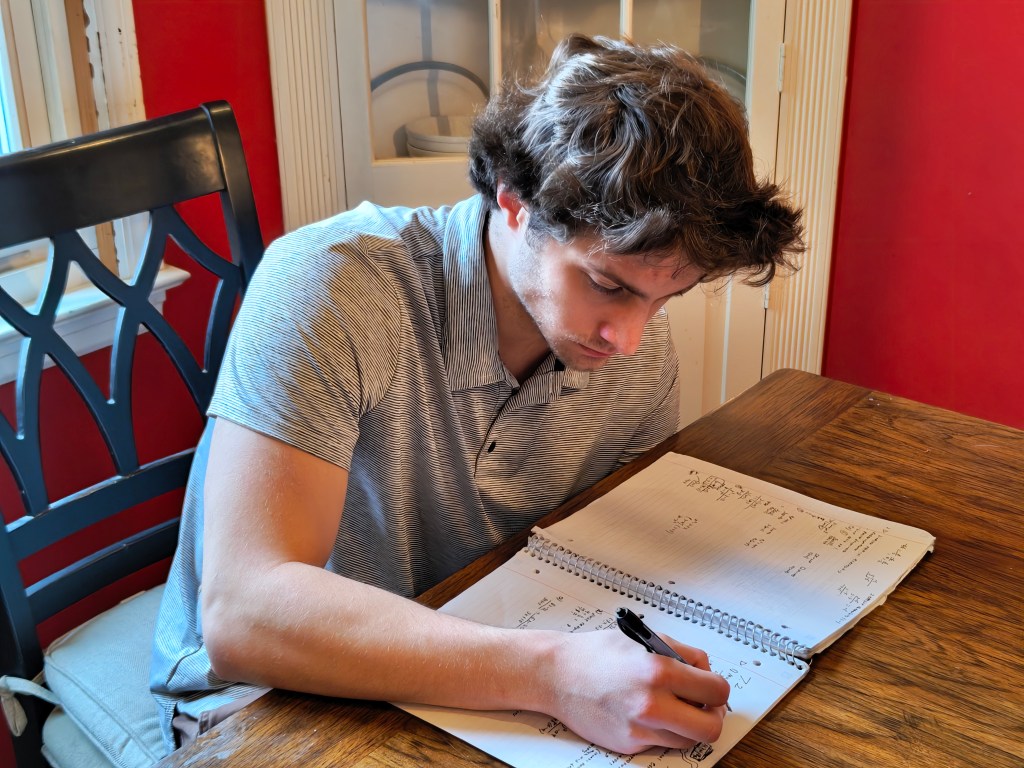
In third grade, Christian Smith struggled with attention deficit hyperactivity disorder. He was having trouble paying attention in class and had a lot of excess energy which led to him being clinically diagnosed.
Smith, of Wilton, said he took a stimulant medication that his doctor prescribed but stopped shortly after because of the reactions he had.
“When I first started taking ADHD medication, it caused me not to eat, increased my anxiety exponentially and caused anger outbursts,” said Smith, now a psychology student at the University of Massachusetts.
Then, in August 2024, he started taking stimulant medication again because he had trouble focusing, and it has worked for him since.
State data shows that more Connecticut residents are being prescribed stimulants, such as Ritalin and Adderall. Stimulants, which are the most widely prescribed medication for ADHD, work by increasing the levels of dopamine and norepinephrine in the brain.
From 2022 to 2024, stimulant prescriptions issued in Connecticut increased by 13.2 percent, according to data from the state.
In 2022, the top five stimulants totaled 987,957 prescriptions. By 2024, they totaled 1,118,829. That’s an increase of 130,872 between 2022 and 2024. In the first three quarters of 2025, the top five stimulant prescriptions amounted to 912,255.
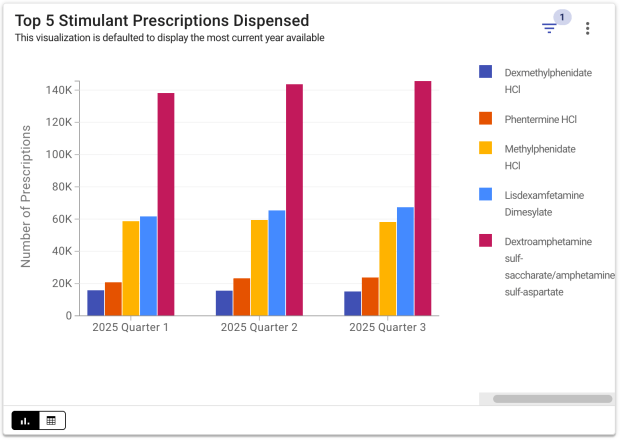 Data from data.ct.gov.
Smith said that the ADHD medications still have their ups and downs.
“Since I have started taking stimulants again, I have been able to focus on tasks, but the downside is I am still not eating as much as I should,” he said.
Although Smith agrees the medication helps him, he added that it’s not the best for everyone.
“I’ve never been supportive of just giving people medication,” Smith said. “Firstly, you are just throwing pills at people and having them sign the paper. Secondly, the effects of the pill will wear off eventually, but having the disorder will never wear off so it’s easier if you learn how to work with the disorder.”
Smith added that even if he doesn’t like the medication, he still needs it to get certain things done.
“I have constant tasks that I need to do every single day that I need to stay on top of. If I don’t take my medication, those tasks will fall and if I wanted to go off the medication, it would be harder for me to get through what I need to get done.” he said.
Smith added that he does not take his prescription all the time.
“I don’t always need to be on medication,” he said. “Usually if I’m not doing something important at that moment, I don’t really take it.”
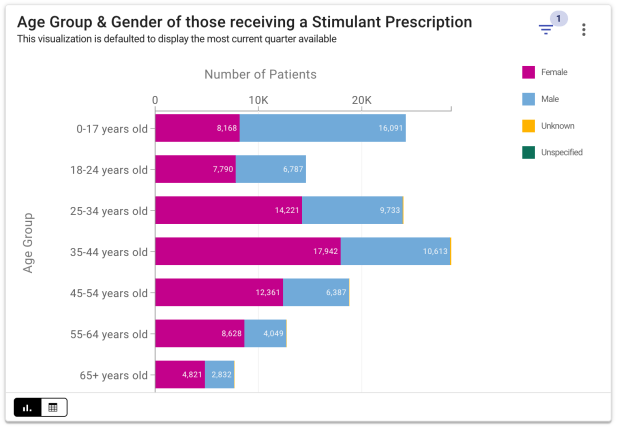 Demographic data for the third quarter of 2025 from data.ct.gov
Dr. Kimberly Soule, a licensed psychologist in Westport, said that therapy can help patients with ADHD.
“It depends on the phase of life a person is in,” she said. “For someone entering middle school, they might not understand executive functioning so helping them with organizational skills would be helpful.”
Soule added that older students may need help with other things, too.
“If they are in college, they might not need help with executive functioning, so helping them prioritize certain things or helping them with impulse control may be more beneficial,” she said.
Soule also said that sometimes ADHD can be misdiagnosed.
“Part of my role is to do assessments and evaluations to determine whether a person has ADHD or if it is something else like anxiety, because sometimes you have trouble focusing when you’re nervous or depressed,” Soule said.
She added that with ADHD, the combination of medication and therapy can help.
“It’s ideal if someone is on medication and is also receiving therapy because you can help the person with skills to not have them solely rely on the medication,” Soule said.
Medication has its strengths, Dr. Hassan Minhas, a psychiatrist in Stamford, said.
Two of the top stimulant medications Minhas prescribes are Ritalin and Adderall for both short- and long-acting help with focus.
In Connecticut, Ritalin, known as methylphenidate, was prescribed 195,671 times in 2022 and 224,111 times in 2024. That is an increase of 14.5 percent. Adderall, or dextroamphetamine, was prescribed 476,541 times in 2022 and 531,172 times in 2024, an increase of 11.4 percent.
Minhas confirms he has seen an increase in prescriptions.
“In my experience, more clients are on stimulants,” Minhas said. “This is likely due to an increase in awareness of ADHD treatments, but also likely in part due to over-prescribing of stimulants.”
Minhas said there was a shortage in stimulant prescription medications, including Adderall and Vyvanse, between 2022 and 2023.
“It is likely a combination of higher prescribing, supply-chain issues and manufacturing not being able to keep up,’’ he said.
Minhas added that they have backup plans for certain medication.
“When shortages like that happen, it is important to have a second and sometimes third option for patients who really need stimulants, when their particular stimulant is not available,” he said.
He said patients had to shop around to more pharmacies during the shortage.
Minhas added that he has some concerns about increased stimulant use.
“Stimulant medication is very addicting, and stimulant abuse is dangerous and problematic, psychiatrically and medically,” he said.
People with ADHD are turning to AI apps to help with tasks. Experts say try it cautiously
But he still believes that prescribed stimulants should be used when necessary.
“Overprescribing and misuse creates more psychiatric problems than it solves and prescribers must be very careful to prescribe only in situations where stimulants are necessary and being used appropriately,” Minhas said.
Alex Klancko is majoring in journalism at the University of Connecticut. This story is republished via CT Community News, a service of the Connecticut Student Journalism Collaborative, an organization sponsored by journalism departments at college and university campuses across the state.