Good afternoon! It’s Thursday, and apparently some methods of wearing a scarf are considered trendier than others. Here’s what else you need to know today.
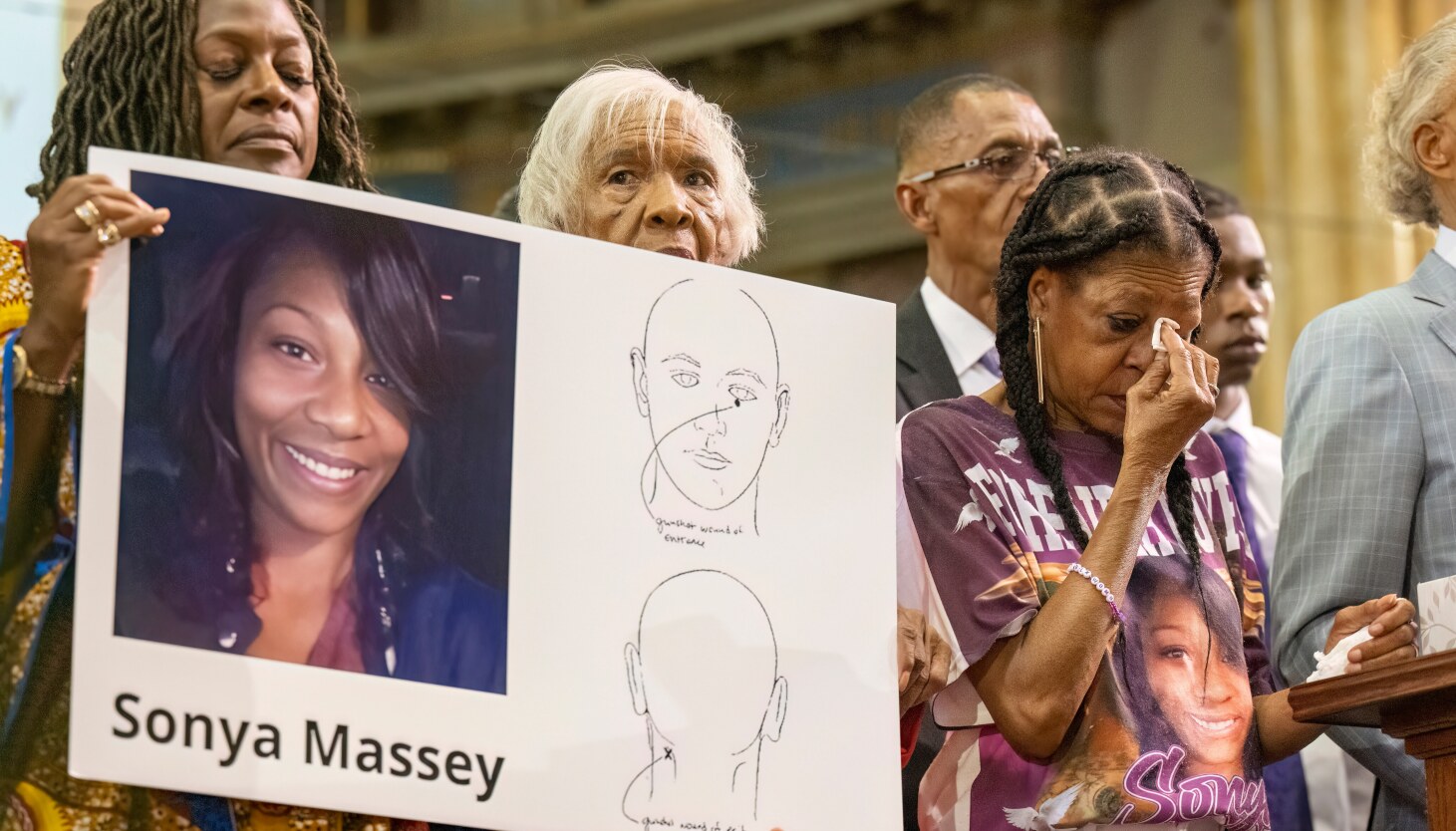
1. A white former downstate cop received a 20-year sentence for murdering Sonya Massey
A jury in October found Sean Grayson guilty of second-degree murder in Sangamon County, my WBEZ colleague Mawa Iqbal reports.
In a police brutality case that drew national attention, Grayson fatally shot the Black Springfield-area woman in her home in 2024 after she had called 911 to investigate a possible prowler. He faced a maximum sentence of 20 years.
Massey’s friends and family members — many of them wearing Sonya’s favorite color, purple — sat tightly packed in six rows of benches inside the Springfield courtroom. They erupted into cheers when Sangamon County Circuit Judge Ryan Cadagin imposed the sentence.
Sonya’s mother, Donna Massey, tearfully told the judge she is now afraid to call the police, out of fear she will end up like her daughter.
Grayson said he made “many mistakes that night” and wishes he could bring Massey back. [WBEZ]
That figure is despite the troops being confined to bases amid federal court battles, my colleague Tina Sfondeles reports for the Chicago Sun-Times.
Sens. Tammy Duckworth and Dick Durbin, along with nine of their Senate colleagues, requested the report from the Congressional Budget Office.
Since June, domestic deployments of National Guard personnel or active-duty Marine Corps members to six U.S. cities — Los Angeles; Washington, D.C.; Memphis, Tennessee; Portland, Oregon; Chicago and New Orleans — totaled about $496 million through the end of December, the report found. Senators had asked for the costs to activate, deploy and compensate guard members, the operational, logistical and sustainment costs and any additional direct or indirect costs.
In light of the report, Durbin called the deployments “an abhorrent violation of the Constitution” and “a harmful diversion of federal resources.” Duckworth said the deployments were “an immense waste of taxpayer dollars” and called them “harmful to our military’s readiness, morale and resources.” [Chicago Sun-Times]
3. Extreme weather has spurred a national blood supply shortage. Here’s how to help
More than 400 blood drives nationally were affected by severe weather, causing thousands of blood donations to go uncollected, the American Red Cross said this month.
The organization, responsible for supplying about 40% of the nation’s blood supply, urged people to donate blood to ensure that patients don’t experience delays in receiving lifesaving care. Nationally, blood donation shortages are most severe for platelets and types O, A negative and B negative blood.
Versiti Blood Center of Illinois, a blood drive operator in the area, said it suffered a blood supply shortage this month. UChicago Medical Center, University of Illinois Health and Northwestern Medicine told the Chicago Sun-Times they haven’t experienced shortages yet but still urged people to donate. [Chicago Sun-Times]
4. Women’s sports fans will have a new place to hang out with the opening of Level Sporting Club
Founded by former Northwestern University basketball player Clarissa Flores, the bar will be near the heart of sports bars crowding around Wrigley Field.
As my colleague Mariah Rush reports for the Chicago Sun-Times, the 5,632-square-foot space, previously home to the seafood boil restaurant Lowcountry, should open at the end of April.
“We’re a Chicago sports bar where women’s sports takes center stage,” Flores said. “Just as we would walk into any regular Chicago sports bar and men’s sports is a priority … that’s going to be flipped here.” [Chicago Sun-Times]
Running an art museum may be one of the toughest arts jobs right now, thanks to cuts in federal support, philanthropic pullbacks, sociopolitical jabs from the left and right and existential questions about the relevance of such institutions in the 21st century.
The Art Institute of Chicago has not been entirely immune to these challenges, including a 7% post-pandemic attendance decline that stems in part from a drop in international traffic to the United States.
But James Rondeau, marking the 10th anniversary of his appointment as president and director this month, is pushing ahead. The museum has a billion-dollar endowment that’s increased 70% during his tenure and about 1,000 art acquisitions each year. Meanwhile, the number of local visitors has increased since the museum significantly boosted its free-access program, which drew 300,000 visitors in 2025.
The ambitious former contemporary curator also started this year trying to course correct from April 2025, when he reportedly stripped his clothes after drinking alcohol and taking prescription medication on a flight from Chicago to Germany. Rondeau subsequently took a 1½-month volunteer leave from his position. [WBEZ/Chicago Sun-Times]
Here’s what else is happening
- U.S. Senate Democrats blocked legislation to fund the U.S. Department of Homeland Security amid ongoing negotiations to avert a federal government shutdown. [AP]
- After federal agents fatally shot two people in Minneapolis, some Trump supporters say they still back the president’s sweeping enforcement of the nation’s immigration laws. [NPR]
- The average U.S. life expectancy hit an all-time high in 2024, as the country continued to recover from the COVID-19 pandemic and deaths from drug overdoses continued to decline. [NPR]
- Here’s what you can find at Chicago’s winter farmers markets. [WBEZ]
Oh, and one more thing …
Built as a synagogue and later housing a series of Christian congregations, a Woodlawn building now serves as part single-family home, part makerspace and artists club, WBEZ contributor Dennis Rodkin reports.
Amber and Tom Ginsburg now own the structure and reused many of the 103-year-old materials during their renovations. That includes old-growth wood flooring that has been made into benches and added to closet doors as decoration. Chicago common brick, salvaged when some old chimneys had to come down, has been added to the façade.
What the couple can’t use, they hang onto, including several pairs of stained glass windows “in various forms of terrible to good shape,” Amber told WBEZ’s “In the Loop.”
You can see photos of what the building looks like now in the link. [WBEZ]
Tell me something good …
Which Chicago-area productions are you looking forward to this season?
Andrew writes:
“I am very looking forward to Goodman’s upcoming ‘Ma Rainey’s Black Bottom,’ and I hope I get to eventually see August Wilson’s entire ‘Century Cycle.’”
Feel free to email me, and your response may be included in the newsletter this week.