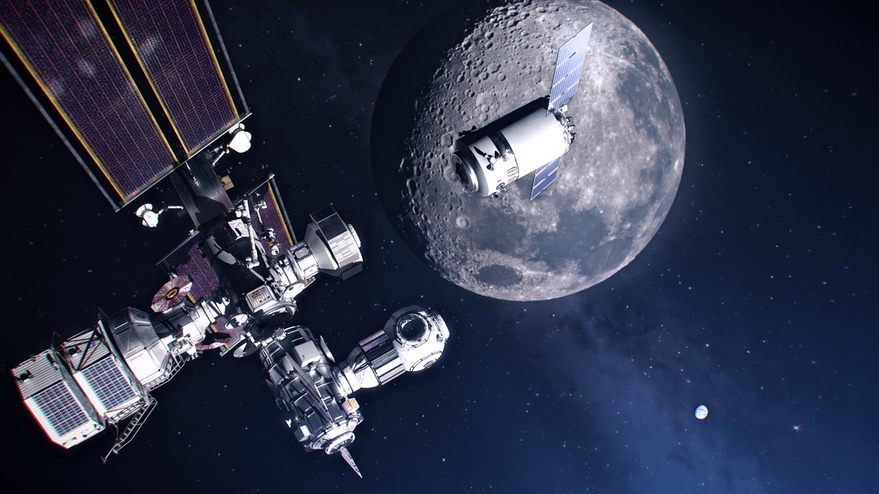
ORLANDO, Fla. — NASA is at a “crossroads” in deciding how to handle logistics for the lunar Gateway as it considers alternative approaches.
NASA selected SpaceX in 2020 for the Gateway Logistics Services program, a commercial service intended to transport cargo to and from the Gateway, analogous to the commercial cargo services supporting the International Space Station. SpaceX’s proposal involved a variant of its Dragon spacecraft called Dragon XL.
Development of that service progressed slowly, tied in part to delays in the Gateway program. “When you’re buying a commercial service, you don’t need to buy that too early in the flow and let it sit dormant,” said Mark Wiese, manager of the Deep Space Logistics program at NASA’s Kennedy Space Center, during a Jan. 29 panel at the SpaceCom Expo here.
NASA gave SpaceX authorization to proceed with the first Gateway logistics mission in 2023. However, Wiese said that last year NASA evaluated a potential change proposed by SpaceX to its Gateway logistics architecture, although neither SpaceX nor NASA disclosed details at the time. The agency planned to decide whether to accept that revision by mid-2025.
Wiese said NASA studied the possibility of using Starship to support Gateway logistics in place of Dragon XL. “We could further understand where they’re going commercially and how that could potentially support logistics needs as we go out to cislunar space,” he said.
Work on Gateway logistics paused last year following the administration’s fiscal year 2026 budget proposal, which sought to cancel the Gateway. Congress, however, funded the program in the budget reconciliation bill passed last July.
“Right now, we’re sitting at a crossroads with those two potential architectures with SpaceX,” Wiese said, as NASA awaits policy direction on how to proceed. That guidance is likely to come sometime after the Artemis 2 mission, scheduled to launch as soon as early February.
His program has also been involved in broader studies of cislunar transportation. In August, NASA selected six companies for short-term studies of orbital transfer vehicle concepts that could operate in cislunar space and other “difficult-to-reach” orbits. The nine studies, with a combined value of $1.4 million, went to Arrow Science and Technology, Blue Origin, Firefly Aerospace, Impulse Space, Rocket Lab and United Launch Alliance.
“To have logistics successfully, we’ve got to have transportation all through cislunar space,” he said. The studies were conducted in cooperation with NASA’s Launch Services Program through its Venture-Class Acquisition of Dedicated and Rideshare Launch Services, or VADR, contract.
Those studies have been completed and reviewed, Wiese said, as NASA evaluates next steps. “We’re eying ideas of ways we could do demonstration missions to try to further incubate that market,” he said, with the goal of enabling multiple companies to perform logistics deliveries in cislunar space.
As with Gateway logistics, he said he expects NASA to decide how to proceed on any next steps after Artemis 2.
Related