Sign up for Chalkbeat Philadelphia’s free newsletter to keep up with news on the city’s public school system.
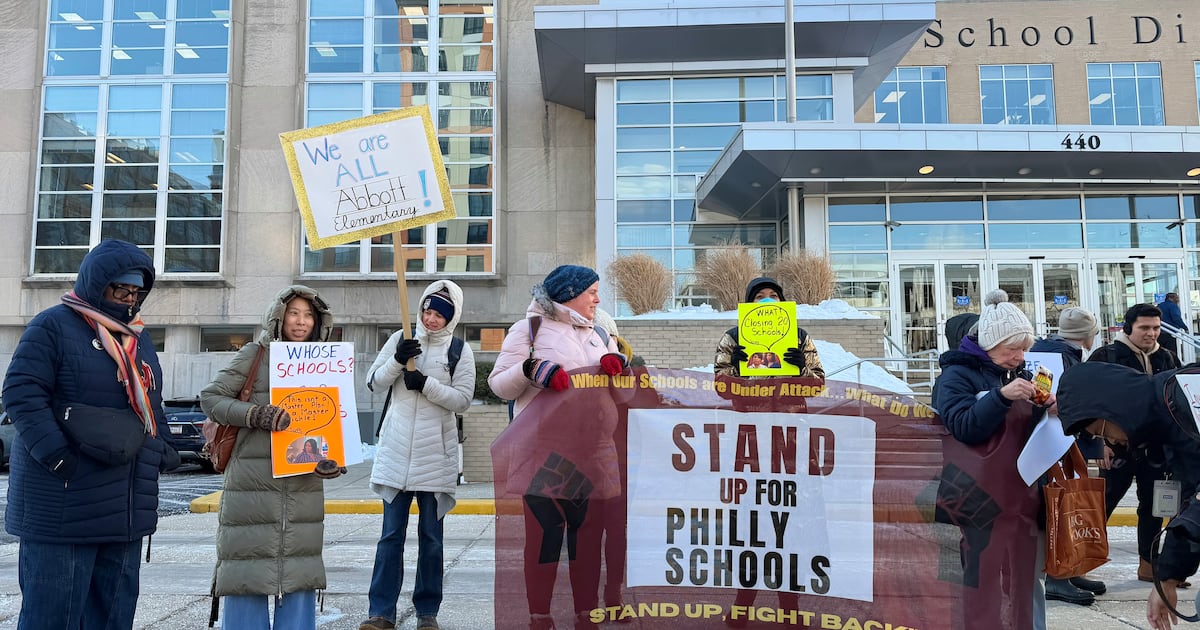
Protestors rallied outside of the Philadelphia school district’s main office in the bitter cold Thursday afternoon, calling on members of the Board of Education to put a stop to the district’s proposal to close 20 schools in the coming years.
The plan, which district officials announced last week, would impact 1 in 3 district schools and result in nearly 5,000 students affected by school closures beginning in 2027. Students would be moved out of deteriorating old buildings to fill empty seats in many underenrolled schools. But it would also relocate hundreds of students to lower performing schools and close schools in neighborhoods the district’s own data shows are vulnerable because of social factors and past school closures.
Superintendent Tony Watlington has said closing schools and shuffling enrollment would lead to more opportunities for all students.
But inside the school district’s main building, board members — who have final say on the closures — gave no indication on how they will respond to the district’s sweeping proposal. They said they would share those thoughts at their board meeting on Feb. 28, when district leaders plan to formally present the plan.
Board president Reginald Streater said it would be “inappropriate” for him to speak about the plan’s merits ahead of the presentation. But he thanked Superintendent Tony Watlington for creating a plan for the district’s aging facilities. Streater said the board will review the proposal during its February meeting but not vote on it.
School leaders, teachers, and parents urged the board to prevent closures and to come up with a better plan that keeps schools open. During a spirited public comment session, several said the proposal would destroy tight-knit school communities and leave students with longer commutes and more crowded classrooms. Some worried the data the district used to make its decision was flawed. And others said they feared the plan reflected a disinvestment in schools where the majority of students are Black and brown.
More than a dozen students and staff from Lankenau High School rallied in front of the district’s main building ahead of the meeting.
“Our voice should be heard,” said Krysten Fanis, a sophomore at Lankenau Environmental Science High School, which the district wants to close and turn into an honors program at Roxborough High School. “How they’re trying to recommend to shut down our school is not OK.”
We’re here to help.
Every day, Chalkbeat Philadelphia reporters are answering your questions, following the money, and digging into what’s happening in the city’s public schools. Keep up with our free newsletter, delivered every Wednesday and Friday morning.
Board members encourage people to weigh in
The Philadelphia Inquirer reported that district leaders have already said they may shift parts of the plan before they formally present it to the board at next month’s board meeting.
That may be a response to the swift pushback. Some City Council members have called for specific changes. And many teachers, students, and families have said they will fight for their schools to stay open.
Streater and other board members encouraged teachers, students, and families to attend the community engagement sessions the district plans to host in the coming weeks at each school it proposes closing. Two board members said they would make an effort to attend the meetings.
Board Vice President Sarah Ashley-Andrews stressed the importance of community input at the meetings. “We want to hear your voice, your comments and concerns,” she said.
Several educators and community members connected to Conwell Middle School, which the district wants to close, held signs during the meeting urging school leaders to keep the school open. Longtime Conwell Principal Erica Green stressed the school’s history, tight alumni network, and recent investments, some of which were funded by settlement money from lawsuits against opioid manufacturers.
“Do not let the almighty dollar drive a choice to remove a beautifully designated historic school and beautifully gifted young people,” Green said.
Representatives of other schools said that the whole district will be impacted by the proposed closures.
“This is a collective effort,” said Paul Brown, a psychologist at Roxborough High School who attended the protest. “Rather than singling out individual schools to fend for themselves, we should be all working together to ensure every student can go to their neighborhood school instead of traveling across the city.”
Board members also appointed two non-voting student board representatives: Brianni Carter, an 11th grader at Philadelphia High School for Girls; Ramisha Karim, an 11th grader at Northeast High School; and Semira Reyes, an 11th grader at The Philadelphia High School for Creative and Performing Arts.
Carter and Karim said they aimed to attend the community engagement meetings to hear what their peers and adults are saying.
Board members also voted to approve several contracts and grants, including:
- $15 million for mechanical, plumbing, fire protection, and electrical engineering design services.
- $3.7 million for purchasing facilities supplies, tools, and building materials
- $610,000 to replace the fire alarm system at James G. Blaine School.
- An agreement with the Community College of Philadelphia to use space at Ben Franklin High School.
Three of nine board members were absent from the meeting, and four called in remotely.
Rebecca Redelmeier is a reporter at Chalkbeat Philadelphia. She writes about public schools, early childhood education, and issues that affect students, families, and educators across Philadelphia. Contact Rebecca at rredelmeier@chalkbeat.org.
Sammy Caiola covers solutions to gun violence in and around Philadelphia schools. Have ideas for her? Get in touch at scaiola@chalkbeat.org.
Carly Sitrin is the bureau chief for Chalkbeat Philadelphia. Contact Carly at csitrin@chalkbeat.org.