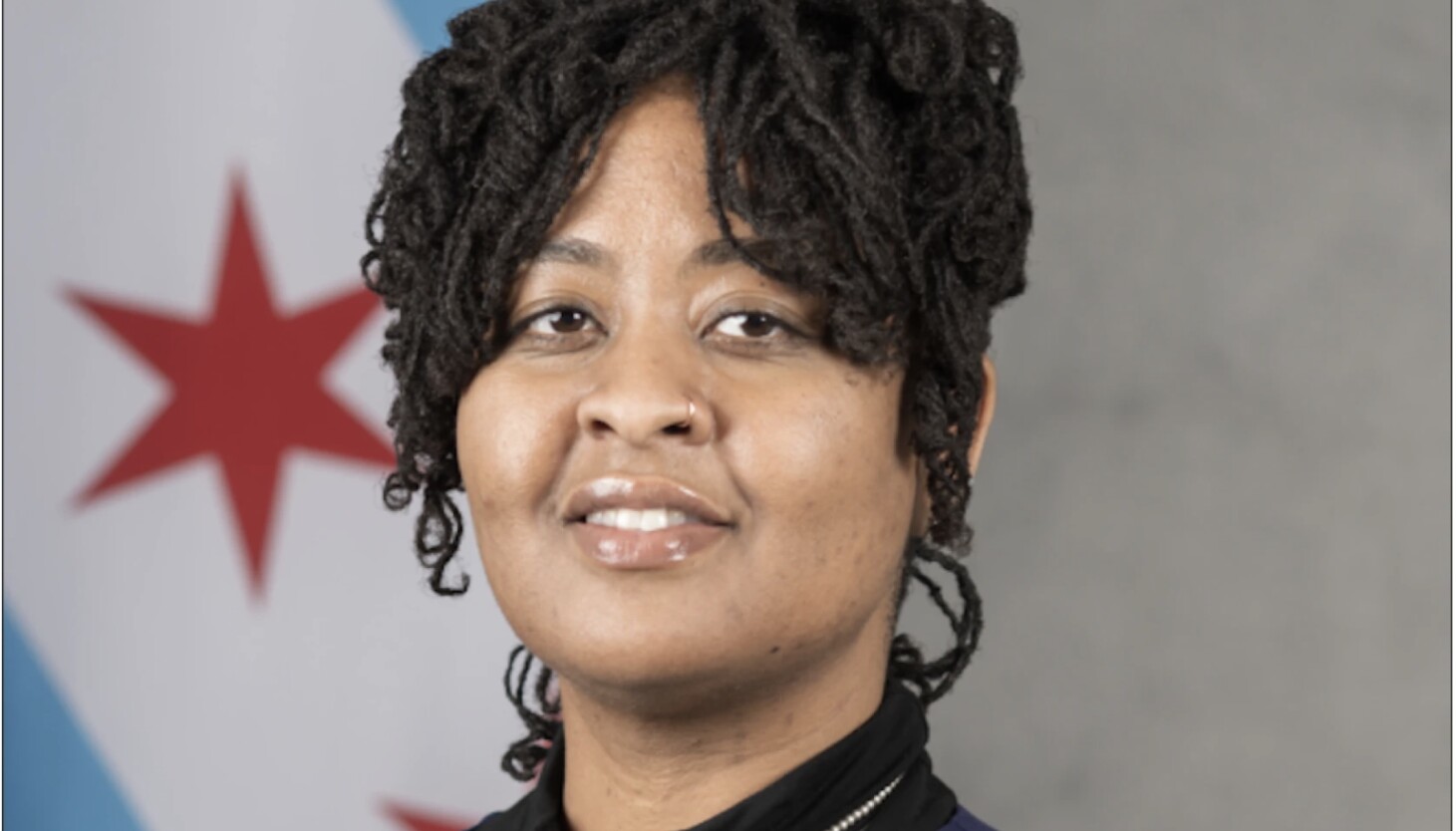
Chicago’s police oversight agency is getting a new boss — its current boss.
It’s been nearly a year since former chief Andrea Kersten was forced out amid allegations she was presiding over a Civilian Office of Police Accountability whose investigations were biased against police officers.
LaKenya White, who started her career at the agency that preceded COPA, was elevated to replace Kersten on a temporary basis. She’s held down the fort, while a nationwide search was conducted for her permanent replacement.
On Thursday, the city’s Community Commission for Public Safety and Accountability voted to give her the permanent job.
It sounds like a familiar Chicago story: a nationwide search goes through the motions only to select the person already in charge. But sources close to the process said White earned the job by rebuilding shattered trust with demoralized COPA employees and stabilizing the difficult environment she inherited.
Though she also came under scrutiny for repeatedly wiping out recommendations to fire officers, during her first months as interim chief administrator.
She’ll be responsible for rebuilding trust in an agency undergoing turbulent times — and as the agency’s list of responsibilities continues to grow.
An ordinance, backed by Mayor Brandon Johnson and Chicago police Supt. Larry Snelling, would soon place COPA in charge of investigating any allegations officers violated the Welcoming City Act by assisting in federal immigration enforcement. Critics in the City Council have questioned the agency’s ability to take on such a role.
The oversight commission paid a firm over $45,000 to conduct the search for the agency’s new leader, according to records obtained by the Sun-Times.
There were over 30 candidates, which included people with significant positions at oversight agencies like COPA, according to sources familiar with the search. The commission denied the Sun-Times request for a complete list.
But the commission stands confident in its decision to nominate the Chicago native and oversight veteran.
“COPA’s work requires leadership that understands both the technical demands of complex investigations and the human impact those investigations have on families, officers, and communities,” CCSPA President Remel Terry said in a statement.
“LaKenya has spent her career inside Chicago’s police accountability system, and she understands how this agency operates at every level. That depth of experience is exactly what COPA needs in the next Chief Administrator.”
At Thursday’s meeting, Commissioner Angel Navarijo said White “can build public trust” and had run COPA “more effectively, improving consent decree compliance and transforming the culture at COPA.”

LaKenya White, Interim Chief Administrator of Civilian Office of Police Accountability, speaks after the Community Commission for Public Safety and Accountability voted to nominate her to serve as the next Chief Administrator of COPA during a meeting at Malcolm X College in Chicago on Thursday, Jan. 29, 2026.
Talia Sprague/Chicago Sun-Times
Addressing the meeting’s attendees, White said while there has been “meaningful progress,” there was a lot of work left to strengthen public trust in the accountability process.
In accepting the proposed goals of her new role for 2026, she promised the the city, as well as Chicago police officers, to be “real” and “fair.”
“I want to thank you guys for believing in me to take this agency on, this isn’t something I take lightly,” White said. “I’m not here for public comment or political opinion, I’m here to do the work … I’m here to bridge the gap between community and police.”
Chicago’s police accountability agency has been without a permanent leader since last February, when Kersten resigned to avoid a potentially embarrassing vote of no confidence.
Kersten faced strong opposition throughout her tenure as chief of Chicago’s police accountability oversight agency. Before she was even appointed, she came under fire for recommending that slain Officer Ella French be suspended for her role in the raid of social worker Anjanette Young’s home.
Kersten apologized for the “heartache, frustration and just flat-out anger” she’d caused French’s grieving family, and was confirmed a month later — but the pushback continued.
Two former COPA officials sued the city, claiming they were retaliated against for complaining about Kersten’s leadership. The city’s largest police union also sued the agency under Kersten, claiming they’d carried out “biased and unfair investigations.” One of the former officials still has a pending case in county court, the other suits have been dismissed.
Last January, Kersten got a letter from the oversight commission saying they’d planned a vote of no confidence in her, sources told the Sun-Times.
This was just the latest tumultuous chapter in the city’s experiment with civilian police oversight, which began in the 1970s as the Chicago Police Department’s troubled Office of Professional Standards and continued with the city’s successor agency, the Independent Police Review Authority.
IPRA was disbanded following public outcry over the police killing of 17-year-old Laquan McDonald on the Southwest Side. Months later, in August 2016, then-Mayor Rahm Emanuel established COPA as its replacement.
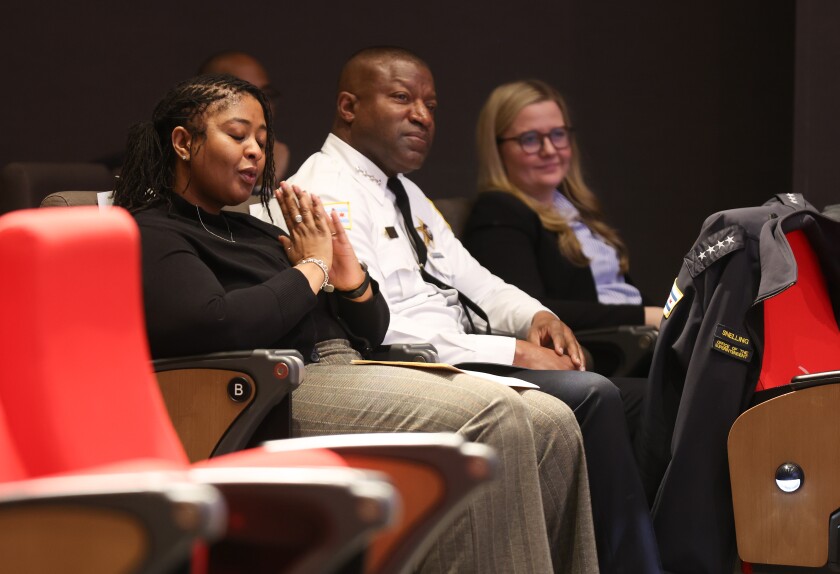
LaKenya White (left) sits next to CPD Supt. Larry Snelling (middle) and reacts after the Community Commission for Public Safety and Accountability voted to nominate her to serve as the next Chief Administrator of COPA during a meeting at Malcolm X College in Chicago on Thursday, Jan. 29, 2026.
Talia Sprague/Chicago Sun-Times
White has worked at every iteration of the police oversight agency. She joined OPS in 2000, then went to IPRA in 2007, where she handled a number of officer-involved shootings. She joined COPA, upon its creation in 2017, and eventually became the agency’s Director of Investigations for Intake, overseeing all incoming complaints.
White took over as interim chief administrator in March 2025. Over the summer, a WBEZ and Sun-Times investigation found White had walked back the disciplinary recommendations for six cops — four that the agency said should be fired and two for whom it said firing should be considered — since taking over the role.
In each case, COPA adopted recommendations made by Snelling, who publicly spoke out against Kersten over her handling of the police shootout that killed Dexter Reed.
But current COPA employees appeared to stand in support of White. As part of their search, the commission held listening sessions with over 100 current COPA employees.
Many, unprompted, recommended White for the permanent position, standing behind her management style and the changes she’d already implemented, according to sources familiar with the meeting.
She’s prioritized training that gave investigators a better understanding of police department policy and officers’ decision-making process, and has been working to strengthen accountability practices, according to the commission.
The mayor now has 30 days to weigh in on White’s nomination. The City Council’s Committee on Police and Fire will then hold a public hearing, and if advanced, White’s nomination will head to a full council vote.
At the meeting, Snelling said White was “well deserving” of the role, and that he “felt it in his soul” she would not only be confirmed, but “do an excellent job.”
“I can tell you she is extremely hardworking, professional and prepared to do the job,” Snelling said. “She has always been fair but firm on her decision making. We don’t always agree on everything and that is absolutely healthy.”