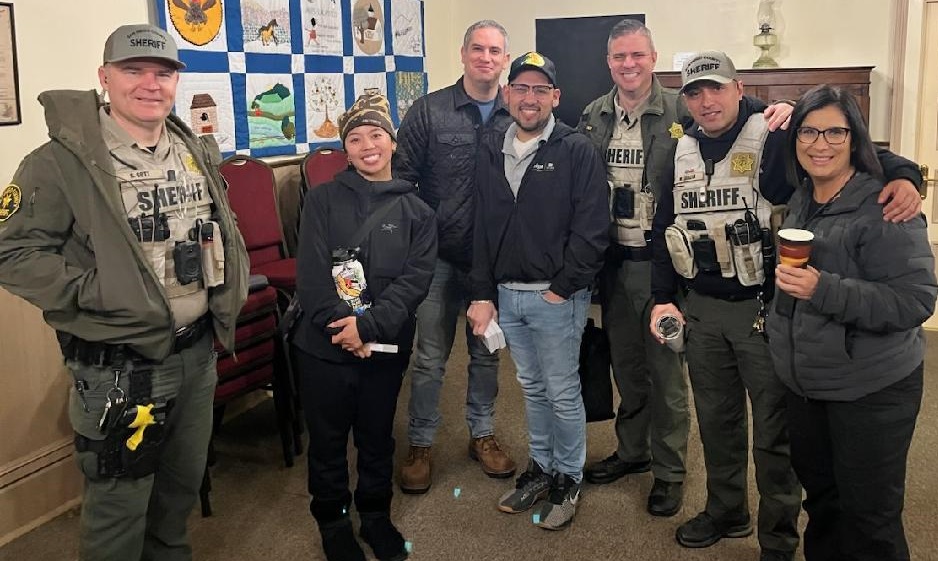
Ten volunteers counted eight homeless people in Ramona during the annual Point-in-Time Count, conducted as a one-day snapshot of the local homeless population.
The early morning count from 4 to 8 a.m. on Jan. 29 was coordinated by San Diego’s Regional Task Force on Homelessness. The count provides an estimate of the number of people experiencing homelessness in San Diego County, including those in emergency shelters and safe parking lots.
Ramona’s counters included homeless advocates from the PATH San Diego program and from the Sheriff’s HART team, which stands for Homeless Assistance Resource Team.
Ramona resident John Stevenson helped organize the count as the leader of the Ramona Homeless Project. Stevenson said he is meticulous about keeping track of the homeless numbers so homeless individuals can get needed resources such as shelter and substance abuse or mental health assistance.
“We had a good crew out there that really beat the bushes,” he said.
Most of the homeless this year were found in their vehicles, Stevenson said. Their numbers were down from 23 in 2023 and 13 in 2024 and nine last year.
Last year, the number of people experiencing homelessness in San Diego County dropped by 7%, and by about 14% in the city of San Diego, according to the data. The volunteers found no fewer than 9,905 people experiencing homelessness throughout the county, down from 10,605 in 2024. Last year’s data showed 5,714 unsheltered San Diegans and 4,191 individuals in shelters and transitional housing.
Stevenson attributes some of the success at reducing the homeless numbers to HART’s efforts at providing vouchers for temporary hotel housing and PATH’s help in finding stable housing for homeless people.
Getting an accurate count can be challenging because homeless people are often on the move frequently or it may not be safe to knock on their covered car windows early in the morning, Stevenson said.
“I know right now there’s four other people but they’re in unregistered vehicles and they move every night,” he said.
Some of Ramona’s homeless were discovered in church parking lots, but fewer people were located in Santa Maria Creek this year. Stevenson cited the 2024 city of Grants Pass v. Johnson U.S. Supreme Court decision that allows municipalities to penalize public sleeping.
Development in the area of the former Kmart store, renamed as Ramona Station, has similarly replaced a “substantial homeless encampment,” he said.
The shopping center is now being developed with a Marshalls, PetSmart, Five Below and Grocery Outlet Bargain Market. Nearby, the Creekside Crossing 54-home residential development is being built at Robertson Street near La Brea and Pala streets.
“There used to be 30 to 40 people living at Santa Maria Creek,” Stevenson said. “But now they’re all gone because they can’t stay there. PATH is good at placing them and HART has vouchers so they’re able to get people sheltered to a large extent.”
Ramona resident Kim Newcomer joined the Ramona Point-in-Time Count for the first time this year with her husband, Guy Buchanan. Although Newcomer said she felt intimidated because she thought it might be scary to approach homeless people on the streets, her fears quickly turned into a sense of empowerment.
Newcomer said having the support of participants from PATH and HART made her more comfortable and confident.
“These people know what they’re doing,” Newcomer said. “This count is important so we can get the resources to help people.”
After arriving at the local Point-in-Time headquarters at Ramona Town Hall at 3:30 a.m., Newcomer said she was greeted by the other volunteers and eased into the process with coffee and donuts.
Out in the field, deputies shone their flashlights while conducting routine surveys of homeless people, she said. While traversing buildings behind Main Street, Newcomer said she and her cohort encountered one homeless man who wanted to talk about his experiences losing his dog.
“These people are just like you and me,” she said. “They’re just having a hard time. A lot of people are struggling to get food on the table and pay rent. It’s difficult. If anything goes wrong you could be one paycheck away from not making it.”
Their group listened to the man’s concerns and then wrote down his phone number to pass onto a social worker, she said.
“We need to rethink where these people get housed and how they get housed,” Newcomer said. “Their housing doesn’t have to be luxurious, just enough to help them get through the next day and the days after.”