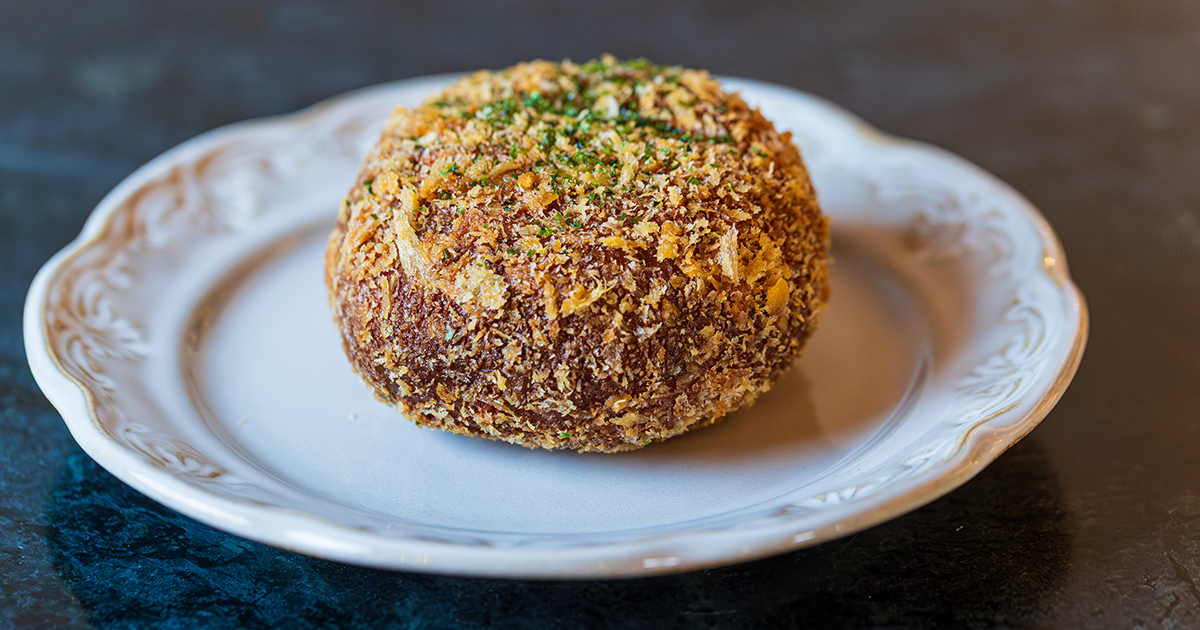
Dancerobot’s adaptation of the savory Japanese pastry is a panko-crusted, beef-cheek-filled marvel.
Devoted foodies and restaurant newbies love Foobooz. Sign up now for our twice weekly newsletter.
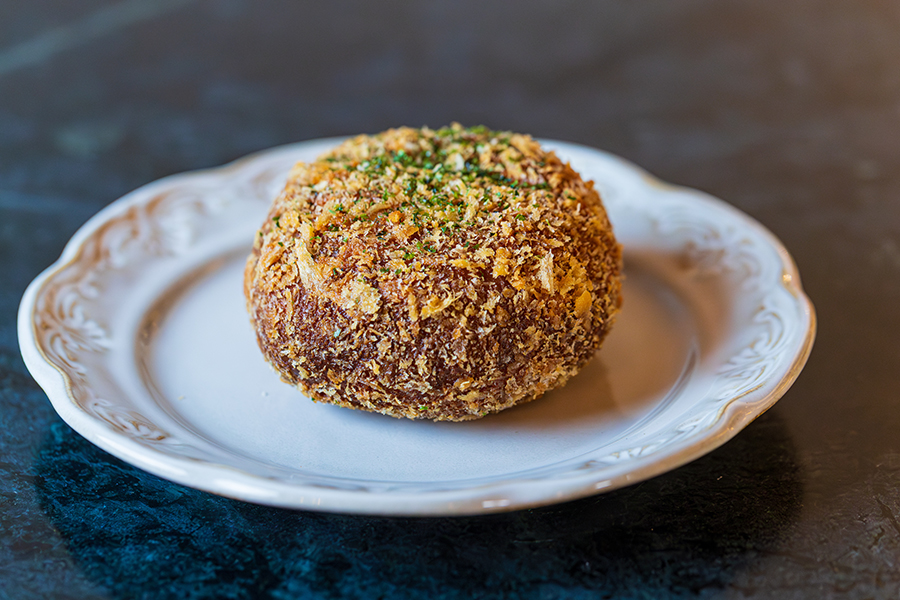
The kare pan at dancerobot / Photograph by Jesse Ito
Welcome to Just One Dish, a Foobooz series that looks at an outstanding item on a Philly restaurant’s menu — the story behind the dish, how it’s made, and why you should be going out of your way to try it.
Sure, the menchi katsu sando at dancerobot gets all the love (and all the likes on Instagram) because it’s this big, towering thing with a fat beef-and-pork cutlet, shredded red cabbage, and Japanese-style tartar sauce all crammed between two halves of a shokupan milk bread bun. And don’t get me wrong: It is a killer sandwich. One of the best in town. But you’d be doing yourself a grave disservice if you went straight for the obvious charms of the kitchen’s social media darling and overlooked the real star of dancerobot’s menu: the kare pan.
Have you tried it already? If you have, you know exactly what I’m talking about — this fried baseball full of curry-soaked beef cheek; this crispy, crunchy, soft and comforting staple of Tokyo late nights and early mornings in Osaka; reimagined here as a puffy, panko-crusted mutant that’s half Japanese convenience store tradition and half ‘90s American suburban junk food.
“I didn’t grow up eating kare pan,” says Justin Bacharach, chef and partner at dancerobot, his and Jesse Ito’s nostalgia-driven, Japanese-American restaurant in Rittenhouse. “But Jesse did. I grew up eating a lot of doughnuts.”
And the kare pan at dancerobot? It’s kinda like a doughnut. A meat doughnut — soft and springy dough, filled with locally sourced beef cheeks and a kind of sweet-spicy Japanese curry, then dusted with fresh panko and deep-fried. Actually, it’s exactly like a doughnut, because the dough Bacharach uses? “Krispy Kreme,” he tells me. “A classic Krispy Kreme yeasted doughnut dough that we … adapted.”
So how does something like that happen? Let me explain …
First, you have to understand kare pan — curry bread, essentially. A puff of dough, stuffed with curry, sold from bakery cases and convenience store shelves all over Japan. Kare pan is ubiquitous there. It’s a perfect snack food at any hour, and there are a million different variations.
Like Justin said, Jesse grew up eating kare pan. Not in Japan, but in New Jersey where he grew up. He wrote about it on Instagram, talking about his dad (Massaharu Ito, who owned Fuji in Haddonfield for years) taking him shopping at Mitsuwa, the Japanese grocery store in Edgewater, New Jersey, and how he would always get the kare pan when he was there. It was a core memory for him. A big part of his childhood. “It’s such a nostalgic flavor to me that brings me so much joy,” he wrote.
When Ito and Bacharach were planning dancerobot, they went on a research trip to Japan. And while they were there, they ate ALL the kare pan. Dozens of different versions, from street-corner bakeries and shops inside train stations and anywhere else they could find them. They ate lots of other stuff, too; but the kare pan? They took that research seriously. Bacharach tells me it was basically the first real idea they had for a menu item, long before dancerobot was ever a thing. And they both knew what they were looking for, but neither could really articulate it as they went traipsing off through Tokyo and Kyoto and Osaka.
Then, on one of their last days in Japan, Bacharach goes out in the morning for a run. And he finds this little bakery that’s basically a block from their hotel. He walks in, asks for a kare pan, tastes it — and it is perfect.
It was a combination of things. It was the curry itself — balanced, sweet and spicy at the same time, just the right thickness so it didn’t all glorp out on the floor as soon as he took a bite. It had the crunch, it had the flavor, but mostly it had this dough that was puffy and soft and sweet and reminded him of Krispy Kreme.
“It’s a milk and flour dough,” he says. Yeasted and left to rise, full of delicate little air pockets that give it that lightness. Bacharach’s version at dancerobot has a little less sugar than an actual yeast doughnut dough, but just a little. And he juices it up with some savory notes as well: some curry powder and mushroom powder to give it balance.
The beef cheeks that make up the filling are left to marinate in Japanese curry overnight, then get braised in dashi and hit with a shot of dancerobot’s house curry sauce, thickened a bit, and folded up in the dough. They’re fried at a low heat once to set the dough, then set aside, rolled in fresh panko breadcrumbs to order, deep-fried again, and dusted in nori powder.
“[Jesse and I] have similar tastes as kids from the ‘90s,” Bacharach says. They know that texture — that chew — of a hot and fresh Krispy Kreme. And the idea of using that dough, with the crunch of panko and the sweet/hot slickness of their meaty curry, all remixed together into this idealized version of their perfect kare pan? It just works. And once you know how it all came together, you can taste every step of the process and every memory baked (fried) into each one.
So sure, go for the sando. Everyone loves the sando. But don’t sleep on the kare pan, the meat doughnut you never knew was missing from your life. A perfect fusion of comfort and nostalgia, of Japanese convenience and American sweetness to match the cocktails and sake on the late-night menu, to round out a solid dinner order, or as a stalwart option on the brunch menu (which Bacharach tells me is due to launch maybe in March). The kare pan are right there, waiting for you.