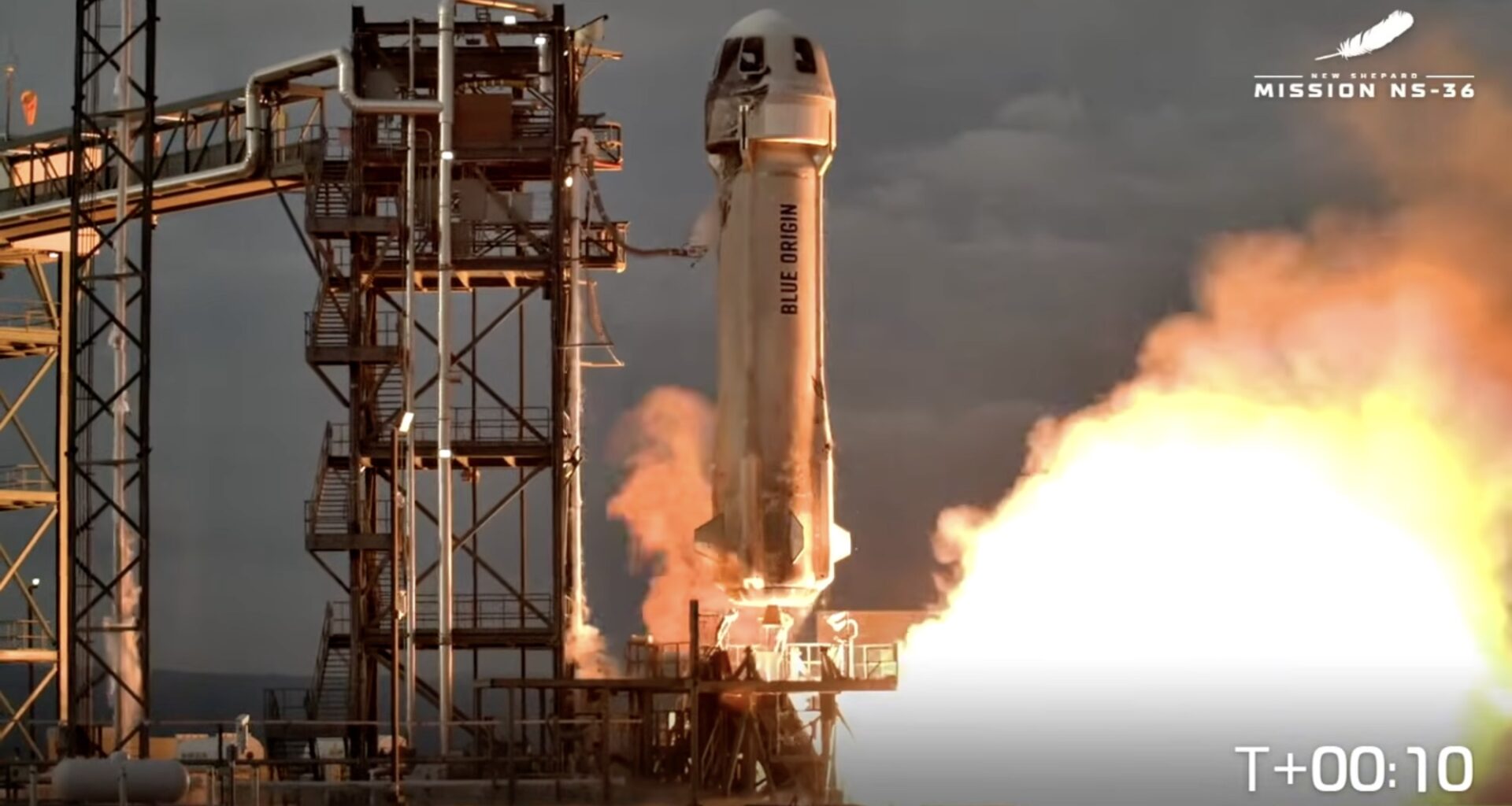
ORLANDO, Fla. — Blue Origin announced Jan. 30 that it will halt flights of its New Shepard suborbital vehicle for at least two years as it shifts its focus to human lunar exploration.
In a statement, the company said it was pausing flight of New Shepard, a vehicle that has flown 38 times since 2015, to concentrate on its lunar programs. Blue Origin said the pause would last “not less than two years.”
“The decision reflects Blue Origin’s commitment to the nation’s goal of returning to the moon and establishing a permanent, sustained lunar presence,” the company said.
The announcement came eight days after the most recent New Shepard mission, NS-38, which carried five paying customers and one company employee who replaced a sixth customer who became ill before launch. The flight followed a typical New Shepard profile, and Blue Origin gave no indication during the webcast that it was preparing to halt vehicle operations.
“As we enter 2026, we’re focused on continuing to deliver transformational experiences for our customers through the proven capability and reliability of New Shepard,” Phil Joyce, senior vice president for New Shepard at Blue Origin, said in a statement after that flight.
Four months earlier, Joyce had said Blue Origin planned to increase the number of New Shepard flights, not suspend them. Speaking at a spaceport conference in Sydney, Australia, he said the company aimed to move to an “approximately weekly” cadence over the next few years, supported by additional vehicles and possible operations from locations beyond Launch Site One in West Texas.
“The demand is really strong,” Joyce said at the time. “We’re continuing to see sales every week, every day.” In its Jan. 30 statement, Blue Origin said it still has a “multi-year customer backlog” for New Shepard.
The company did not explain how New Shepard resources would be redirected to lunar programs or whether the pause would affect jobs.
Accelerating lunar lander plans
Blue Origin is developing its Blue Moon lunar lander, including a Mark 1 uncrewed version and a Mark 2 crewed version for NASA’s Human Landing System (HLS) program. The company recently completed its first Mark 1 lander, which departed its Florida assembly facility Jan. 22 and was shipped to Houston for thermal vacuum testing at NASA’s Johnson Space Center.
Blue Origin has not announced a launch date for that lander. It will not fly on the next New Glenn launch, scheduled for late February. Eddie Seyffert, Blue Origin’s director of civil space, said after a panel at the SpaceCom Expo here Jan. 29 that the lander will spend at least two weeks in thermal vacuum testing on a “green-light” schedule, meaning no major issues. After testing, it will be shipped back to Florida for launch preparations.
NASA has urged both Blue Origin and SpaceX — the two companies selected for HLS awards — to accelerate development of their lunar landers as part of efforts to ensure the Artemis 3 mission launches no later than 2028, a deadline set by a White House executive order in December.
Neither company has disclosed details of its acceleration plans, which NASA is reviewing. “We are looking at a renewed urgency to return to the moon sooner,” said Thomas Percy, manager of systems engineering and integration in the HLS program office at NASA’s Marshall Space Flight Center, during the panel. “We are working with both of our providers to identify ways that we can move faster.”
“Those discussions are ongoing. There’s not a lot I can say about the specifics,” he added.
NASA Administrator Jared Isaacman said Jan. 30 that the agency is prepared to support those efforts. “We are going to do everything we can to enable the acceleration plans that were submitted by both HLS providers,” he said in an interview with SpaceNews.
“We are willing to rethink a lot of our requirements in order to achieve the objective on time,” he said. “We are willing to make available any resources and expertise that we have in order to better set those missions up for success.”
Asked about the acceleration plans during a Jan. 17 news conference tied to the Artemis 2 rollout, Isaacman praised both companies’ proposals without providing details.
“These are both very good plans. I would say they both reduce technical risk from where we were before,” he said. He added that a key factor will be increased launch rates to demonstrate technologies such as in-space propellant transfer, which is critical for both the Blue Moon Mark 2 lander and SpaceX’s Starship.
“So, I’d say if we’re on track, we should be watching an awful lot of New Glenns and Starships launch in the years ahead.”
Related