Even though Operation Midway Blitz may be over, the Trump administration’s immigration enforcement efforts in Chicago are still ongoing.
So too are the legal fights over what happened this past fall, when thousands of people were arrested, detained or deported.
Records reviewed by NBC 5 Investigates show lawsuits filed during the immigration crackdown in Chicago have raised public awareness about both Immigration and Customs Enforcement and Border Patrol tactics and technology.
“As you can see from the public records in this case, we’ve had numerous discovery fights; we’ve been seeking many of DHS’ and ICE’s records about how they are operating that facility at Broadview; how they are holding people, also how they are transferring people out; how their voluntary departures are working; how the access to counsel is being implemented,” said attorney Alexa Van Brunt.
Van Brunt represents a group of now-former immigration detainees who are suing the federal government over conditions at the Broadview ICE facility.
Part of the lawsuit focuses on complaints of overcrowding and dirty conditions from last fall — something the government argues has largely been addressed as conditions were improved, and the number of people there has dramatically reduced since the height of the operation this past fall.
But attorneys for the plaintiffs say they are still concerned about who was processed through the facility, where did they go, how many signed voluntary departure waivers and what might happen if ICE and Border Patrol make good on plans to potentially return en masse to Chicago this spring.
“One of the risks that we are concerned about – is that if immigration enforcement takes a turn again – that all of the sudden that facility could become overcrowded and those rights could be violated left, right and center as they were in the past,” Van Brunt said.
Court records show the government has already shared materials including daily detention logs, emails, photos from a site visit among dozens of other records — but Van Brunt argues they need more – including the immigration files of each detainee.
During recent filings in January, attorneys for the federal government asked the judge to “rein in the plaintiffs’ attempts to seek discovery… beyond what is necessary …” but acknowledge some materials are not available — including surveillance footage – which “due to a technical issue” – did not record at Broadview over an 11-day period between Oct. 20 and 31.
NBC 5 Investigates did reach out to the Department of Homeland Security, and as of Friday, we were waiting to hear back.
A spokesman for the U.S. Attorney’s Office in Chicago said Friday they could not comment while the case is still ongoing.
The government has pushed to dismiss the case. A response to that motion is due by Van Brunt and her fellow lawyers in early February.
Additional hearings are planned in the coming months, including a preliminary injunction hearing both sides are preparing for in April.
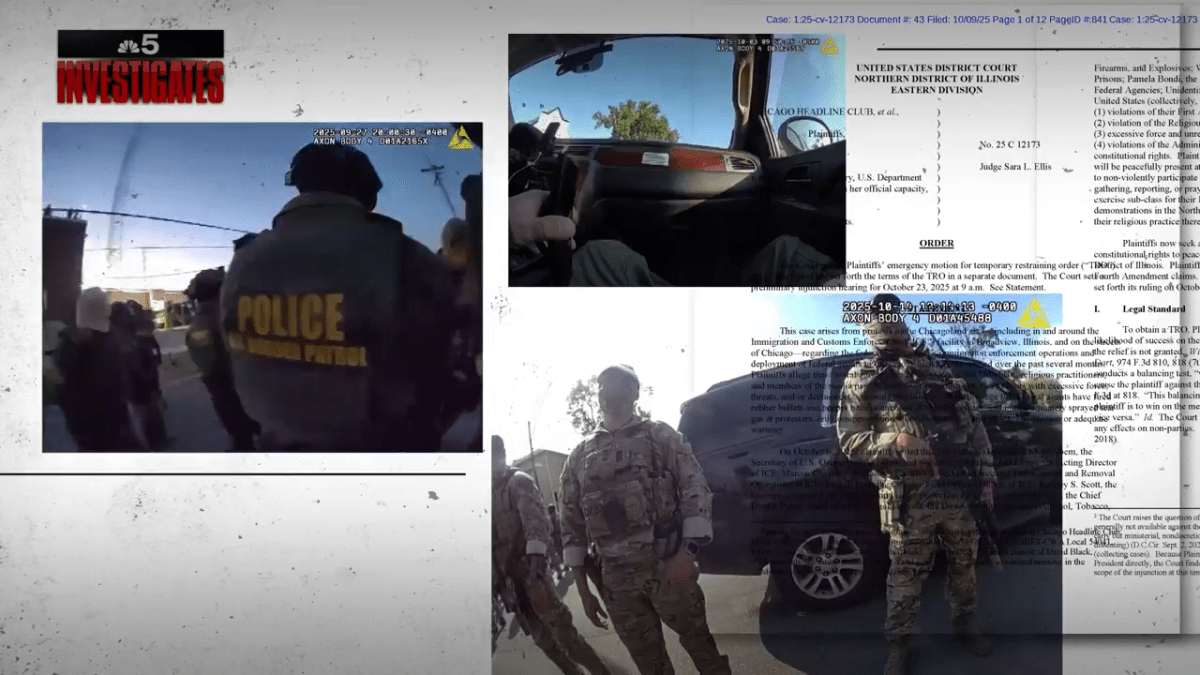
An NBC 5 Investigates’ review of body camera footage from a separate lawsuit over the agents’ use of force has helped lift a veil of secrecy surrounding both ICE and Border Patrol tactics and technology.
Specfically, an NBC 5 Investigates’ review of body camera footage shows the ICE and Border Patrol have – at times – relied on artificial intelligence to aid in enforcement.
An Oc. 3 clip – included in a batch of records from litigation filed over agents’ use of force – shows an agent using ChatGPT to help craft a report.
A recently filed lawsuit by the state of Illinois against the Trump administration alleges that agents used an app called Mobile Fortify to aid in facial recognition of those approached or detained by immigration agents. The Department of Homeland Security acknowledged the app’s use in greater detail this week as part of a federal disclosure document uploaded to the DHS website, NBC 5 Investigates found.
“Great. Here we go. They’re gonna gas them,” one agent can be heard saying on the video. “I grabbed one today but there were no filters left so…”
Another agent then says: “I really didn’t think going to an ICE station was going to be like this.”
Moments later, Border Patrol Commander Gregory Bovino can be heard saying: “Hey, if you got masks, put them on.” Before Border Patrol agents moved toward a crowd of protesters and grabbed shields away from those who gathered.
Minutes later, as one of the protesters is detained, body-camera footage shows a rare glimpse inside the Broadview ICE processing facility, which became a flash point for protests through Operation Midway Blitz.
In another clip from Oct. 14 — where a large crowd gathered in the Near East side neighborhood after agents were involved in a chase and subsequent crash — Chicago police can be seen attempting to disperse the crowd.
An object can be seen being thrown at agents, and seconds later tear gas is deployed.
But another clip shows eight minutes before that happened — one agent can be heard telling another it’s time to go – raising questions about communication on the ground during operations.
The videos and other information related to information enforcement efforts are why those like Van Brunt argue legal fights like hers are necessary.
“I think it has generally been a struggle with an agency that has shrouded itself in secrecy,” she said.