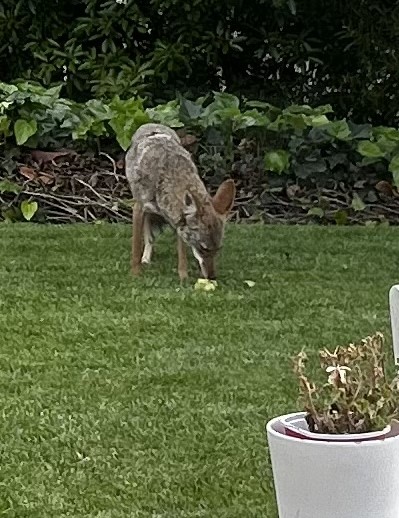
If you’ve ever seen coyotes in your neighborhood, you might want to be on higher alert than usual in coming months.
This is mating season for coyotes, which means that pupping season — when they give birth and rear their young — will soon follow, leading to slight changes in behavior.
“Generally coyotes breed between January and March and typically mate for life,” according to Autumn Welch, wildlife operations manager for the San Diego Humane Society. “So this time of year, you might see juveniles who have dispersed from the pack … looking for their own territory and a mate. You may see them scouting around.”
Coyotes that have already found a mate may use deep bushes for birthing dens, so Welch advises keeping vegetation trimmed so coyotes don’t see it as a place to give birth.
A coyote’s pregnancy is only about two months, and pups are born from March to May, often in litters about four at a time.
The female coyotes often stay with the newborns in the den while the males go out to collect food. Sometimes, siblings from a previous litter will stay and watch the pups. Though the mothers may venture out, it usually won’t be far from the den, Welch said.
After several weeks, pups may start exploring and learning to hunt. At that age, much of a coyote’s diet consists of rodents, small birds, fruit and plants, Welch said. Thus, an added suggestion to avoid attracting coyotes is to pick up any fallen fruit in your yard.
At the same time, Welch said, mother coyotes might become “a little more aggressive or protective because their pups are still vulnerable and young.”
“You might see a coyote follow you, but that could be because you are close to the den and she wants to make sure you stay away from her babies,” Welch said.
Coyotes have “strong family bonds. Like us with our kids, they want their pups to be OK,” Welch said. “It’s just that awareness we recommend people have.”
Over the years, coyote sightings have been reported in La Jolla near schools, the bike path and in residential areas, even during the day, when coyotes typically aren’t seen. They even have been spotted at and near the beach, including Windansea and La Jolla Shores.
In October, three sightings were reported on Colima Street near Bird Rock Elementary School.
And in November, two young children were confronted by a coyote near Westfield UTC mall and a 3-year-old was bitten on an arm and a hip and was taken to a hospital. The other child also was injured and was treated at a hospital.
Still, coyotes “generally avoid humans,” according to the San Diego Humane Society’s website, and wildlife experts say the biggest risk they present in urban areas is to small pets.
The Humane Society recommends that residents take the following measures to prevent confrontation with coyotes:
• Don’t feed pets outside or feed them there for more than an hour, and remove the food and water bowls afterward
• Don’t leave your animals unattended and off leash in public areas
• Don’t feed coyotes
• Practice good housekeeping, removing fallen fruit and using enclosed bins for compost and trash to avoid attracting coyotes
• Leave coyotes alone, and if confronted by one, use “hazing” methods including yelling, waving and making noises. Don’t run away.
Additional guidelines are available at sdhumane.org/resources/coyote-hazing-guidelines. The Humane Society also has fliers with information about coexisting with coyotes at sdhumane.org/resources/wildlife-fliers.
The Urban Coyote Research Project released an article detailing how to prevent conflict with coyotes, noting the importance of coexistence in non-threatening situations.
“Our relationship with coyotes is directly affected by our behavior,” according to the article. “Coyotes react to us, and we can foster mutual respect or a lack of respect through cues we send to them.”
The San Diego County Department of Animal Services oversees wildlife issues but will respond only when a wild creature is posing an immediate threat to humans or other animals. It does not respond to reports of wildlife roaming loose. ♦