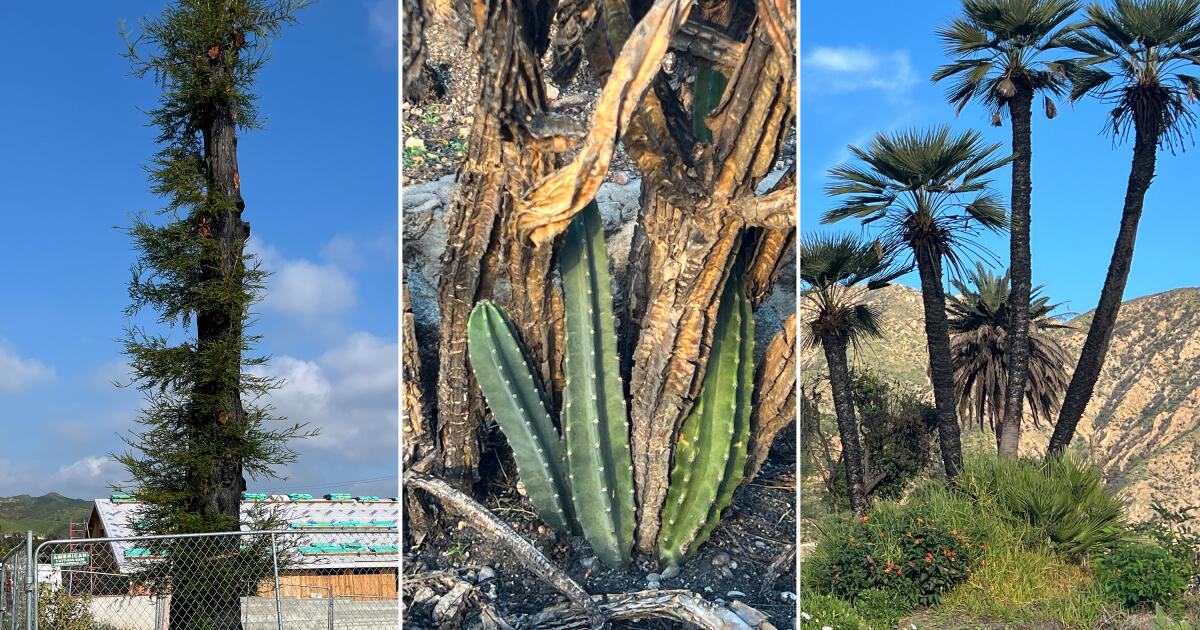
Welcome to February, and if you, like me, had hopes that our tumultuous, rapidly changing world would slow down once we hit 2026, you have my deepest condolences.
These days, it seems like my only solace beyond family and friends is diving so deep into nature, even weeding is a balm. It’s either that or howling, and frankly, pulling weeds is more productive and sometimes even joyful, as when I clear a spot where a volunteer sunflower or sweet pea from last year’s crop is struggling to break through.
Below, as always, you’ll find a good list of upcoming plant-related classes and events. Note that now is the time to prune your fruit trees. (Most Armstrong Garden Centers are offering free fruit tree pruning classes from 9 to 10 a.m. Feb. 7) And if you haven’t pruned your roses yet because they’re blooming, you’re late. Cut yourself a big bouquet and trim spindly, dead or crossing branches to encourage better blooms this spring. (Rose Lane Farms in North Hollywood has some helpful tips.)
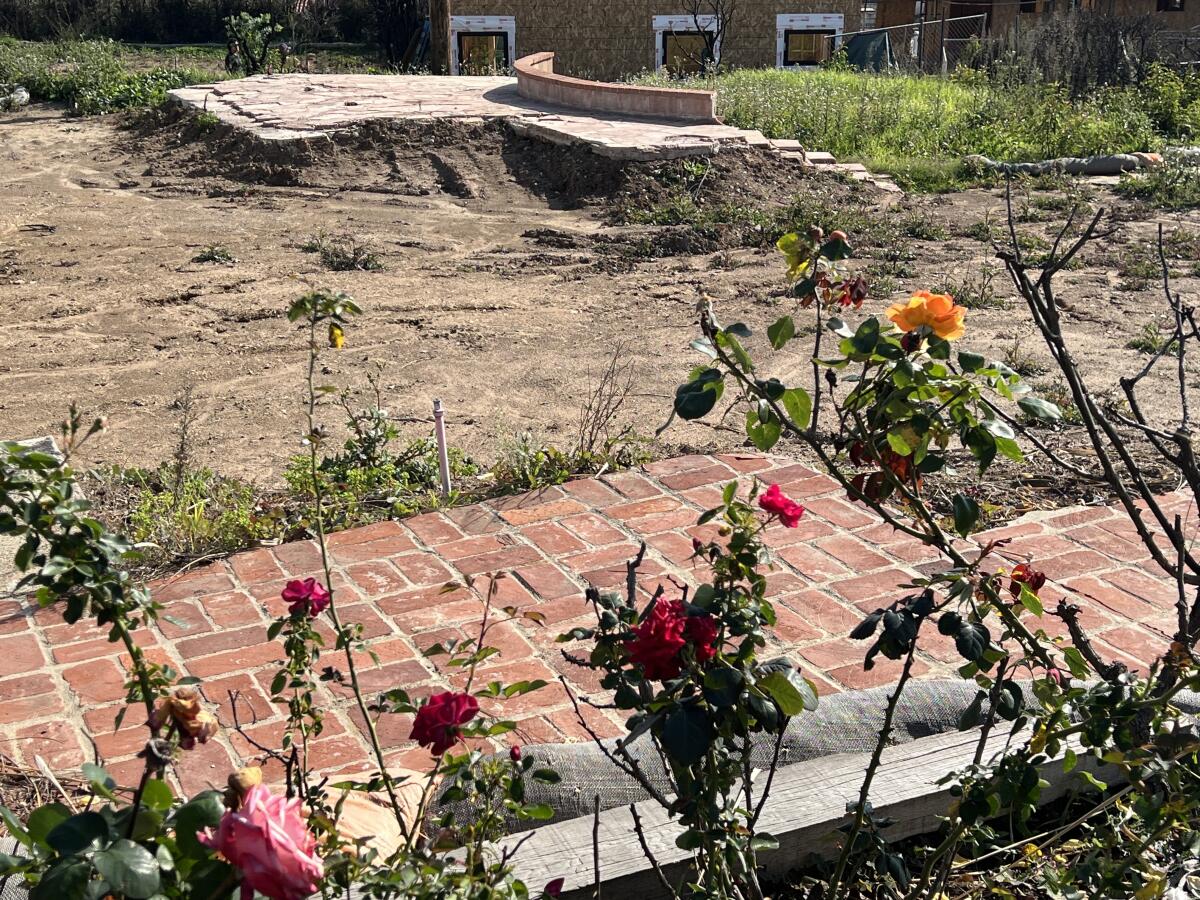
Roses bloom on the edge of a burned, scraped property in Pacific Palisades.
(Jeanette Marantos / Los Angeles Times)
I’m thinking of roses because of an email I received from Tom Carruth, once one of the country’s leading rose breeders who now oversees the Huntington’s extraordinary rose garden.
Carruth, 74, lived in a century-old home in Altadena for 37 years until it burned down in the Eaton fire last January. The night of the fire, Carruth and his husband, Rob Krueger, evacuated to a nearby friend’s home, then evacuated again a few hours later after their friend’s home was threatened.
They spent a few hours at a Red Cross shelter, then drove back to their home shortly after sunrise, in time to see the roof of their East Altadena Drive house ablaze. They just had time to get Krueger’s car out of the garage before their entire house and all its contents were destroyed, including the elaborate decking and water features Carruth had created in the back.
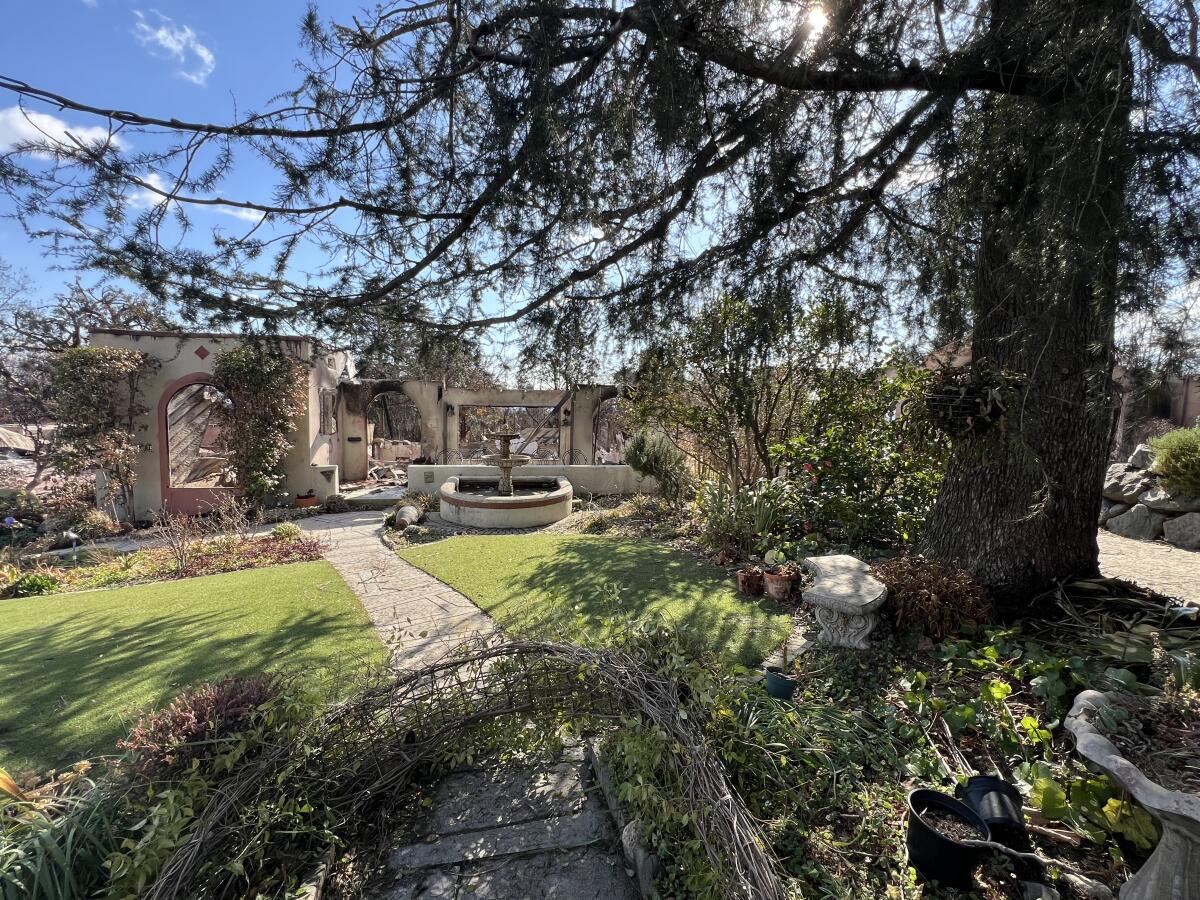
Tom Carruth’s fire-ravaged home and relatively pristine front yard on East Altadena Drive on Jan. 27, 2025, just 20 days after the Eaton fire started.
(Jeanette Marantos / Los Angeles Times)
The eerie thing, though, was that the couple’s sculpted front yard, heavy on roses, bulbs and a 100-year-old deodar cedar, seemed untouched by the flames that upended Carruth and Krueger’s lives.
Plenty of plants were destroyed in the Eaton and Palisades fires, of course, especially highly flammable shrubs like tall, skinny arborvitae. But time and again, as I drove through the smoking ruins of Altadena, Pacific Palisades and Malibu days after the fires, I saw trees and plants unfazed by the flames that devoured structures just a few feet away.
At the time, it felt surreal, seeing so much greenery in the midst of such destruction, almost a mockery of human suffering. But a year later, the fact that so many plants survived and continue to thrive seems almost miraculous.
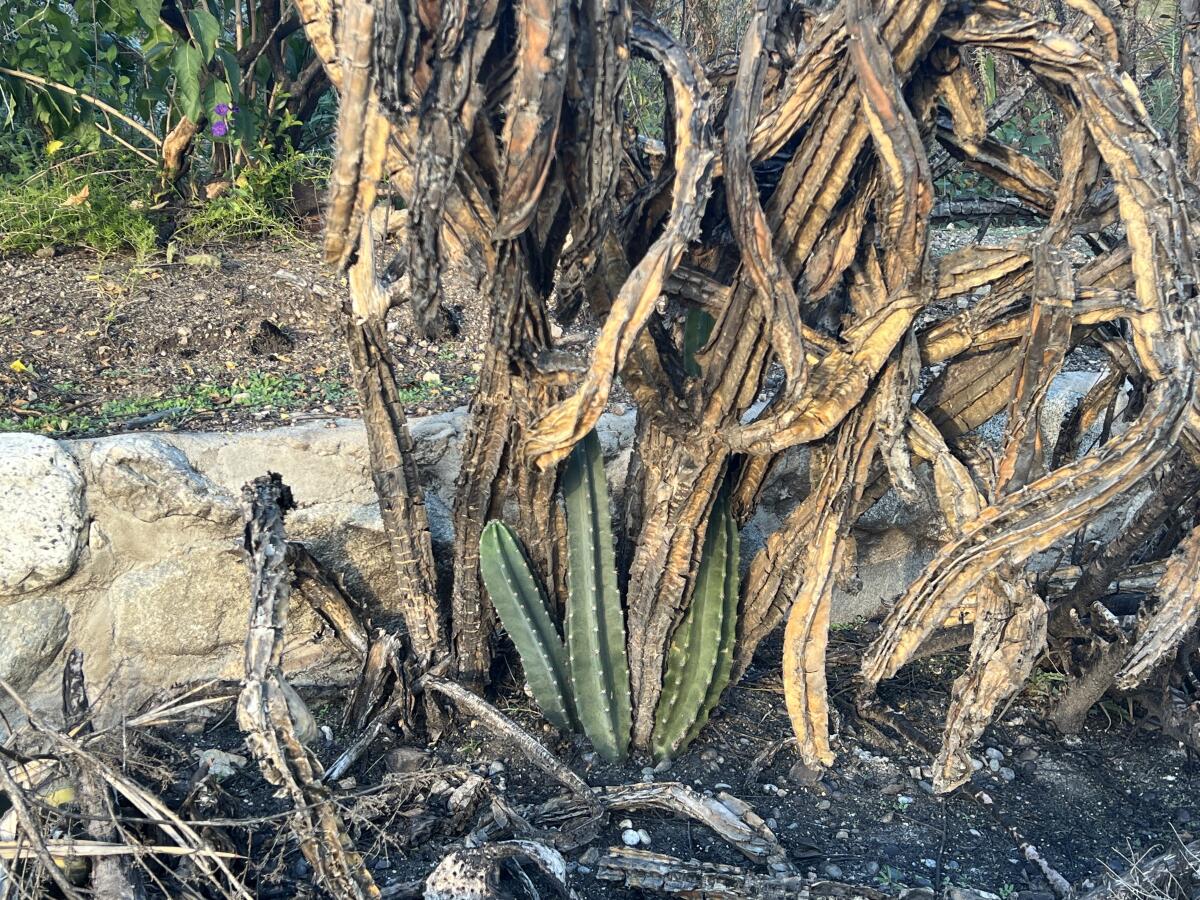
Fire desiccated a giant tangled cereus cactus on Alta Pine Drive in Altadena, but new growth is literally sprouting from the ashes.
(Jeanette Marantos / Los Angeles Times)
That’s what Carruth wanted to talk about when he emailed me in January. He won’t rebuild — at his age, he said he doesn’t want to spend the next two years worrying about construction. He and his husband were lucky enough to find a beautiful rental home in West Altadena, just outside the burn area, and he avoids visiting his old neighborhood because it’s so sad. But his friend and former colleague Gary Roberson, creator of the cycad garden at the Huntington, recently got him thinking about all those plants that survived, such as his beloved deodar cedar.
“I had friends with a cycad [a.k.a. sago palm] in a pot that had all its foliage burned off, but it’s coming back,” Carruth said. “At my house, I’ve noticed my lantana bouncing back, and you can see how bougainvillea and Washingtonia palms [Mexican fan palms] are still lining the streets. Plants have a lot more resilience than we give them credit for.”
That’s Roberson’s message too, which he shared during a phone interview in January. “Don’t give up on your plants,” he said, especially after a trauma like fire. “If they can survive all that, they will be a treasure.”
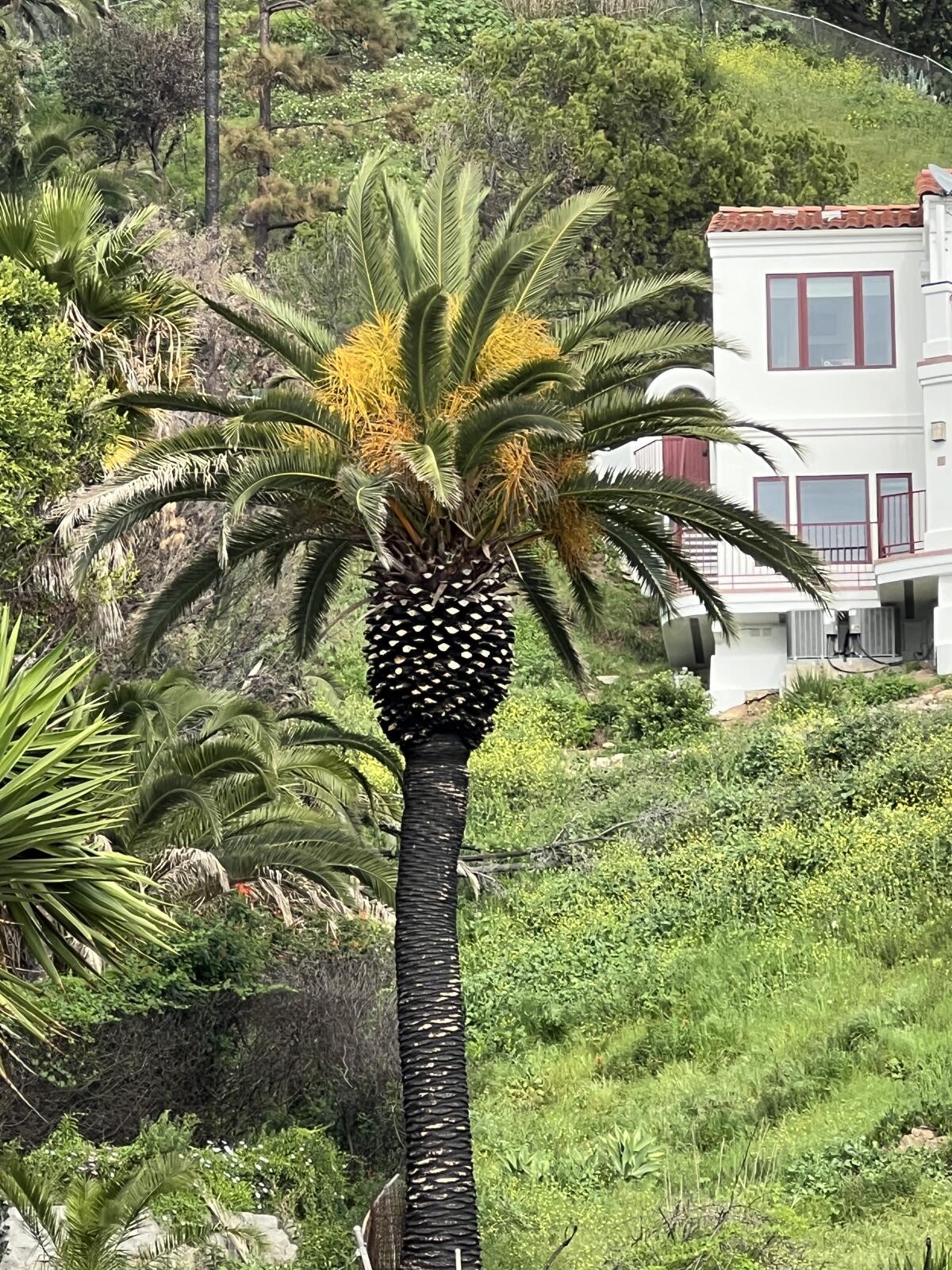
A Canary Island date palm along Pacific Coast Highway in Malibu stood right in the path of the Palisades fire and was flanked by homes that burned. A year later, it appears to be thriving despite its deeply blackened trunk.
(Jeanette Marantos / Los Angeles Times)
A few weeks ago, I spent several afternoons driving around the fire areas in Altadena, Pacific Palisades and Malibu to photographed plants — including supposedly finicky roses! — that not only outlived the fire, but also the neglect that came afterward when there wasn’t any water for irrigation.
What I saw seemed to validate arborists and community groups such as Altadena Green, who lobbied hard to keep people from cutting down trees that were singed in the fire, but still alive.
Scorched trees as well as burned-up plants such as banana trees, birds of paradise and succulents were sprouting healthy, new growth out of the ruins of their charred stumps. Blooming roses, giant pink hibiscus and sunny coreopsis hugged the edges of properties where the land had been scraped to remove burned debris. Many palms with deeply black trunks were sprouting vividly green tops.
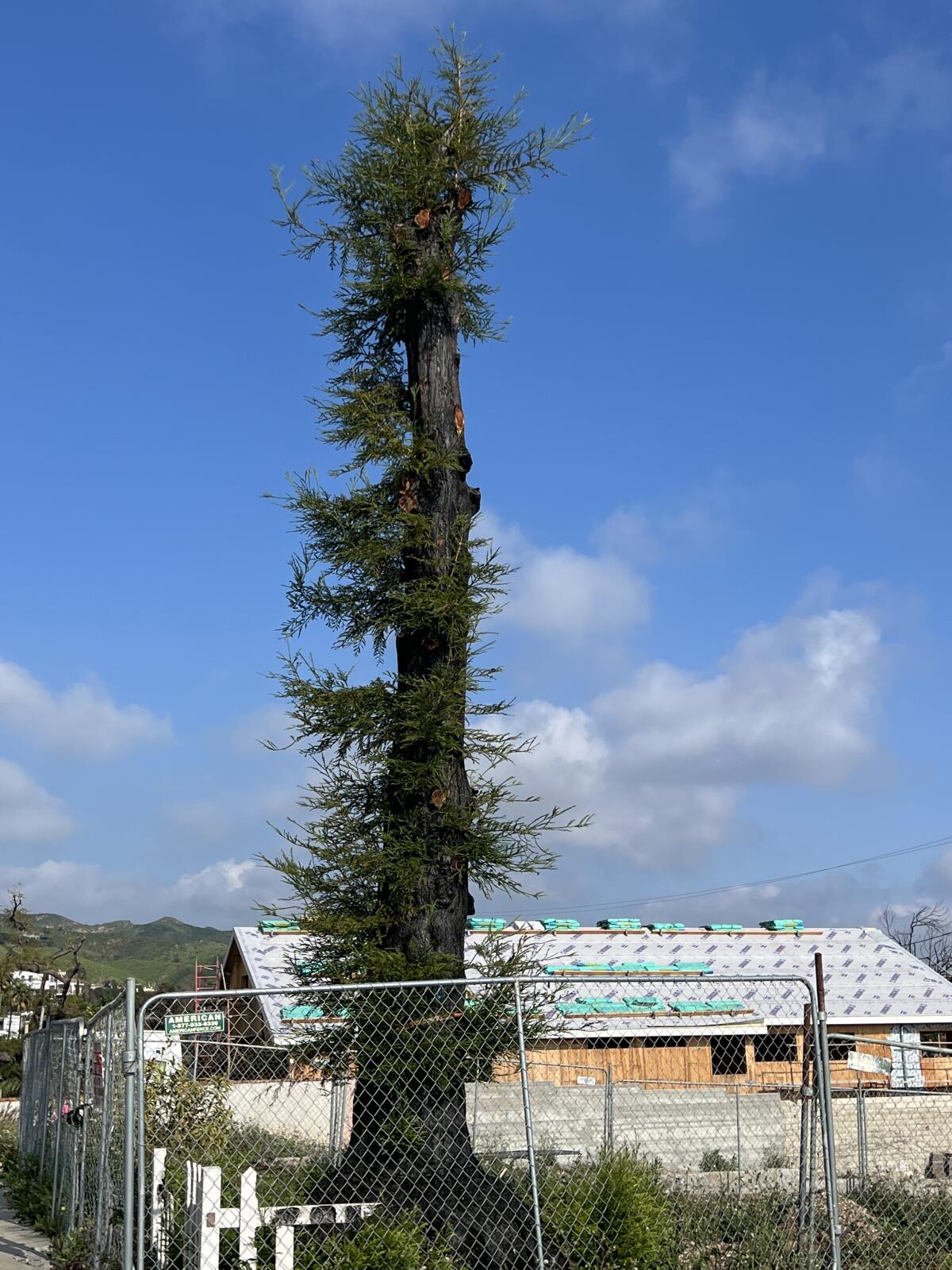
A tall, blackened cedar tree with all its limbs removed is sprouting new growth on Edgar Street in Pacific Palisades a year after the Palisades fire.
(Jeanette Marantos / Los Angeles Times)
TreePeople, a nonprofit organization devoted to planting and maintaining trees in urban and wild areas of SoCal, recently reported a similar phenomenon around Castiac Lake, where the Hughes fire burned 10,000 acres in late January 2025, including 25 acres where the organization had been planting seedlings to restore native chaparral oak woodlands. Within just two months, the organization began to see signs of the seedlings resprouting on the charred land and growing taller than they’d observed before the fire, according to the group’s website.
During my drives around the Eaton and Palisades burn areas, I saw ficus trees trained into tall privacy hedges, burned to a crisp on one side and growing lushly on the other. Many giant oaks, conifers, sycamore and eucalyptus towered over empty, broken lots, apparently unscathed.
What amazed me the most was the remains of what appeared to be a tall conifer — possibly a cypress or cedar — on Edgar Street in Pacific Palisades, where the Palisades fire ravaged an entire street. All this tree’s limbs had been removed and its trunk looked charred from top to bottom. At first glance, it resembled a tarred telephone pole. Yet up and down the trunk, the tree was circled with new feathery foliage, vibrantly green and healthy.
It’s like the 5-foot tall cycad next to the old Everest hamburger restaurant on Lake Avenue at East Mendocino Street, Roberson said. The building burned to the ground and the soil has been scraped, but that blackened sago palm is still there, sprouting tons of new growth.
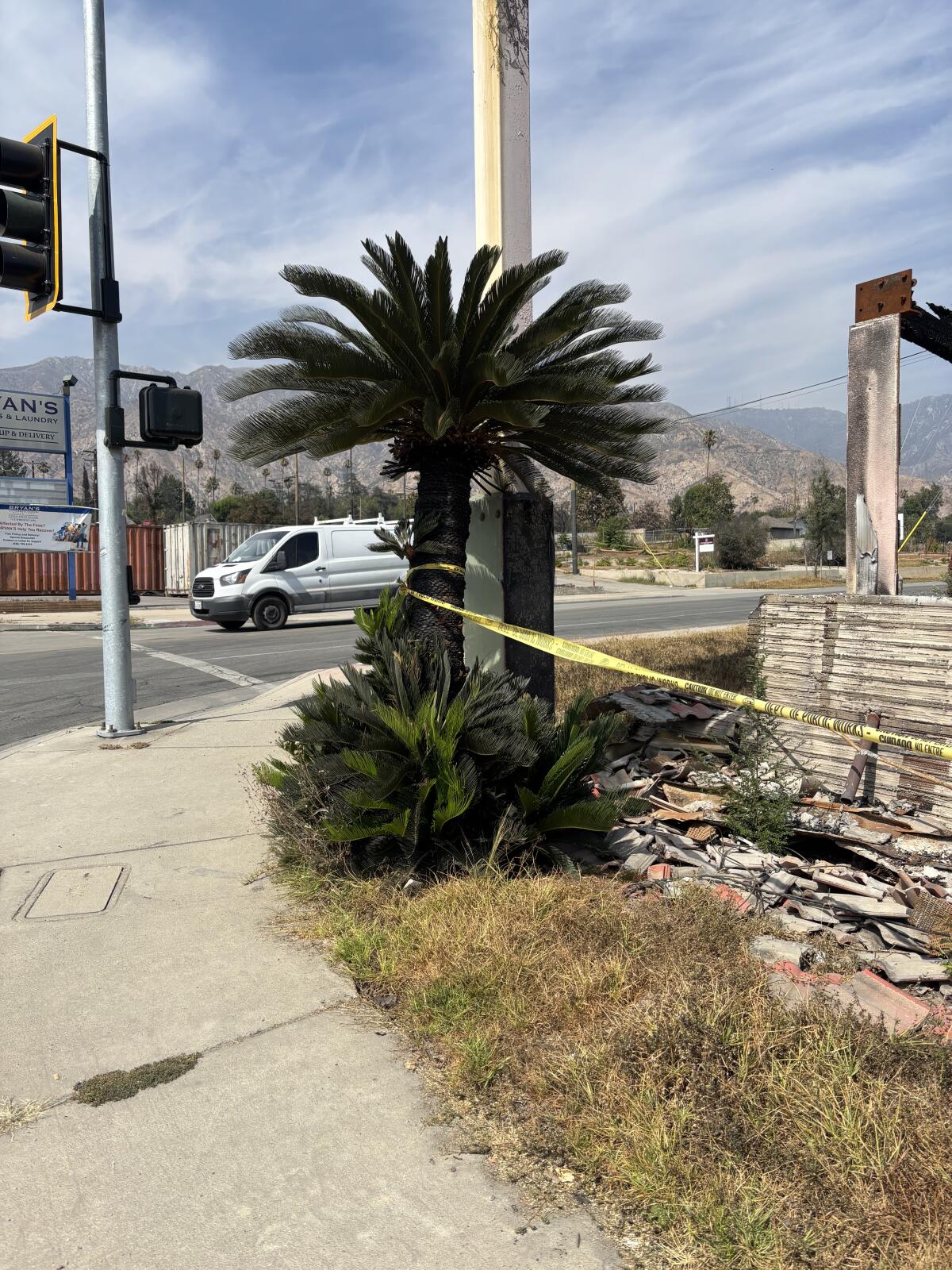
A blackened cycad known as a sago palm (Cycas revoluta) defiantly sprouts abundant new growth next to the fire-ravaged Everest hamburger restaurant on Lake Avenue and East Mendocino Street in Altadena on Aug. 4, 2025. “They thrive on neglect,” said cycad expert Gary Roberson.
(Gary Roberson)
All that defiant growth is understandable, Roberson said. “Plants grow with more vigor after they’ve been threatened,” he said. “Their natural defense is to bloom, to produce more seed. In our rush to sanitize everything [after the fires], we may have pushed away things that didn’t need to be removed. It’s like after a big frost or freeze, you need to always step back and see what happens [to the plant] before you get rid of it.”
Roberson also lost his Altadena home in the fire and has shared a home with friends this past year while he sorted out his future. He was already planning to retire from the Huntington at the end of 2025, after 20 years, and in January, he moved back to his childhood home in Rochester, Wash.
He’s still rooting hard for all of Altadena’s fire survivors, flora and fauna. “It shows me hope that everything will come back,” he said. “Their resilience is a hopeful sign that we’re going to recover.”
 You’re reading the L.A. Times Plants newsletter
Jeanette Marantos gives you a roundup of upcoming plant-related activities and events in Southern California, along with our latest plant stories.
By continuing, you agree to our Terms of Service and our Privacy Policy.
Free lawn-free landscapes
The city of Los Angeles’ Department of Water and Power is offering free turf removal, plants, landscape plans and installation of drip irrigation systems to eligible homeowners through the Landscape Efficiency Assistance Program. Applicants must have an LADWP account, proof of property ownership, between 1,000 to 3,000 square feet of green lawn in their front yard, rain gutters on the front of their house and live in an eligible community.
If you don’t qualify for the LEAP program, there’s still LADWP’s $5-per-square-foot turf replacement rebate available to all single-family residential customers. Pre-approval is required, so look at the rules before you start ripping out your lawn to be sure you qualify.
A ‘slimy good time’ returns
SNERCH, a.k.a. the Natural History Museum of Los Angeles County’s Snail Search Community Science Project, starts Sunday through March 31, giving community scientists a chance to photograph as many slippery, slimy slugs and snails as they can find in Southern California.
Best photos can win a prize, but all the submissions will help researchers track what’s out there in the snail-slug world and better understand the complicated lives of these under-studied creatures.

Consider subscribing to the Los Angeles Times
Your support helps us deliver the news that matters most. Become a subscriber.
Upcoming events
Feb. 1 and 15
Volunteer Water Days at the Westwood Greenway, 10 a.m. to noon in Rancho Park. Volunteers capable of carrying 3 gallons of water over rocky ground are needed to water newly planted native shrubs and trees along the greenway to help them get established before the summer. Register online. westwoodgreenway.org
Feb. 3
Birds, Bees and Butterflies: Creating a Pollinator Garden, a free class taught by Dani Brusius, a UC Master Gardener of Ventura County, from 6 to 7 p.m at the Camarillo Library in Camarillo. ucanr.edu
Feb. 4
Healthy Vegetable Community Gardens, a talk by Master Gardener Maria Delgadillo at the Cherry Blossom Garden Club from 11 a.m. to noon at the Sepulveda Garden Center in Encino. Admission is free. facebook.com
Feb. 6, 13 and 27
3-Part Native Garden Design, a workshop for planning a new garden, complete with irrigation systems, taught by Steve Gerischer, past president of the Southern California Horticultural Society and the Pacific Horticulture Society, 9:30 a.m. to 1:30 p.m. each day at the Thedore Payne Foundation in Sun Valley. Note that the foundation’s online introductory class, “Right Plant, Right Place,” is a prerequisite for the design course. Tickets are $396.11 or $471.96 for two adults working on one garden design. (Members get 25% discount.) events.humanitix.com
Feb. 7-8
The Southern California Camellia Society’s 52nd Camellia Show, 1 to 5 p.m. on Feb. 7 and 10 a.m. to 5 p.m. on Feb. 8 at the Huntington in San Marino. The show is free with $34 admission to the garden ($28 for seniors 65 and older, military and students with ID, $15 ages 4-11. Members and children 3 and younger enter free.). huntington.org
Feb. 7
Build It. Fix It. Love It: Trail Crew Introductory Class With the Palos Verdes Peninsula Land Conservancy, a free class in trail building and maintenance with classroom training followed by hands-on field training during future workdays. It’s from 10 a.m. to 1 p.m. at the Ladera Linda Community Center in Rancho Palos Verdes. Students must be at least 18. Free, but registration required. pvplc.volunteerhub.com
Feb. 8
Pachypodiums, In the Field, Garden, and Greenhouse, a talk by cactus expert Woody Minnich at 11 a.m. during the South Coast Cactus & Succulent Society meeting at the Fred Hesse Jr. Community Park McTaggart Hall in Rancho Palos Verdes. Admission is free. southcoastcss.org
Feb. 10
Bluebird conservation, nestboxes and monitoring, a talk by members of the Southern California Bluebird Club at the Orange County Organic Gardening Club meeting, 7 p.m. at Centennial Farm in the Orange County Fairgrounds in Costa Mesa. instagram.com
Botanizing the Remote Corners of Colombia, a talk by photographer and horticulturist Dylan Zoller, from 7 to 8 p.m. at the Sherman Library and Gardens in Corona del Mar. Tickets are $20 ($10 members). thesherman.org
Feb. 13
Ventura County GSOB Blitz 2026, a chance for adult volunteers to help search for gold-spotted oak borers, a.k.a. GSOB, small beetles that have killed thousands of Southern California’s oak trees in San Diego, Orange, Riverside and Los Angeles counties, and are now threatening oaks in Ventura County. The “blitz” includes training in how to spot infestations, from 10:30 a.m. to 2 p.m. at the Las Llajas Trailhead in Simi Valley. Register online. ucanr.edu
Feb. 14
Open Farm Day at Black Thumb Farm, 1:30 to 3:30 p.m. in Panorama City. Learn practical garden tips by helping with chores at this urban farm. This monthly event is free, but registration is required. mobilie.us/blackthumbfarm
Feb. 15
Point Vicente Interpretive Center Garden renewal, a free monthly volunteering event, typically the third Sunday of the month, sponsored by the South Coast Chapter of the California Native Plant Society, 10 a.m. to noon. chapters.cnps.org/southcoast
Feb. 21-22
PlantCon Los Angeles, a convention of plant-related seminars, workshops and sellers, from 10 a.m. to 6 p.m. each day at the Magic Box in downtown L.A. Admission for the two days with access to all on-site presentations is $49.39 for adults. Single-day tickets for children are $16.46 and must be purchased with an adult ticket. plantcon.org
Feb. 27-March 8
Tomatomania! kicks off the 2026 season of pop-up sales at Roger’s Gardens in Corona del Mar, offering 250 tomato varieties. The Tomatomania season extends through April 19 in Southern California, with 13 sales events in San Diego, Los Angeles and Ventura counties. Admission is free. tomatomania.com
Feb. 27
Drip Irrigation Workshop for Native Plant Gardening, taught by Theodore Payne Foundation horticulture director Tim Becker, from 9 to 11 a.m. at the foundation’s Los Nogales Nursery in Ernest E. Debs Regional Park in Montecito Heights. Register online, $69.90. (Members get 25% discount.) events.humanitix.com
Feb. 28
Fire-Resilient Gardens: A Maintenance Walk and Talk with Theodore Payne Foundation educator Erik Blank, 9 to 11 a.m. at the nursery in Sun Valley. Reserve tickets online, $56.36. (Members get 25% discount.) events.humanitix.com
Bonsai Celebration, from 10 a.m. to 5 p.m. at the Huntington in San Marino. The show is free with $34 admission to the garden ($28 for seniors 65 and older, military and students with ID, $15 ages 4-11. Members and children 3 and younger enter free.) huntington.org
Feb. 28-March 1
Ikebana Show 2026 — Joyful Flowers: the Japanese Art of Floral Arranging, presented by Ikebana Lessons and the MOA Group, from 10:30 a.m. to 4 p.m. at the Sherman Library and Gardens in Corona del Mar. The show includes vendors selling ikebana supplies and bouquets as well as free demonstrations at 11:30 a.m. each day explaining how to create simple ikebana arrangements. Free with $5 admission to the garden (members and children under 4 enter free). thesherman.org
What we’re reading
It may not look like anything is happening on the Wallis Annenberg Wildlife Crossing in Agoura Hills. But the work is hard to spot from the road and is progressing on schedule for a November opening, the builders say.
All that hot weather in early January was lovely, but it could spell doom for a wildflower superbloom this spring.
Better drive it while you can, because it’s harder to keep California’s iconic Pacific Coast Highway open against the onslaught of climate change up north around Big Sur and even here in the narrow stretch between Malibu and Oxnard where the sea is slowly pounding away at the highway’s foundations.