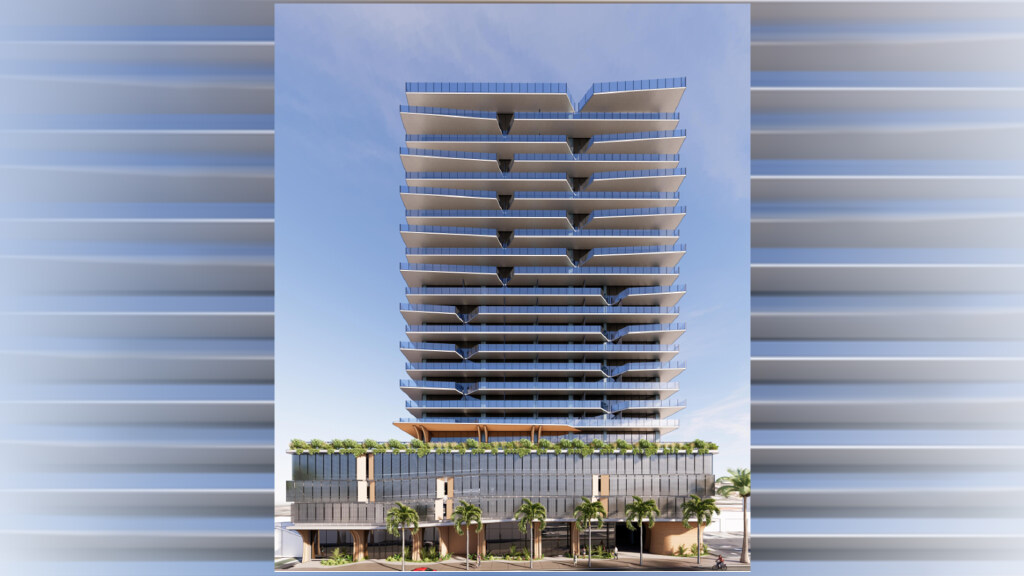
Nearly two years after submitting an initial application to build a mixed-use tower in Pacific Beach, the developer behind the project, sometimes referred to as Project Vela, has made little progress in convincing the city of San Diego that its unconventional application of local and state laws to breach, by an order of magnitude, the neighborhood’s height limit is lawful.
The parties appear at an impasse.
City staff maintain that the project, which calls for 139 hotel rooms and 75 apartments atop ground-floor shops on a 0.67-acre site, is not legal in its current form, primarily because the developer plans to treat the visitor accommodation units as long-term rentals.
In a Dec. 23 letter, San Diego’s Development Services Department said it could not approve the fourth iteration of the project from real estate investment firm Kalonymus Development Partners LLC, citing insufficient and conflicting information.
Matt Awbrey, a spokesperson for Kalonymus, said the developer plans to resubmit the project for a fifth time.
“The applicant fundamentally disagrees with the city’s assessment of the project and its current review status, and believes staff is on the verge of setting a dangerous precedent that sends a message to every homebuilder and developer that the city is willing to politicize its ministerial approval process even if you play by the rules,” Awbrey said in a statement to the Union-Tribune. “The applicant looks forward to continuing to work with city staff on this project, and is therefore in the process of providing a formal response to the city.”
The city and the developer can continue to go back and forth in what they both describe as an iterative process, but the differing positions suggest that the matter may eventually come to a head in the courtroom.
In March 2024, Kalonymus submitted a preliminary application to build a mixed-use tower with 22 stories and a rooftop deck at 970 Turquoise St. in Pacific Beach. The early submission process was created by the state Legislature in 2019, as part of Senate Bill 330, to allow developers to apply with just a subset of project information while simultaneously freezing development standards. The law aims to assist housing projects, making them subject only to the policies in effect at the time of submission.
The project, often called the Turquoise tower, is also leaning on another state law, California’s density bonus law, to bypass the neighborhood height limit, boost its residential unit count and maximize commercial density.
The Pacific Beach parcels in question, home to the shuttered French Gourmet restaurant and other businesses, are just blocks from the ocean. Here, San Diego’s Coastal Height Limit Overlay Zone prevents buildings over 30 feet tall. The local coastal zone was established by a 1972 voter initiative and is distinct from the California Coastal Act of 1976.
The Turquoise project, by contrast, is said to stand 239 feet high, as measured from the ground to the roof. It may stretch as high as 269 feet by other city measurement standards.
Density bonus law has been expanded over the years to incentivize development of income-restricted residential units. Under the law, housing developments that deed-restrict a percentage of residential units for very-low, low- or middle-income families are eligible for density bonuses. The projects are also entitled to waivers from development standards that would otherwise render a project impossible, as well as incentives that reduce the cost to build the rent-restricted units.
California’s Department of Housing and Community Development has said previously that the height limit is a development standard that conflicts with density bonus law and has no authority over projects that meet the law’s affordability thresholds.
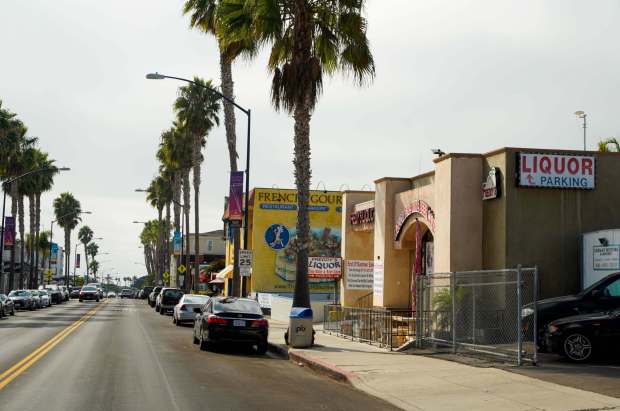 A view of Turquoise Street in Pacific Beach, where Kalonymus is planning to build a mixed-use tower. The site includes the recently shuttered French Gourmet restaurant and bakery. (Alejandro Tamayo / The San Diego Union-Tribune)
The Turquoise project is setting aside 15% of the 32 residential units allowed under the base zone, or five units, for very-low-income households. The developers are also setting aside 15% of the 32 residential units, or five units, for moderate-income households. As such, the project is eligible for two 50% bonuses, one for each of the subsidized unit types. The project is also eligible for an 11-unit, local density bonus because it includes three-bedroom units.
With the bonuses applied, the number of residential units allowed on the site is 75.
The applicant is also seeking a density bonus incentive to exceed the base floor area ratio, or FAR, for the site, which would allow for 139 visitor accommodation units.
The hotel rooms are designated as commercial in nature, but the developer has said it plans to rent them as market-rate apartments.
The city’s municipal code allowed the long-term rental of visitor accommodation units under the version of the code that was effective at the time the developer submitted its preliminary application. The regulations were later changed, effective as of October 2024, to clarify that visitor accommodation lodging, other than single-room occupancy units, can no longer be used for stays of more than 30 days.
The Turquoise tower has drawn the ire of community members and political leaders who view the high-rise as an affront to the low-rise neighborhood and believe the developer is exploiting well-intended policies.
State Sen. Catherine Blakespear, D-Encinitas, authored legislation, sponsored by San Diego Mayor Todd Gloria, to close a perceived loophole that the politicians said allowed Kalonymus to misuse the density bonus law to create a supersized commercial project with limited housing.
Marcella Bothwell, who leads the vocal opposition group Neighbors For a Better California, has referred to the Turquoise tower as “a big middle finger to the neighborhood.” Her group is actively raising money to fight the developer in court, should the city approve the project.
City staff’s primary issue with the project, at least on paper, is that the proposed hotel rooms will be used as residential units.
“The applicant’s strategy is to call the units commercial for some purposes and residential for other purposes, but the city needs clarity in order to perform its duties,” the Dec. 23 letter states. “The applicant has stated that these units in question will provide housing … but for purposes of using (density bonus law), including to increase the height of the structure from 30 to approximately 269 feet, it states the units are for visitors.”
A city spokesperson said the developer cannot call the units visitor accommodations for one purpose and housing for another. The city, the spokesperson said, needs the developer to assign one unit type so that it can apply the correct set of rules.
“Based on the information available, the units in the building are indistinguishable as to land use: they are all designed to function as residential dwelling units. This means that the project proposes 214 dwelling units,” Keely Halsey and Gary Geiler, assistant directors in the city’s Development Services Department, wrote in the Dec. 23 letter. “This number far exceeds the number that could be achievable through even the most lenient density calculations allowed by the law.”
Kalonymus has two options, the letter states. It can either revise the project with an allowable number of units, or it must prove that the commercial units are for visitors.
The developer has identified a third option.
In recent months, Kalonymus has invoked another state law, Assembly Bill 130, to force the city to issue the building permit. The law, which went into effect at the end of June, extends the protections of the Permit Streamlining Act to ministerial projects, or those that must be approved if they comply with regulations. The law requires public agencies to make a decision on a housing development project within a set timeframe, and deems the failure to act as an approval.
On Sept. 23, a lawyer representing Kalonymus informed the city that the project was deemed approved because the city did not act within 60 days of the project’s third submission on July 24.
“Given the impact of recent changes to the (Permit Streamlining Act), we are requesting the city’s acknowledgment that the project has been deemed approved by operation of law, and an explanation of the city’s timeline to issue the permit so that construction can commence immediately,” Timothy Hutter, an attorney with Allen Matkins Leck Gamble Mallory & Natsis LLP, wrote.
Hutter followed up with a second letter on Oct. 22.
“For purposes of the city’s analysis of the project’s eligibility for (density bonus law) benefits and other development rights, those issues should be treated as closed,” he wrote. “The city’s discretion was always severely limited for this project, and the earlier failure to timely respond caused the project to be approved by operation of law.”
The city, through the spokesperson, said it does not agree with the developer’s interpretation of the law.
“The city has reviewed each submittal and provided detailed comments to the applicant explaining where the plans are inadequate, unclear or incorrect. Currently, the plans are still noncompliant. The applicant is free to resubmit corrected plans,” the spokesperson said. “It is wholly unreasonable for an applicant to draw out the review process by failing to make corrections after being told multiple times, and then claim that the passage of time gets them out of having to make the corrections. This is not a good-faith tactic. The city has a responsibility to the public and future users of the building that it actually complies with code.”
Kalonymus is a self-described boutique firm that specializes in multifamily, mixed-use and opportunistic investments. The firm was started by Max Zeff, who previously worked at multifamily housing developer Carmel Partners. The Turquoise project architect is Carrier Johnson + Culture.