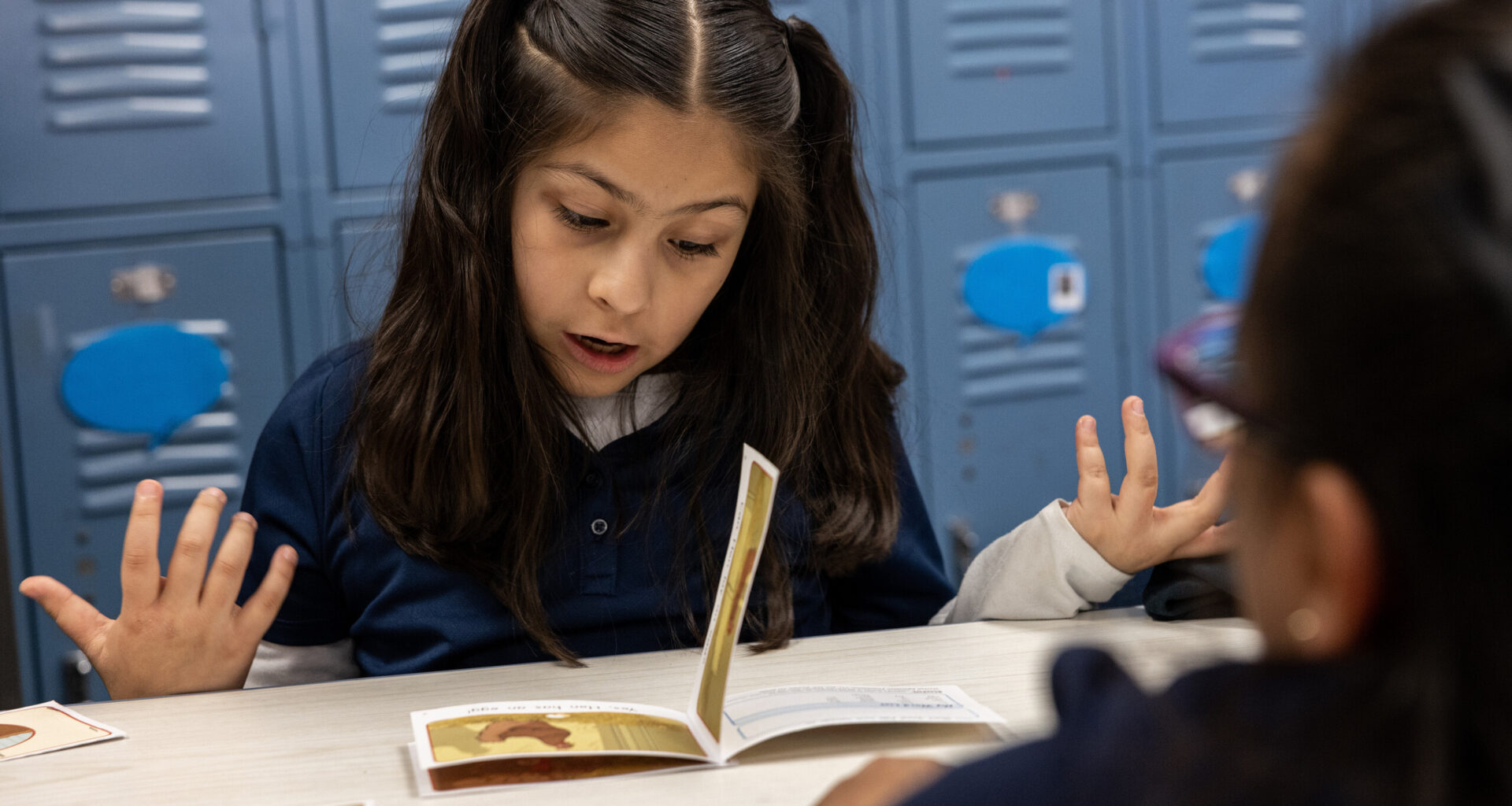
When it’s time for independent reading in her second-grade class, Destiny Burrola gets excited.
Reading feels great, she said. She’s really good at it, adds. But there’s another reason Destiny has fallen in love with reading time.
“It looks like peace and quiet, and you’re hearing some ASMR-sounds, so you can go to sleep,” she said, referring to gentle, calming noises.
But she still reads?
“Yeah,” Destiny said. “I always finish my book.”
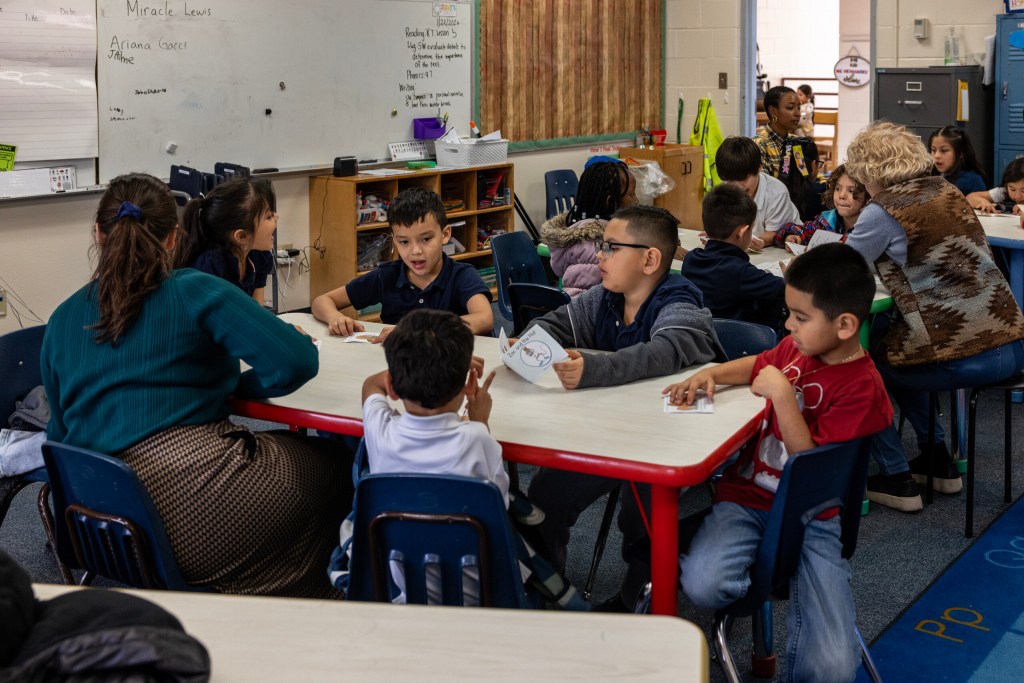 Volunteers support students in Bookworms at E.M. Daggett Elementary School with reading on Jan. 22, 2026. Pre-K to second-grade students who attend the after-school program work to improve their reading skills. (Maria Crane | Fort Worth Report/CatchLight Local/Report for America)
 Second grader Destiny Burrola holds up “Hen” during Bookworms, an after-school reading program at E.M. Daggett Elementary School, on Jan. 22, 2026. Bookworms provides materials for students to use in the classroom and at home with family members. (Maria Crane | Fort Worth Report/CatchLight Local/Report for America)
Destiny is among dozens of Fort Worth ISD elementary students taking part in Bookworms, a free after-school literacy program that provides small-group support to students selected by educators based on academic need.
At E.M. Daggett Elementary, where Bookworms meets once a week, students rotate through groups based on skill level.
A reading specialist helps students at one table sound out short sentences using picture clues. Some trace the words with their fingers before reading aloud; others glance back at the pictures for reassurance.
Another group is playing a bingo-style game with the students circling matches as they scan cards filled with three-letter words.
“This game we will play using rhyming words,” the instructor tells the students as they hover over cards, crayons ready.
 Second grader Iden Rodriguez listens for words to rhyme and complete his bingo during Bookworms, an after-school program at E.M. Daggett Elementary School, on Jan. 22, 2026. Students listened for a word and had to find a rhyming match on their bingo cards. (Maria Crane | Fort Worth Report/CatchLight Local/Report for America)
The approach emphasizes phonics and reading comprehension — foundational skills that literacy specialists say many students still struggle with, explains Epiphany Moore, who oversees developing such lessons for Literacy United, the nonprofit that operates Bookworms.
“They struggle the most with those phonic skills,” Moore said. “More specifically, blending and segmenting with sounds seems to be a huge challenge for them.”
Students arrive with different needs, she said. Some can recognize letters and sounds while others cannot, requiring instruction to be tailored in real time.
“What we try to do is take more of a holistic approach where we can individualize in some ways but meet everyone’s needs,” she said.
 Jehoshaphat Mwamba reads out loud during Bookworms, an after-school program at E.M. Daggett Elementary School, on Jan. 22, 2026. Bookworms provides additional reading support to five elementary schools in Fort Worth ISD. (Maria Crane | Fort Worth Report/CatchLight Local/Report for America)
For some students, progress shows up quickly.
“I used to not know how to read,” second grader Iden Rodriguez said. “But now I know.”
Asked how reading feels, he didn’t hesitate.
“I feel happy,” Iden said. “I love reading a lot.”
His favorite book is “Dog Man,” a pick he shares with Destiny.
Bookworms serves students at five Fort Worth ISD elementary campuses and is offered at no cost to schools or the district. The program operates amid persistent literacy challenges in Fort Worth ISD, where many students still struggle to read at grade level.
Bookworms campuses in Fort Worth ISD
The free reading program serves elementary students at five Fort Worth ISD campuses:
- E.M. Daggett Elementary
- Alice D. Contreras Elementary
- De Zavala Elementary
- George C. Clarke Elementary
- Van Zandt Guinn Elementary
 Students work with a volunteer during Bookworms at E.M. Daggett Elementary School, on Jan. 22, 2026. Each student had a turn to read out loud at their table. (Maria Crane | Fort Worth Report/CatchLight Local/Report for America)
“This is an opportunity for early reading intervention for the students that need it most,” said Kendall Miller, Literacy United’s director of outreach and talent management.
Students in the Bookworms program showed measurable academic gains during the 2024-25 school year, according to an independent evaluation conducted by Celia Scott, an associate professor of education at Tarleton State University.
Her evaluation tracked 44 students across four schools who participated in 26 sessions. Students averaged attendance at more than 90% of sessions.
Students averaged a 13.68-point increase from the beginning to the end of the year on one national progress exam FWISD uses. The children also showed improvement across all skill areas on a phonics screener, with particularly strong growth in decoding patterns such as consonant-vowel-consonant words and silent-e words.
More than half of participating students reported improved attitudes toward reading by the end of the program, according to Scott’s evaluation.
Beyond test scores, volunteers say the program helps students build confidence, particularly those who are afraid of making mistakes in front of peers.
“One of the scary parts of this process for the kids is that feeling of exposure — the fear of failure,” said Emily Dye, a volunteer with the program and a fiction editor.
She recalled working with a student who initially refused to read aloud.
“I can’t read this,” the student told Dye.
“I don’t believe you,” Dye responded. “I think you can at least give it a shot.”
By the second page, the student was reading on her own.
“Those light bulb moments, the confidence that you see the kids getting — it makes it all worth it,” Moore said.
Bookworms is supported through private funding, including a recent donation from the Paslay Foundation, and relies heavily on volunteers to staff its small-group sessions.
What limits how quickly the program can expand, Miller said, isn’t interest from schools — it’s people.
“Volunteers are our big thing,” Miller said. “That would be our biggest opportunity to grow.”
Back in the classroom, as the game wound down, Destiny looked up from her card, beaming.
“I got bingo!” she announced.
For the adults in the room, it was a small win — and exactly the kind they’re hoping will add up.
Matthew Sgroi is an education reporter for the Fort Worth Report. Contact him at matthew.sgroi@fortworthreport.org or @matthewsgroi1.
At the Fort Worth Report, news decisions are made independently of our board members and financial supporters. Read more about our editorial independence policy here.
This <a target=”_blank” href=”https://fortworthreport.org/2026/02/01/bookworms-program-builds-confidence-in-fort-worth-isds-youngest-readers/”>article</a> first appeared on <a target=”_blank” href=”https://fortworthreport.org”>Fort Worth Report</a> and is republished here under a <a target=”_blank” href=”https://creativecommons.org/licenses/by-nd/4.0/”>Creative Commons Attribution-NoDerivatives 4.0 International License</a>.<img src=”https://i0.wp.com/fortworthreport.org/wp-content/uploads/2021/04/cropped-favicon.png?resize=150%2C150&quality=80&ssl=1″ style=”width:1em;height:1em;margin-left:10px;”>
<img id=”republication-tracker-tool-source” src=”https://fortworthreport.org/?republication-pixel=true&post=379770&ga4=2820184429″ style=”width:1px;height:1px;”><script> PARSELY = { autotrack: false, onload: function() { PARSELY.beacon.trackPageView({ url: “https://fortworthreport.org/2026/02/01/bookworms-program-builds-confidence-in-fort-worth-isds-youngest-readers/”, urlref: window.location.href }); } } </script> <script id=”parsely-cfg” src=”//cdn.parsely.com/keys/fortworthreport.org/p.js”></script>