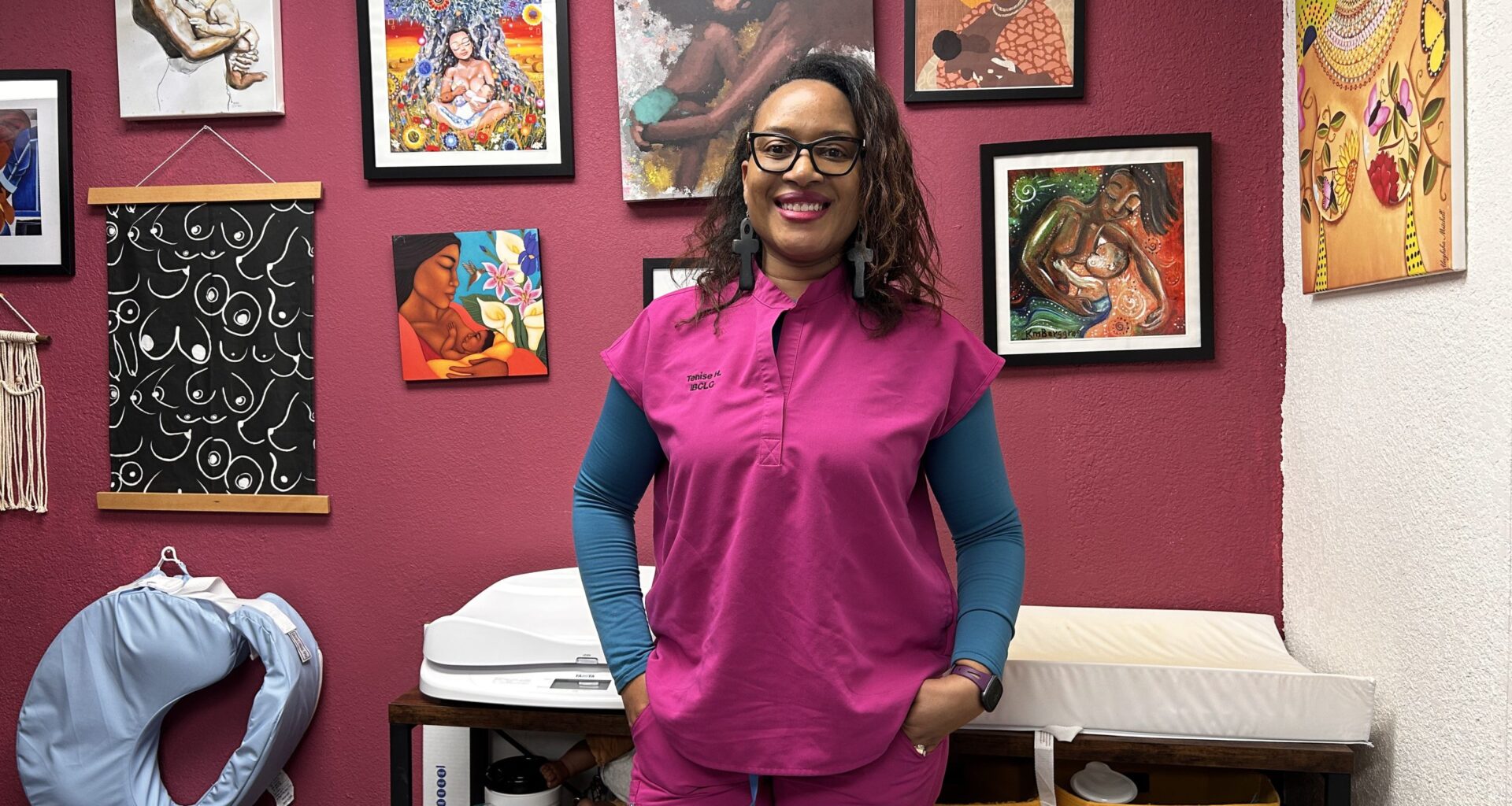
Tenise Hordge started Mother’s Magical Milk in January 2021 and recently celebrated the business’s fifth anniversary.
She worked in the corporate world for 18 years before switching gears after the pandemic and becoming an international board certified lactation consultant.
Hordge is also the author of “My Mommy’s Milk,” which is based on her experience breastfeeding as a mother. She is married with two children.
The conversation has been edited for length and clarity.
Ismael M. Belkoura: Can you tell me a little bit about yourself? How did you get into this industry?
Tenise Hordge: I had my first child in 2017 and she really changed my perspective. She was a preemie. She came at 31 weeks gestation, spent six weeks in the NICU. I knew that I wanted to breastfeed her because I thought it was trendy. I didn’t really understand the benefits. The amazing nurses there, the International Board Certified Lactation Consultants, really helped me understand more about human milk, breastfeeding and the benefits to the baby.
During the pandemic, I had COVID-19 fatigue. I had our second child. We had an amazing birth experience. I had him at home. But I remember sitting in my makeshift office in July 2020, and I wasn’t really feeling fulfilled at work. I wanted to do something different.
At this point, public health was top of mind, and so I started delving more into human milk. And human milk is fascinating. It’s constantly changing. It’s changing throughout the day, throughout a feed, over time. The benefits to women are really overlooked. We know it’s good for the baby, but it’s really amazing for women, especially women with hypertension or diabetes, which Black and brown women disproportionately have compared to our white counterparts. Breastfeeding reduces the instances of hypertension by 33%. It reduces the chances of certain cancers. It reduces osteoporosis. Breastfeeding directly reduces most of these core morbidities.
I knew that I wanted to do something different, and I wanted to take the skill sets that I had and educate my community on the benefits and the management of breastfeeding. Being African American, two to three generations ago, people didn’t breastfeed because of the stigma created by slavery. But it’s the biological norm. I am able to be in a position where I can educate on the normalcy of this, but able to provide support as well.
I launched Mother’s Magical Milk in January of 2021, so we just turned 5. Two years ago. I finished up my doctorate degree in health care administration so that I could try to affect the laws and policies that disproportionately affect women here in Texas.
Belkoura: What is the support that you provide, and what are the services that you, through Mother’s Magical Milk, provide?
Hordge: Let’s talk about support first. We live in a society where we try to be container families. We try to put our babies in containers, like a crib, and we were never really designed to do that. When I talk to elementary school students, I talk to them about baby horses. When a horse is born, the baby foal gets up and walks right away. We need to be carried. We need to be close to our providers. But we live in a society where families work, and we have these expectations that break down this biological norm from happening. Being able to support these families in the most vulnerable time, working with other health care providers, having that continuity of care, can alleviate some of these stressors so we can get back to that biological norm.
At Mother’s Magical Milk, we offer free prenatal breastfeeding education, we’ll do one-on-one consults. If a mother has implants or she’s had a breast surgery or a biopsy, or hypertension or higher BMI, she may want to meet with me privately to talk about her specific breastfeeding situation. Then the majority of the time postpartum, a family will come in, they’ll have a seat. I’ll do a physical exam on the baby. And then I’ll examine mom — her breasts, especially if she’s experiencing any discomfort or pain, we’ll work on positioning and latching while the baby is drinking, we’ll go through a care plan.
Belkoura: How would you differentiate yourself, when it comes to the services you provide, from the regular doctor that they might be seeing at one of the larger institutions?
Hordge: Most M.D.s get about 16 hours of lactation education in their four years of medical school. It’s outdated, and if they weren’t really into it, they have put it out of their head. I am up to date on evidence-based lactation. One of the things that sets me apart from my other competitors is culturally competent care. Knowing what mastitis looks like on a brown skin tone or understanding what redness, inflammation or irritation looks like on a brown nipple instead of a pink nipple. This is important when we’re serving a variety of populations, because it might not always present the exact same way.
Belkoura: Whenever you first meet with parents do they ever express that the services that you provide are very different from everything else that they’ve been kind of researching?
Hordge: Starting at the website, I want you to know that this is who I am, this is what I bring to the table, this is my background. All of this artwork here, you see a variety of women, you see them feeding their babies. It’s very normalized. I don’t want this place to look like a hospital. I don’t want it to be sterile, because I need somebody to sit down and tell me, “My nipples are bleeding. They are sore, and I don’t know what to do.” I need them to be comfortable enough so that I can help them. I want you to come in here and feel like this is a safe place for me to let somebody know that I’m struggling so we can get this person the support that they need.
Belkoura: You said it’s your five-year anniversary. How has it gone in the last five years?
Hordge: It’s been an amazing ride. I’ve had the pleasure to serve over 1,000 families. It’s an honor to be in a position to serve.
When I think about what the next five years looks like, we are slightly pivoting. This year, we’re launching a lactation clinic, which will serve twofold. It’ll provide free to reduced-cost lactation care for those who need it the most in the areas that they are. But it’ll also be a place for those who want to become an International Board Certified Lactation Consultant to earn their clinical hours. Care will be delivered with my oversight and other International Board Certified Lactation Consultants so that we’re creating jobs, but also creating resources for the community.
Belkoura: Here in Tarrant County?
Hordge: We’ll have two different clinic locations, one here and one in Dallas County.
Belkoura: Talk to me a little bit about this journey that you’ve had in this space without a medical degree. What have been the challenges, but what have also been the benefits?
Hordge: The insurance system in this country has the opportunity to be redone. One of my favorite movies is “The Day After Tomorrow.” There is a scene in the New York library and they’re trying to find books to burn so they can stay warm. There’s a man and a woman arguing over this first edition book, and there’s a kid that said, “This is all tax law down here, we can burn all these books.”
That’s how I feel about the health care system, we can burn it all and start over.
Insurance is a barrier as it relates to services provided, but also the profession of lactation consultants. We are a valued member of the health care team, but not often paid for our worth or our services. Even though lactation benefits should be covered under the Affordable Care Act, there are loopholes that insurance companies will hit every time so that they’re not supporting families when they need it the most.
I bring a different perspective. I’m a mom, I had two very different breastfeeding journeys. I have a wealth of experience outside of health care that I bring to the table to give a different perspective. Being able to communicate with someone is a skill set that you carry between both of those professions. I’m able to meet people where they are, especially in this early postpartum timeframe, offering your expertise, and then being able to be flexible and adjust to the best needs.
Belkoura: Not insinuating that babies aren’t the focus, but how important is it from your perspective that mothers are getting the attention and care and support needed through the system?
Hordge: The dyad — the mother and the baby — are my clients. But if I’m going to recommend a plan that totally trashes mom’s sleep or doesn’t take into consideration mom’s mental state, that’s not a plan. Based on mom’s mental state, I may alter my plan or my suggestion. If I know that mom doesn’t have support or help at home, she’s not going to be able to go home and pump every two and a half hours and care for this baby. It is 150% taking into consideration what it’s like at home. We want to make sure that I’m providing a plan that’s going to set this family up for success.
Belkoura: Is that kind of specialized approach rare in this space?
Hordge: I don’t know that it’s rare, but when it’s not a given, it’s disheartening. I don’t just copy and rinse and replicate that for each family. You really need to understand the history of each family. You need to understand what it looks like at home, what they are capable of doing, and then recommend the best fit. I 100% think that this should be the standard.
Belkoura: You also mentioned the importance of being aware that the medical system may not be aware, when it comes to Black and brown mothers, of those unique challenges for them. How important is it for you to be filling that space?
Hordge: When we are discounting what a woman is saying that she is feeling and experiencing, we have totally lost the game. We need to believe women when they say that they’re hurting when they’re not feeling good, and we have to fill the gap. We are the health care providers. We are the trusted folks that should be answering this call.
Ismael M. Belkoura is the health reporter for the Fort Worth Report. Contact him at ismael.belkoura@fortworthreport.org.
At the Fort Worth Report, news decisions are made independently of our board members and financial supporters. Read more about our editorial independence policy here.
This <a target=”_blank” href=”https://fortworthreport.org/2026/02/01/made-in-tarrant-mansfield-business-brings-mother-centric-care-to-breastfeeding-support/”>article</a> first appeared on <a target=”_blank” href=”https://fortworthreport.org”>Fort Worth Report</a> and is republished here under a <a target=”_blank” href=”https://creativecommons.org/licenses/by-nd/4.0/”>Creative Commons Attribution-NoDerivatives 4.0 International License</a>.<img src=”https://i0.wp.com/fortworthreport.org/wp-content/uploads/2021/04/cropped-favicon.png?resize=150%2C150&quality=80&ssl=1″ style=”width:1em;height:1em;margin-left:10px;”>
<img id=”republication-tracker-tool-source” src=”https://fortworthreport.org/?republication-pixel=true&post=389303&ga4=2820184429″ style=”width:1px;height:1px;”><script> PARSELY = { autotrack: false, onload: function() { PARSELY.beacon.trackPageView({ url: “https://fortworthreport.org/2026/02/01/made-in-tarrant-mansfield-business-brings-mother-centric-care-to-breastfeeding-support/”, urlref: window.location.href }); } } </script> <script id=”parsely-cfg” src=”//cdn.parsely.com/keys/fortworthreport.org/p.js”></script>