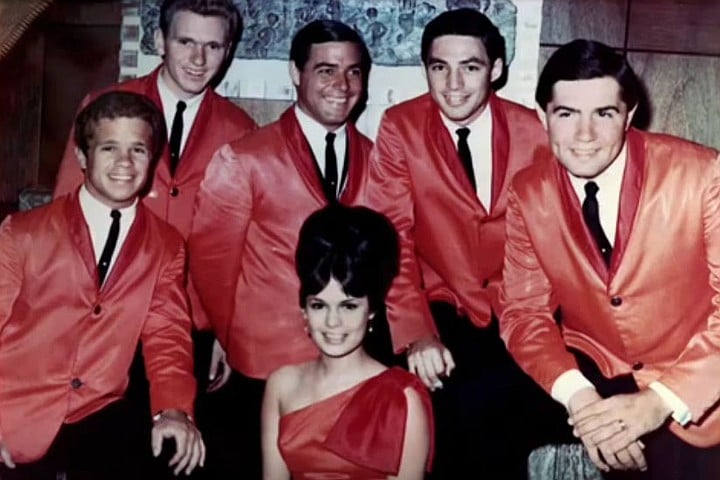

Local bassist worked with PF Sloan and the Brain Police
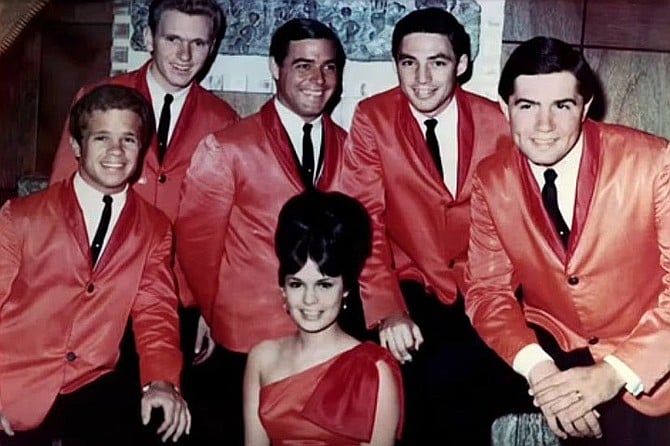
Bassist Frank Mannix, a vet of iconic local 1960s acts like Sandi & the Accents and the Brain Police, has reportedly passed away.
The Accents got their start when guitarists Frank Mannix and Don Lovas met as they were both hired to fill in for other members of a band called the Shadows in early 1962. Mannix was just 14, Lovas 17, but both were already veterans of other bands. Mannix was in the Vibrants with a singer named Linda Young, and Don Lovas had his own band, the Galaxies, with drummer Tony Johnson.
Johnson recalls on his Facebook page “When I was a young lad, Don Lovas, my oldest friend and the guitarist in the Accents, asked me to join his band, the Galaxies. I was too young for a driver’s license so Don had to come pick me up to take me to rehearsals. My parents, bless their souls, did not object to this guy with a pompadour and a ’55 Chevy taking me to who knows where, and didn’t object when this led to my coming home very late at night from gigs.”
Frank Mannix began to book the Accents for dances at public and private schools and various church youth groups. They regularly played Saturday night dances at El Cajon Valley High School.
In the summer of 1962, 17-year-old Gabe Lapano moved to San Diego with his family. He enrolled at Helix High School, the school Linda Young attended. During that first fall semester, Gabe caught Linda’s attention as he sat playing the piano in the choir room and she asked him if he wanted to stop by one of the Accents’ rehearsals.
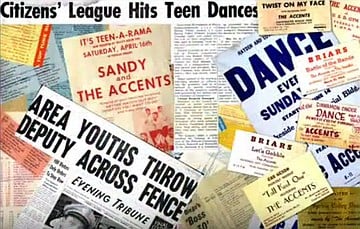
Gabe Lapano brought his Wurlitzer electric piano over to Tony’s parents’ house, where the band rehearsed in the living room. Like Don, Frank, and Tony, Gabe was already a seasoned musician and singer, having played consistently since the age of 14 with well-known bands in the Spokane area. As the Accents had no male vocalist, Gabe’s pure, high tenor was a needed, and very welcome, addition.
Shortly thereafter, Linda had to leave the band because of health reasons, so the four-piece early core of the Accents was now set. The band was gigging steadily and in 1963 expanded the roster by adding Don Beck on tenor saxophone.
At this time, Doug Meyers was in the horn section of San Diego’s the Nomads, who played every Wednesday night during the summer at the La Mesa Youth Center. This was a big band with multiple singers and four or five horns doing choreographed steps. For reasons that no one seems to remember clearly, Meyers left the Nomads and joined the Accents, and Beck left the Accents and joined the Nomads. There were no hard feelings on either side, however.
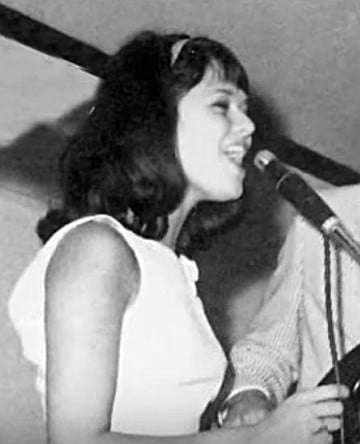
Another band on the scene at the time named the Valiants featured a female vocalist named Sandi Rouse. Meanwhile, the Accents had decided to add a girl singer to the band, and made an announcement about upcoming auditions at their Sunday dance. A friend of Sandi’s convinced her to give it a try, although she felt torn about leaving her group.
After joining the Accents, she was an immediate hit with the fans. The band’s repertoire could now be expanded to include songs that became favorites of the dancers, such as “Heat Wave,” “Be My Baby,” and Ike and Tina Turner’s “A Fool In Love.” She also joined Gabe for duets on songs like “Unchained Melody” and “Goodnight, My Love.”
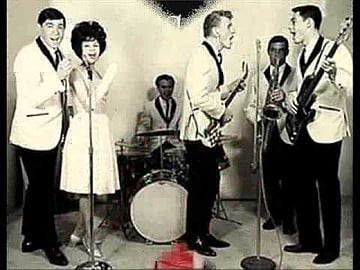
A small record company soon was interested, and the band traveled to record at a top L.A. studio. The result was their first single, “Better Watch Out Boy,” a song composed by one of Sandi’s acquaintances, George Semper of the Kingsmen. The record climbed to the top 10 in San Diego and top 20 in L.A. and a few other major cities.
They followed this with “I’ve Got Better Things To Do” in 1964, written for Accents by the L.A. team of PF Sloan and Steve Barri, the composers of “Eve of Destruction” and “Secret Agent Man.”
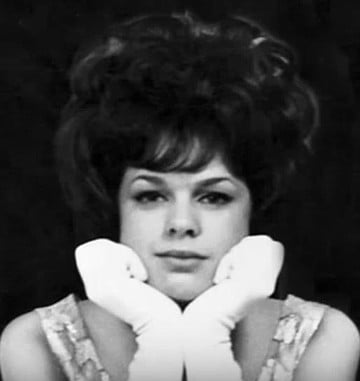
PF Sloan recalled for the Reader “They called and asked if I’d write a song and produce a record for them. I was about nineteen and my bosses in L.A. couldn’t understand why I was going down there. San Diego was considered creatively untouchable, mainly due to provincial thinking on their part.”
Of the group, he remembers “Sandi [Rouse] had a really lovely voice and the band came up with some great guitar parts…Some of the members later went on to become the Wondermints,” he says, referring to the ensemble who eventually became Brian Wilson’s backing band.
Video:Sandi & the Accents, “Better Watch Out Boy”
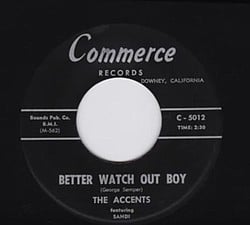
Single on Downey, California-based Commerce records
“What Do You Want to Do” and “On the Run” were the next releases, both written by the Accents’ own Gabe Lapano. All of these were top 20 singles in Southern California. By this point, the band has all but abandoned its R&B sound, other than at occasional live gigs.
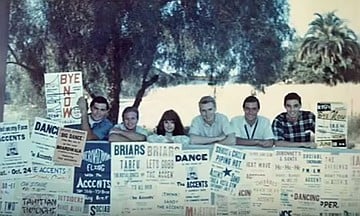
“By the time we Accents rose to prominence in San Diego,” recalls drummer Tony Johnson, “we were part of a movement towards white performers that culminated in the Beatles and Stones and the San Francisco scene, and killed rhythm and blues. The only exception was a one-night performance assembled by Austin de Lone at a theatre in Mill Valley. We didn’t have a black singer but we did have a horn section and it was great.”
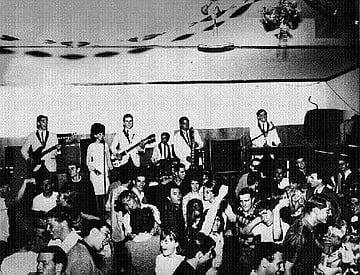
By the summer of 1966, it was time for the Accents to move on. They had offers of record deals from big labels but had not been comfortable with the virtually total control the companies sought over their bookings and image.
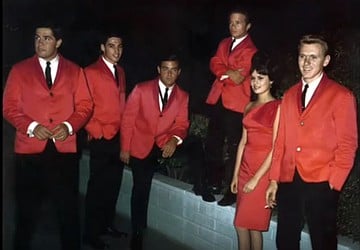
An August 1966 farewell show came to a close as Sandi and Gabe, for the last time, sang the Jesse Belvin classic, “Goodnight, My Love.”
“Before you go, there’s just one thing I’d like to know…
Is your love still warm for me, or has it grown cold?”
After Sandi and the Accents, they continued as Sandi and the Classics from around 1966 through 1968, with Sandi and Don from the original lineup.
Lapano also fronted the 7 Sons. Essentially a one-shot Lapano project, the 7 Sons released one single in 1967 on VTI Records, “On the Run,” produced by Al DiMartino (producer for both the Cascades and the Accents) and John Gummoe (original Cascades singer).
Gummoe (who left the Cascades in 1967 to pursue a solo career with singles like “It’s Raining” and “Come What May”) and Lapano also teamed up in a post-Cascades band called Two Bits, as well as forming a country-rock band together called Kentucky Express. The duo was soon joined by singer Kent Morrill, with whom both had played in a shortlived group called Image, to release the debut Kentucky Express album That’s Not What Lovin’ Is in 1971. They split the following year.
Don Beck, who played the same tenor sax obtained in 1959 for his whole career, later toured with Loretta Lynn and spent years with King Biscuit Blues Band before passing away in April 2007.
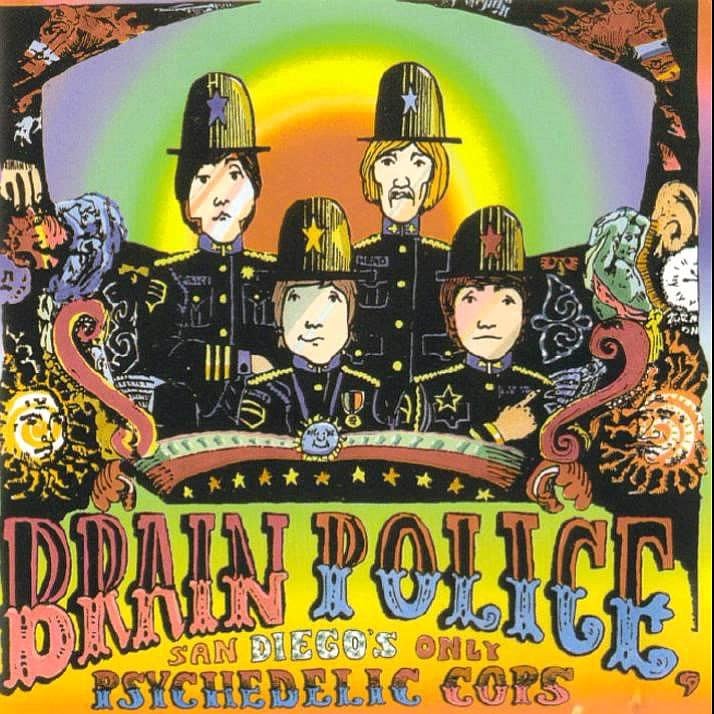
Accents drummer Tony Johnson joined with Frank Mannix in a new San Diego group specializing in psychedelic rock, the Brain Police. In the late ’60s, the band opened for many national acts, including the Who, the Byrds, Cream, Jefferson Airplane, Strawberry Alarm Clock, Steppenwolf, and Buffalo Springfield.
“Tony Johnson and Frank Mannix from Sandi & the Accents joined with my brother Rick and I to form the Brain Police in 1967,” says David Randle, “almost immediately joined by Walter Scott and Sharon Bomar as the Soul Patrol.”
They essentially spun off from the Man-Dells, a group with guitarists Rick Randle and Larry Grant and bassist Norman Lombardo, who were all still in junior high when that group released its first single in 1965, “Bonnie” (with “Oh No” on the flipside). The trio also played with the Other Four.
By the end of 1968, the band had written over 50 songs and were touring in a new Dodge van, stuffed with equipment such as amps, a Ludwig double-bass drum kit, a Hammond organ, and a $4000 P.A. system.
However, the album they recorded failed to land a major-label contract. A self-titled album recorded by the Brain Police in La Mesa in 1968 sat on a shelf for over 30 years until it was released by the U.S. reissue label Rockadelic.
On September 15, 2007, a version of Sandi and the Accents performed a reunion concert at the Scottish Rite Center in Mission Valley. Around the same time, the band announced plans to record a new CD, to include all four of their singles plus 14 tracks recorded live in 1964 and 1965 at local venues like downtown’s Community Concourse.