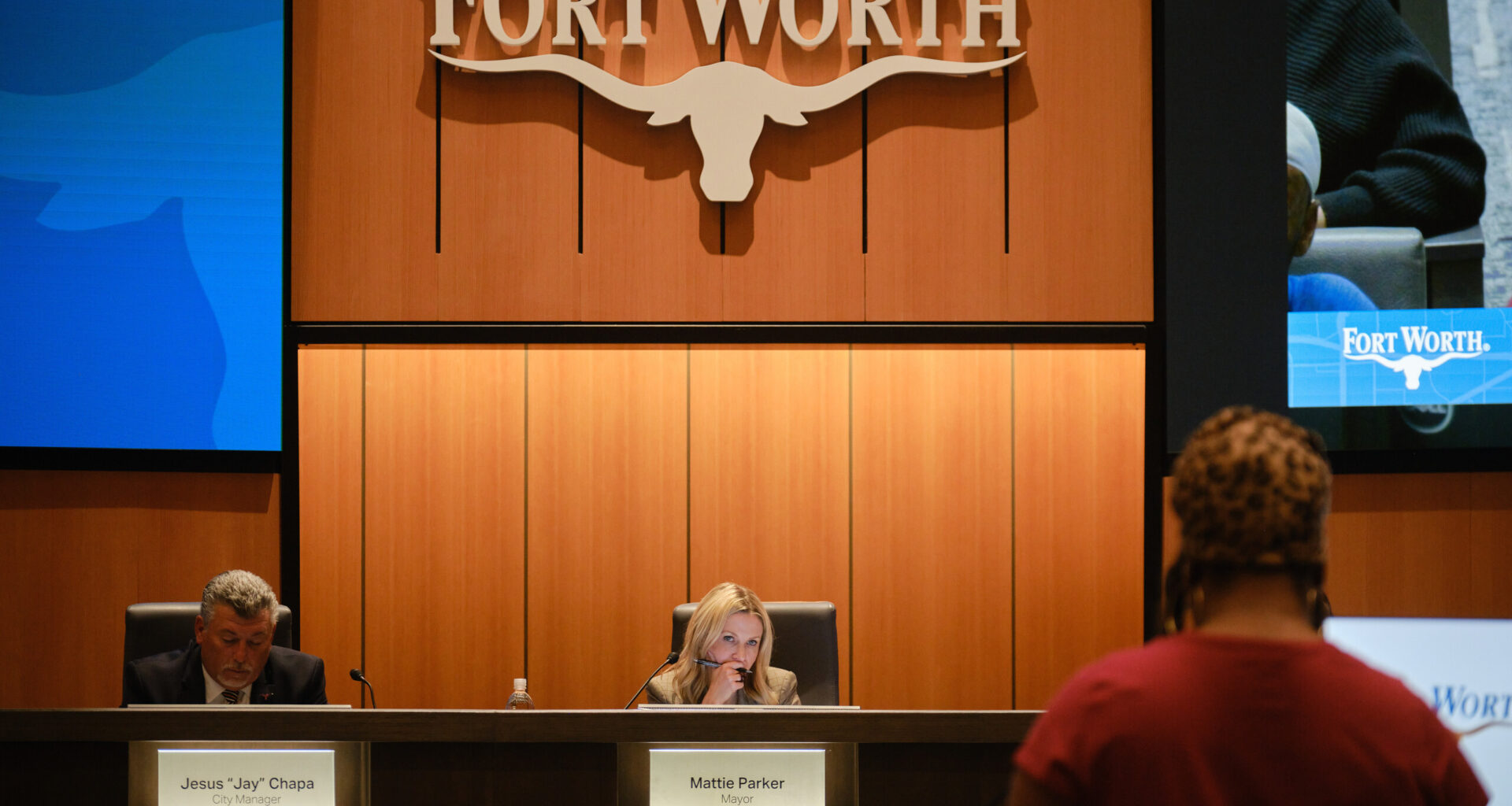
Liquor package stores, smoke shops and credit-access businesses will face more limitations after the Fort Worth City Council unanimously approved an ordinance that sets distance requirements in neighborhoods.
The council, which adopted the ordinance Jan. 27, wants to diversify the types of businesses in neighborhoods.
A 2024 city report to the council noted that neighborhood-oriented commercial zoning where such businesses are allowed was more common in some parts of the city “potentially posing a blight upon or (causing) concern in areas due to negative secondary effects.”
Under the ordinance, these businesses must now meet distance requirements from places such as parks, schools, day cares and other similar businesses in neighborhoods.
During a Dec. 2 work session, council member Mia Hall thanked city staff for researching the issue since many of the businesses are located on the city’s east and south sides.
She said the ordinance changes were “reasonable and fair” to support neighborhoods and their residents.
Three people spoke out against the changes during the Jan. 27 meeting.
Randy Bishop, who has owned and operated Jack Star Liquor at 3725 E. Belknap St. for 44 years, said he supports parts of the ordinance and acknowledged that Fort Worth has “too many liquor stores.”
However, Bishop urged them to include exemptions to long-term businesses since it would prohibit him from rebuilding his business if a fire or tornado destroyed more than 75% of the building.
Jack Star Liquor has operated in Fort Worth since 1974.
“I’d lose everything,” he said. “That’s not really fair. … I couldn’t build back a liquor store.”
Also opposed was Austin Rankin, Dallas-Fort Worth regional director of operations for Spec’s Wines, Spirits & Finer Foods, who also spoke on behalf of the Texas Package Stores Association. The group represents about 3,700 liquor stores in the state.
He described the changes as anticompetitive and antibusiness.
“I’m here today to speak against the ordinance that would severely impact the liquor store industry in Fort Worth by eliminating the distance between liquor stores in certain zones while running counter to the state alcohol laws in the middle of the game after we legally entered the Fort Worth market,” he said.
Liquor stores are highly regulated by state laws, including with age restrictions, Rankin added. He called the city’s move “overreach.”
The suggestion that liquor stores cause neighborhood problems is ridiculous, Rankin said.
“We sell alcohol for off-premise consumption, which means you take our products home, to events, to family gatherings and other places where it is legal to take and consume them,” he said.
Convenience stores that serve alcohol are not included in the Fort Worth ordinance, he noted.
“There’s nothing in this ordinance that would prevent them from locating across the street from one another, which they frequently do,” Rankin said. “How is this fair?”
Fort Worth resident Danielle Tucker, who owns and manages seven properties in areas that lacked meaningful development for 40 years, said she opposed the ordinance because it would stigmatize low-income areas.
“This justification for this ordinance focuses on low-income areas, suggesting children walk past certain businesses and may be influenced by them,” she said. “That framing unfairly stigmatizes entire communities and ignores decades of disinvestment. If children are being failed, it’s not because of neighborhoods serving businesses, it’s because of systematic issues zoning alone cannot fix.”
She pointed out that convenience stores throughout the city that sell alcohol are not highly regulated while package stores are.
Certificates of occupancy issues inconsistently applied lead to clustering, she added.
Zoning changes
The separation distance between certain businesses is expanded to include parks, churches and day care centers “in the best interest of the public health, safety and general welfare to deter the proliferation and saturation (of) liquor or package stores, retain smoke shops and credit-access businesses,” according to the new ordinance.
Retail smoke shops will be prohibited within 500 feet of parks, churches, day care centers, schools, universities and hospitals. New smoke shops would have to be at least 1,000 feet from similar businesses.
For liquor stores and credit-access businesses, those must be 1,000 feet from other package stores or credit-access businesses.
The city said affected businesses received a written notice of the zoning changes in November.
Eric E. Garcia is senior business reporter at the Fort Worth Report. Contact him at eric.garcia@fortworthreport.org.
The Report’s news decisions are made independently of our board members and financial supporters. Read more about our editorial independence policy here.
This <a target=”_blank” href=”https://fortworthreport.org/2026/02/02/liquor-stores-smoke-shops-face-zoning-changes-in-fort-worth-neighborhoods/”>article</a> first appeared on <a target=”_blank” href=”https://fortworthreport.org”>Fort Worth Report</a> and is republished here under a <a target=”_blank” href=”https://creativecommons.org/licenses/by-nd/4.0/”>Creative Commons Attribution-NoDerivatives 4.0 International License</a>.<img src=”https://i0.wp.com/fortworthreport.org/wp-content/uploads/2021/04/cropped-favicon.png?resize=150%2C150&quality=80&ssl=1″ style=”width:1em;height:1em;margin-left:10px;”>
<img id=”republication-tracker-tool-source” src=”https://fortworthreport.org/?republication-pixel=true&post=392111&ga4=2820184429″ style=”width:1px;height:1px;”><script> PARSELY = { autotrack: false, onload: function() { PARSELY.beacon.trackPageView({ url: “https://fortworthreport.org/2026/02/02/liquor-stores-smoke-shops-face-zoning-changes-in-fort-worth-neighborhoods/”, urlref: window.location.href }); } } </script> <script id=”parsely-cfg” src=”//cdn.parsely.com/keys/fortworthreport.org/p.js”></script>