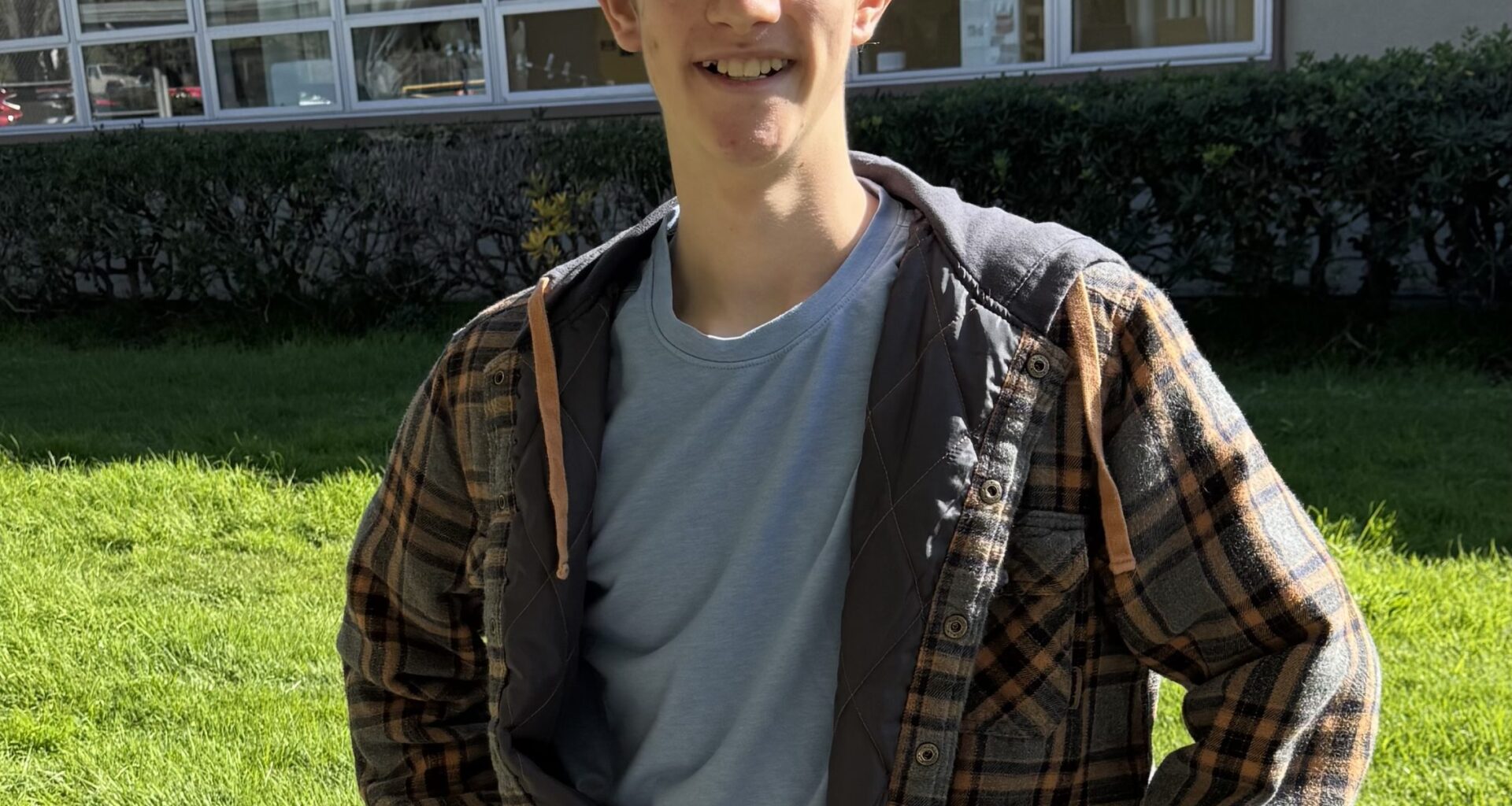
PACIFIC BEACH – Damian Toma is finishing all his course requirements at Mission Bay High School and is on schedule to graduate in May 2026.
What’s unusual about that is that Damian is a 16-year-old sophomore — who finished the requirements in just two years.
Toma was born in San Diego and spent his elementary school years between California and Albuquerque, New Mexico. From fourth grade on in San Diego, he attended Alcott and Hawthorne Elementary in its GATE (gifted and talented) program.
In sixth and seventh grade, he was introduced to Chinese Mandarin language studies at Maria Montessori School. For eighth grade, with the desire to continue his Mandarin language studies and a keen desire to expand his social opportunities, he enrolled at Pacific Beach Middle School.
“I spent eighth grade at Pacific Beach Middle, which combined both Chinese Mandarin and a larger student body. I made more friends than I’d previously imagined, engaged in accelerated and seminar classes, and felt motivated to get ahead,” Toma said. “And get ahead, I did.”
Curiosity is nurtured in the Toma family. From a young age, Toma expressed a unique interest in math, physics, and science.
“I recall watching Neil DeGrasse Tyson’s Cosmos series when I was young. I felt my first inkling that I wanted to study physics. I just called it ‘learning about cool space stuff’ at the time,” Toma said. “The visuals were beautiful, the explanation somehow palatable for my second-grade brain.
“I remember, early in third grade, making diagrams of celestial orbits and future solar system models and presenting them to my class full of fellow 8-year-olds.
“Then at Hawthorne, I recall picking up a calculus book. That first chapter was about infinite series and sums. I delighted in the patterns on the pages, how each sum could be represented as one compressed collection of symbols,” he said.
By eighth grade, Toma realized that studying and understanding physics required a strong mathematics toolkit. His dad encouraged him to work ahead in math.
“I took his advice,” Toma said. “By the time I walked to the podium at eighth-grade graduation, I had self-studied the first half of AP Calculus AB, a course usually intended for college freshmen. In my ninth-grade year, I enrolled in AP Calculus AB and AP Physics I at Mission Bay.”
When asked at what age or grade Damian began to question whether high school really needed to last four years, his father, Paul Toma, responded: “I think he saw the opportunity to graduate early, and he may have mentioned it in passing during car rides home from middle school, and I was just oblivious. I do recall Damian regularly saying, ‘Time should not be wasted.’ I think he meant learning opportunities.”
“Damian’s mother, Shannon, and I were not completely on board,” Toma added. “We wanted him to be engaged in the most challenging academics we could find… But we also wanted him to enjoy the social experience of high school.
“We eventually understood that high school could only offer him so much in his field of interest (math and physics). Even before the ninth grade, Damian was engaging in college and even graduate-level material at home. So we have supported his pursuit.”
How does someone go about telling their high school they want to graduate early?
In ninth grade, Toma took the initiative to engage with his MBHS counselor, Jo Ann Sweidel, on what was needed to make this work.
“When I first met Damian, I was struck by his maturity, communication ability, and his determination,” Sweidel said.
She has been an advocate to help him navigate all the approvals that were needed. A number of his teachers were also helpful in supporting his journey and advocating for him.
“This early graduation has been a highly collaborative process, particularly between Ms. Sweidel and me,” Toma said.
“There were quite a few people to contact: the director of San Diego Unified’s Office of Graduation; MBHS’s principal Dr. Brown; and admissions officers at schools like UC Berkeley, Stanford, Princeton, and Caltech to see what their suggestions might be for an early graduate.”
“The first step was to obtain permission from our principal,” Sweidel said. “The second step was to create the plan of how to squeeze two years of classes into one year.
“However, the true challenge was getting into the college classes. It was not easy, as many of these college classes become full.”
Because Damian was going through this process as a high school student, he had to go through a different process that required obtaining permission from the high school and community college for each class he wanted to enroll in, as well as meet all proficiencies and prerequisites required.
“At times, he had to go on a wait list and then reach out to the professor directly to explain his situation and why he needed to take the class. So, it was stressful at times as we waited to see if he would get into the class!” Sweidel said.
Toma will have (with AP exam credits and community college work) earned 60-70 UC transferable credits, depending on the institution. Private and out-of-state colleges and universities will make their decision on the transferability of his accumulated credits.
He is applying to several schools. From SDSU, UC Irvine, Cal Poly to Northwestern, Carnegie Mellon, U of Penn, and Stanford.
When asked about a specific major, he has a vision and a plan. “Since I want to go into physics education, I’m looking for three main things,” Toma said. “First, strong undergraduate research opportunities. I want to work directly with faculty on cutting-edge physics problems on the borders of observational astrophysics, cosmology, and particle physics, not just to read about them in textbooks.
“Second, access to courses that bridge physics and communication, whether that’s science journalism, educational design, or even marketing courses that help me understand how to reach broader audiences with physics content.
“Third, a collaborative environment where I can build alongside students from different disciplines. My long-term goal is to create scalable physics education platforms, so I need to learn from computer science majors, future hedge fund managers, and neuroscientists as much as from physicists.
“I need a place that’ll help me become a better teacher, communicator, and builder. I’m also hoping for a college with solid a cappella or breakdancing groups.”
READ NEXT