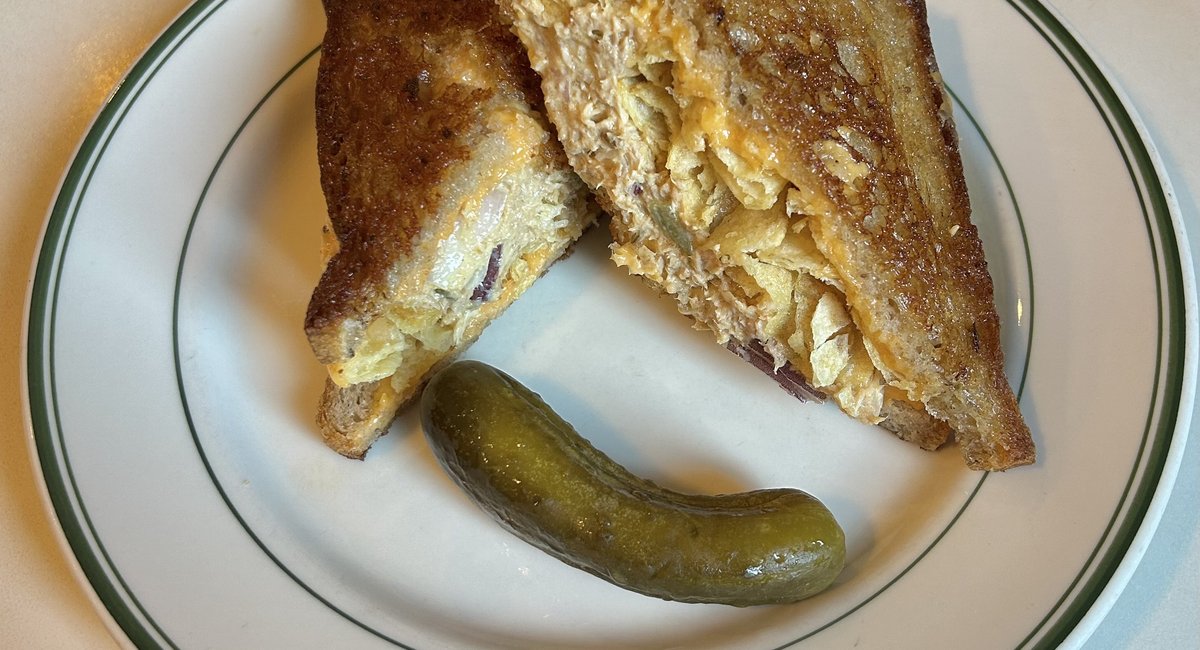
The tuna melt has no rizz and little aura. It is a vaguely stateless, certainly status-less sandwich. Long overlooked in the diner canon, the tuna melt is a luncheonette curiosity — and yet, what wonders can lie between those two slices of rye.
The central cause of the tuna melt’s lowly status is likely that it is a salad sandwich, which, like the egg salad sandwich or the chicken salad sandwich, situates it in the dork realm. Meat salads have long been the consignment store of scraps. Then there’s the hot tuna, the only thing more unappetizing than hot mayo, which there also is.
The tuna melt also runs afoul of that apocryphal proscription against combining fish and dairy. “The use of cheese and fish,” says chef Mark Strausman of Mark’s Off Madison, “is one of cuisine’s biggest faux pas. In Italy, if you ask for parmesan on your spaghetti alle vongole, they ask you to leave the country.” And yet, asks Straussman, “Who doesn’t love a good tuna melt?” Who doesn’t indeed?
Though the decline of the New York City diner has been well documented, we’re living in the golden age of tuna melts. Across Formica counters, city chefs are pushing tuna melts of great distinction and panache. Sam Woo at Chinatown’s Golden Diner, Straussman at Flatiron’s Mark’s Off Madison, Scott Tacinelli and Angie Rito at Don Angie in the West Village, Jeremy Salamon at Agi’s Counter in Crown Heights and others are all exploring the variations on the form.
Neo-luncheonettes like S&P Lunch in Flatiron and EJ’s on the Upper East Side, as well as a surviving cadre of originalists like Veselka, B&H and countless diners unknown, are keeping the original un-gussied tuna melt extant. Thanks to a cameo in the horny hockey drama “Heated Rivalry,” the tuna melt might even be having a moment. Georges Bataille had an egg; Ilya has his homemade tuna melt.
The history of the tuna melt is, like a tuna melt itself, messy. The most common origin story — that it was a fortuitous lovechild born at a Woolworth’s lunch counter in South Carolina in 1965 when a scoop of errant tuna salad fell from a shelf headlong into a grilled cheese — is demonstrably false. (The tuna melt appeared in a 1936 edition of “The Joy of Cooking”). Rather, the sandwich seems borne from a constellation of events including the popularity of canned tuna in the 1910s, the new presence of home ovens with broil rods in the 1920s, and the widespread post-war omnipresence of sliced bread.
The tuna melt at Russ and Daughters
Regardless of its origin, the tuna melt offers near infinite variation. Every element — tuna, cheese and bread — can be swapped out or innovated. And in this tuna melt renaissance, they are. Woo at Golden Diner, for instance, adds pickles, mustard, cayenne, onion powder and garlic powder to his tuna fish, as well as, crucially, potato chips into the sandwich for texture. At Russ & Daughters Café, where the tuna melt special proved so popular that it is now a regular menu item, fried capers are scattered atop the cheese for small punches of flavor. And at Agi’s Counter in Crown Heights, each sandwich is topped with an olive and guindilla pepper. The intrepid can order a fried egg to sit on the bread like a caloric kippah.
Cheese, which is what makes a melt a melt and not simply a sandwich, is traditionally cheddar. In my house growing up, it was a Kraft cheese food product that didn’t melt so much as let itself gently descend into liquid. These days, though, many chefs prefer Cooper Sharp; others are using mixtures of cheese, from fontina at San Sabino to a mixture of Swiss and cheddar at Mark’s Off Madison.
A great tuna melt is itself a symphony of texture, flavor and, controversially, temperature. The classic bread is rye toast — “tuna melt, whisky down,” in the fading parlance of diner speak — and relies on the slight bite of caraway and the crunch of toast as a foundation for the tuna salad. But these days you’ll find tuna melts on croissants (as at Birdee in Williamsburg) and focaccia (as at Mark’s), and on heavily sesame seeded Jerusalem bagels (as at K’Far in Williamsburg.)
As for the tuna itself, old-school tuna salads tend to be homogenous and mayonnaise-heavy, a dun cumulus of pulverized fish. Such is the case at B&H on 2nd Avenue, Veselka, across the street and S&P Luncheonette in Flatiron. There is nothing wrong with this. When coupled with a stiff toast, there can be no greater pleasure. New-school tuna salads tend to be chunkier. At Agi’s Counter in Crown Heights, chef Jeremy Salamon uses albacore loins, confited in-house.
But perhaps the most trenchant proof that we are living in the brave new world of tuna melts — or that the world is an ontological free-for-all, or maybe both — is that now, not all tuna melts are even tuna. Scott Tacinelli and Angie Rito of the West Village’s San Sabino offer a swordfish melt at lunch. The confited swordfish salad is blanketed in melted fontina under a pickled-pepper-marinated tomato and atop Sullivan Street focaccia. Is it a tuna melt? Perhaps not. But it is so delicious it could be one.