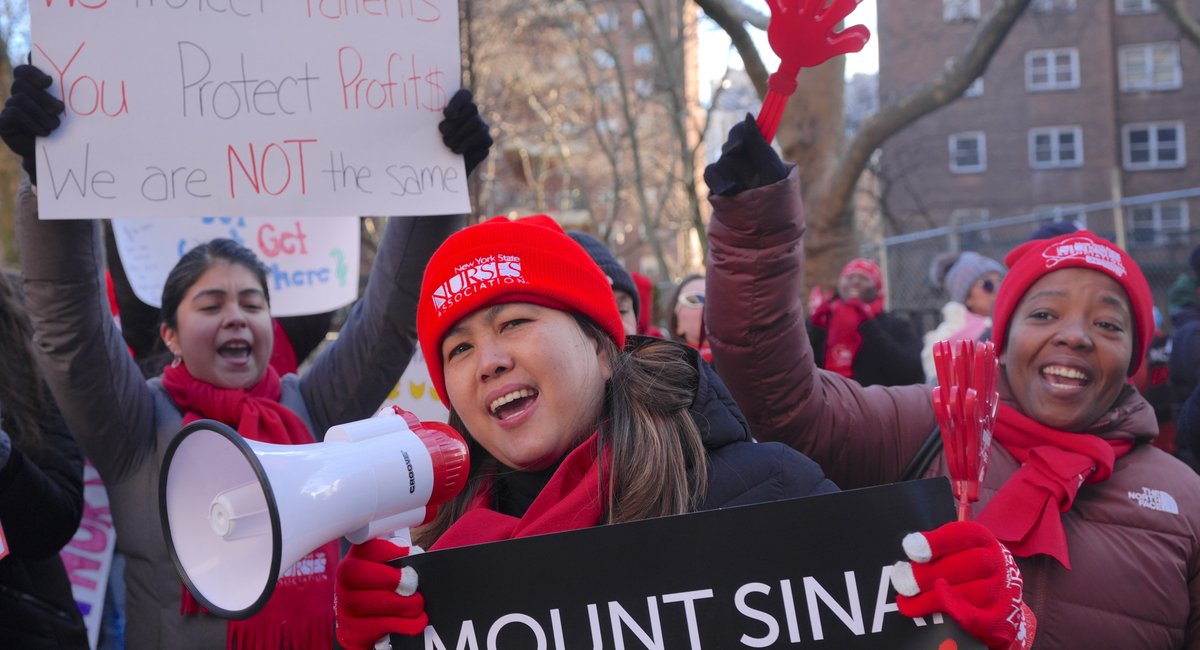
Nurses on strike in New York City have started to see new movement in contract negotiations with hospitals in recent days as they have traded proposals across the bargaining table at the Javits Center in Manhattan.
But it’s still unclear whether it will be enough to quickly propel the parties toward a deal that will bring nearly 15,000 striking nurses back to work at hospitals run by Mount Sinai, Montefiore and NewYork-Presbyterian. Their previous contracts expired Dec. 31.
After 23 days on the picket line, some nurses say they’re still frustrated at the pace of talks — and they’re not impressed with hospitals’ latest salary offer. Hospitals, for their part, say they’re putting forth comprehensive, revised proposals with “responsible” economic offers.
In recent days, the hospitals have jointly proposed a 3% raise each year for three years, the New York State Nurses Association confirmed to Gothamist. But NYSNA officials said the hospitals’ offer comes with delayed start dates for the raises each year that have the effect of significantly reducing the overall salary boost.
“ What they’re putting forward at this point doesn’t make any sense. It’s not even a cost-of-living increase,” said Shelley Layne, a nurse on strike at NewYork-Presbyterian.
Hospitals have not confirmed the terms of their latest salary offer.
Nurses have so far reached tentative agreements to maintain their premium-free health benefits, while allowing hospitals to put in place measures to try to achieve savings, according to NYSNA. But staffing and hospital safety remain key sticking points, union officials said Tuesday.
Here’s where things stand as negotiations continue.
How much money is on the table?
Throughout the strike, many nurses have maintained that their fight for a raise is secondary to their concerns about other issues, such as staffing and hospital safety. But some nurses still say hospitals’ economic proposals are far too low.
The offer that’s currently on the table is far lower than the 18% raise over three years that Mount Sinai said nurses were seeking in a recent proposal. That’s the amount nurses got in their previous contracts after striking three years ago, and a significant reduction from their initial ask this time around.
The average base salary for nurses at NewYork-Presbyterian is currently $163,000, according to hospital officials. The average base salary for nurses at Montefiore is around $165,000, while nurses at Mount Sinai make just under $130,000, according to the New York Times.
On Saturday evening, hospitals issued a joint statement saying they had issued a “fair, reasonable and responsible economic proposal.” Hospitals also noted that they have to take into account that several safety-net hospitals with fewer financial resources have agreed to match the salary increases they eventually agree to with the nurses.
“Both parties continued to make progress with the mediator to resolve the outstanding issues at the bargaining table,” Mount Sinai spokesperson Lucia Lee said in a statement Tuesday.
Staffing and other issues
Nurses on the picket lines routinely cite hospital safety measures — such as widespread use of metal detectors and panic buttons — and adequate staffing as key concerns.
In their previous contracts with these hospital systems, nurses won major staffing gains, including commitments to maintain certain nurse-to-patient ratios and a process for requiring hospitals to pay out fines when they violate their staffing commitments. Mount Sinai, NewYork-Presbyterian and Montefiore have paid out millions of dollars to nurses in recent years as a result of those staffing agreements.
NYSNA says NewYork-Presbyterian is now trying to roll back the provisions nurses won in the previous contract to enforce staffing ratios, while other hospitals have agreed to maintain the status quo.
Angela Karafazli, a spokesperson for NewYork-Presbyterian, said Tuesday that it’s not true that NewYork-Presbyterian is proposing staffing enforcement that’s weaker than other hospitals.
At Montefiore, nurses say they’re also pressing hospital officials to address other aspects of patient care, including overcrowding in the emergency room and the use of “hallway beds.”
Montefiore has responded that it has already worked to reduce overcrowding, cutting the length of stay in the emergency department by nearly half an hour since 2023.
How long can the parties hold out?
While negotiations drag on, hospitals continue to pay outsize salaries to traveling nurses who are being hired to fill in to help maintain operations.
Unionized nurses, meanwhile, have had their pay and health benefits suspended during the strike, though they are now eligible for unemployment benefits, NYSNA confirmed.
Nurses are holding actions this week, calling on Mayor Zohran Mamdani and Gov. Kathy Hochul to put more pressure on hospitals to end the strike.
Nurses demonstrated outside Hochul’s office in Manhattan yesterday, urging her not to extend an executive order that allows nurses and other clinicians who are not licensed in New York state to practice here during the strike. The order was supposed to expire Monday, but Hochul approved a brief extension to Wednesday.
“Governor Hochul is putting public health first,” said Nicolette Simmonds, a spokesperson for the governor. “Her administration has worked for weeks to help resolve the strike and facilitate negotiations that have already delivered results, including preserving nurses’ health benefits.”
Both Mamdani and Hochul have called on the parties to quickly reach an agreement.
On Tuesday morning, Layne, the nurse with NewYork-Presbyterian, marched with other nurses in red NYSNA gear across the Brooklyn Bridge to City Hall.
“ A lot of people don’t realize that the nurses are still on strike,” Layne said. “They’re going to see a sea of red.”