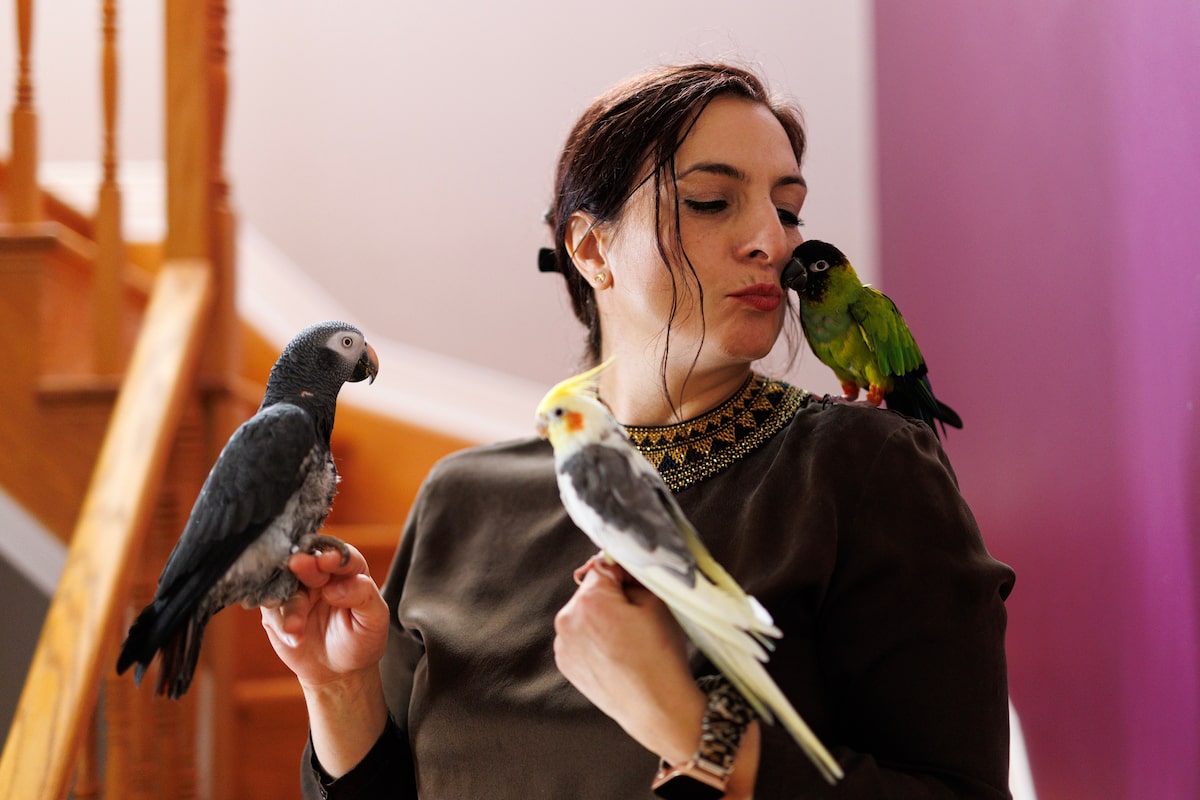
Carmen Baru with her pet parrots, from left, Malinke, Loli and Coco at her home in Ottawa.Keito Newman/The Globe and Mail
Carmen Baru lives in Ottawa with her three parrots: Coco, Malinke and Loli. At almost 30 years old, Malinke, a Timneh African Grey, is the eldest. Coco, a nanday conure, is about 26. Ms. Baru estimates that Loli, a cockatiel that landed on her balcony more than a decade ago, is 15.
Ms. Baru, 48, knows at least one of her parrots could outlive her – some African Grey parrots can live up to 60 years in captivity. Without a plan, she worries about who would care for them – and how they would pay for that care. Ms. Baru estimates she spends between $500 and $1,000 on food and vet bills for each parrot.
A lawyer by profession and one of the directors for Parrot Partners Canada, a parrot rehabilitation centre located outside of Ottawa, Ms. Baru knows other pet owners share her concerns – and are taking legal steps to make sure their animals are cared for long after their passing.
Estate planning for animals, especially those with long lifespans such as parrots or tortoises, allows owners to designate caregivers and set aside funds for food and medical care, reducing stress and uncertainty about what happens to a pet after its owner’s death.
In Canada, pets are considered personal property under the law and are treated in estate plans much like other valuable possessions, such as heirloom jewellery, says Debbie Stanley, chief executive of ETP Canada, a professional executor firm based in Guelph, Ont.
Pets such as dogs or cats can be easier to plan for, since they don’t live as long as parrots.Keito Newman/The Globe and Mail
As a result, Ms. Stanley says, owners cannot leave money directly to an animal. “ I can’t leave the money to Milo, my chocolate lab – I would have to leave it to the person who will be taking care of him.”
The simplest and most popular strategy is to list one or more beneficiaries in the chattels clause of your will or power of attorney – the section that determines how personal belongings and pets will be distributed, along with a cash gift.
When the time comes, a beneficiary may change their mind about taking a pet for any reason, so Ms. Baru recommends naming one or two backups. Because listing a beneficiary in an estate plan is not legally binding, there’s nothing preventing that person from surrendering your pet to an animal shelter.
That’s one of many reasons it’s important to have conversations with your potential beneficiaries about what this responsibility entails before naming them in your will or power of attorney.
For Ms. Stanley, listing her 25-year-old daughter as Milo’s beneficiary was a no-brainer. “My daughter said, ‘No matter what, make sure that I get the dog.’”
Estate planning for animals, especially those with long lifespans such as parrots, allows owners to designate caregivers and set aside funds for food and medical care.Keito Newman/The Globe and Mail
Pets such as dogs or cats can be easier to plan for, since they don’t live as long as parrots. Malinke entered Ms. Baru’s life in 2009, when his original owner, a close friend, decided she could no longer take care of the African Grey. The friend gave Malinke to Ms. Baru, knowing he would be in good hands with someone who had spent most of her life around birds.
Because parrots are emotionally and socially intelligent creatures whose bonds with their owners run deep, Ms. Baru says it’s important to list beneficiaries with whom your bird is already familiar. “Even all these years later, Malinke still speaks in the voice of my friend – still says her name and the name of her dog,” she said.
Owners can also leave money for their pet’s future caretaker to cover expenses. One of Ms. Baru’s clients once set aside $40,000 for their dog’s care; another designated $20,000 for their cat.
There’s no standard amount for how much money you should leave, but a starting point is to multiply your pet’s expected lifespan by the annual cost of their basic needs, Ms. Stanley said.
Food is often the largest recurring expense. Generally, it costs between $965 and $4,020 a year to care for a dog, while expenses for a cat can run between $930 to $2,400 a year, according to Rover.com, an online marketplace for dog walkers and pet sitters.
Ms. Baru knows at least one of her parrots could outlive her and worries about who would care for them after she is gone.Keito Newman/The Globe and Mail
Veterinary bills have also surged in recent years. A 2025 Rover.com report found that costs for office visits, preventive care and vaccinations rose by up to 50 per cent for dogs and 25 per cent for cats.
Pet owners should also account for the extras such as pet sitting, treats and toys. “My dog is probably a bit pampered because he goes to doggy daycare, and sometimes we have someone come stay at the house when we’re on vacation to care for him,” said Ms. Stanley.
Including detailed instructions outlining your pet’s emergency contacts, veterinary history, diet, medications, stressors and routines can smooth the transition – for both your pet and its future caretaker.
In some cases, you can also arrange for an organization to take your pet. Parrot Partners Canada, for example, can take on a “supervisory role,” Ms. Baru says. “The parrot can go to your person of choice, but should something go wrong, Parrot Partners can step in to intervene.” Usually, she adds, the parrot owner would have to pay for this type of arrangement.
This is one solution that requires owners to get creative, Ms. Baru points out. Given how limited legal tools are for addressing pets in estate planning, she likens the process to forcing a round peg into a square hole.
Still, naming even one beneficiary is far better than leaving your companion out of your estate plan altogether, which could cause unnecessary emotional stress for the animal.
“When you make these kinds of preparations, you’re only doing it for yourself up to a certain point; you’re also doing it for the ones that come after you, so it’s a gift of love,” Ms. Baru said.
Editor’s note: This article has been updated to correct Carmen Baru’s business title. She is one of the directors at Parrot Partners.