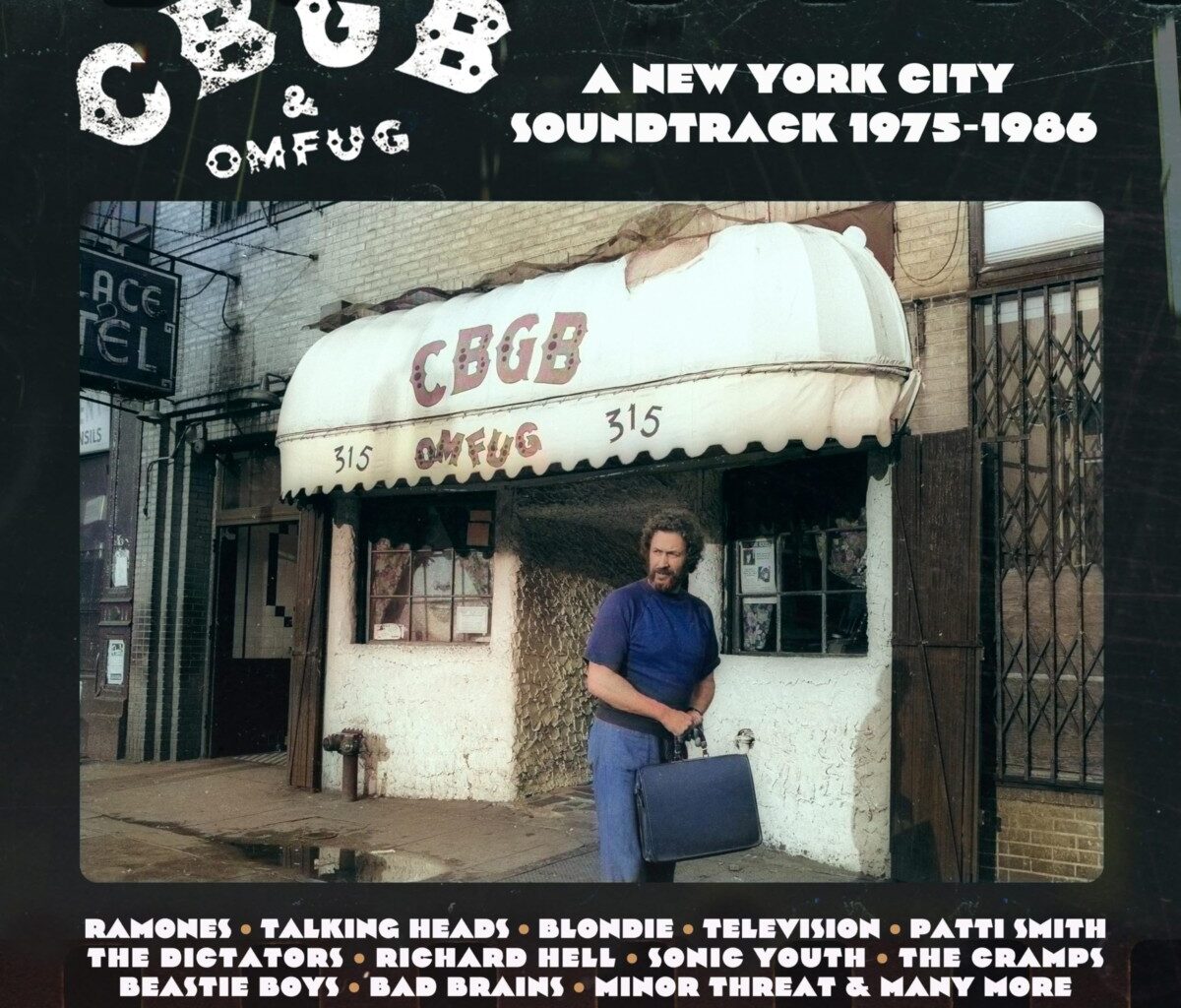
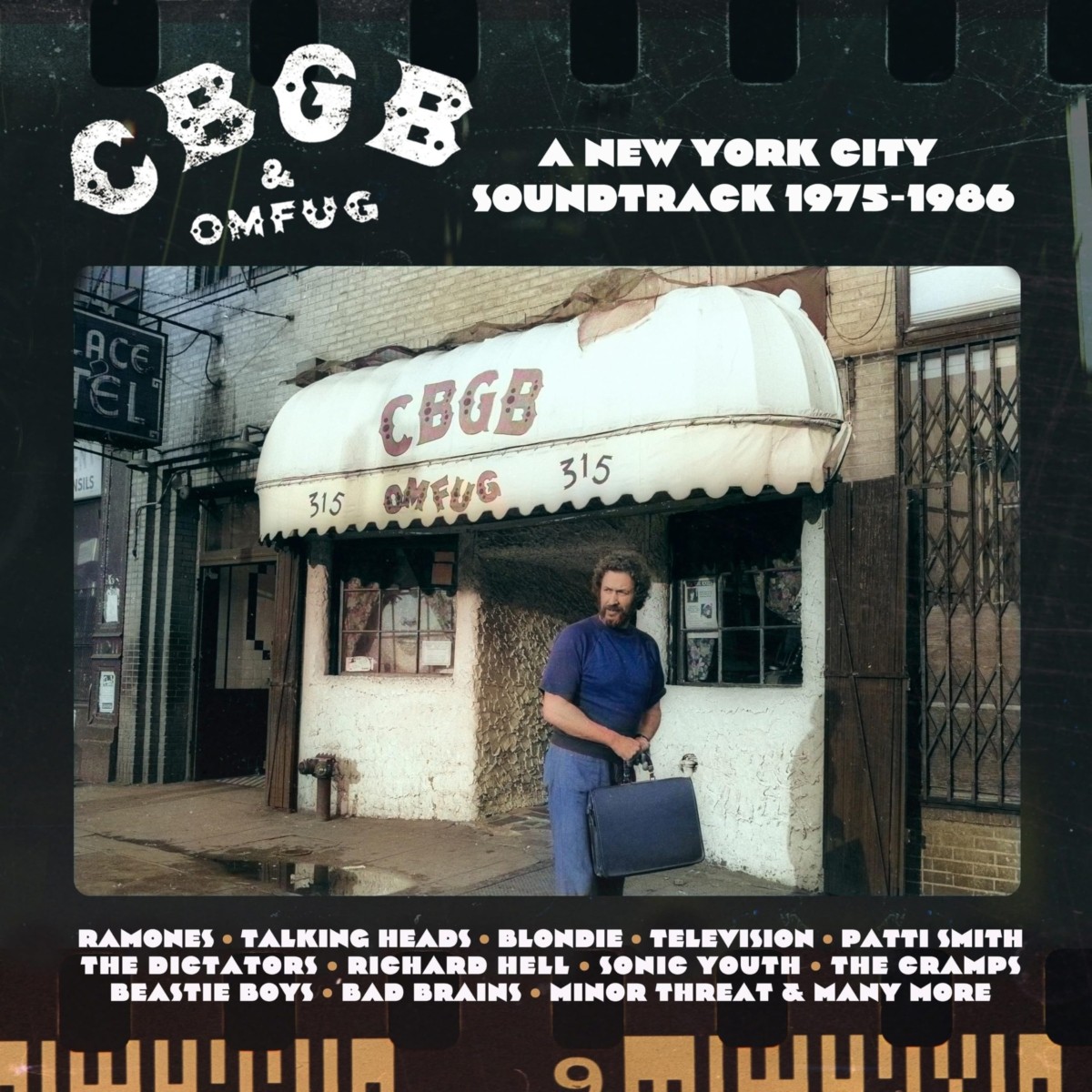
 If Hilly Kristal’s original vision for his club Country, Bluegrass, Blues had been realized CBGB, even if successful, probably wouldn’t be the celebrated venue it is today. When it was founded in 1973, the East Village was not the natural home for those particular music genres, whereas in 1974-5, it was a flashpoint for the new breed of rebellious underground musicians who would become the first punk rockers. The scenes and bands documented on this sprawling four-disc compilation feel like they belong to a different world than the mellow, folk/blues, Laurel Canyon, ‘60s hangover era the club opened in. Some of the bands represented are partly responsible for that gulf. That said, A New York City Soundtrack isn’t all punk and proto-punk, and it’s the breadth of the visitors to CBGB’s hallowed stage that make this more than just another punk/new wave nostalgia-fest.
There are of course bands without whom any CBGB compilation would be redundant but that group, including the Ramones, Patti Smith, Television, Talking Heads, Suicide and the Electric Chairs all outgrew the club, and their work needs little introduction. The songs that represent them are mostly expected ones: “See No Evil,” “Picture This,” A Clean Break,” “Ghost Rider,” “Beat on the Brat” etc. and of course they are great. A single-disc, CBGB’s Greatest Hits-type album containing 12 or 13 of those tracks would be an excellent introduction to the club’s legacy, but also something that’s been released a million times before. So, mostly it’s the lesser-known artists that make this a delight.
Some of those are only comparatively less well-known; back in ’75 Tuff Darts were seen as perhaps the most likely CBGB band to break out of the underground, but by the time their debut album finally emerged in 1978 the moment had passed. Even so, “Fun City,” taken from that album preserves the very New York Dolls-ish, snotty glam-punk charm of their music. It’s a decent song, and even a decade later a whole sub-genre of hair metal bands like Faster Pussycat and Dogs D’Amour were reproducing its mix of old-time rock ‘n’ roll, punk attitude and sleazy discontent. Speaking of the Dolls, they’re mysteriously absent from the compilation but the Brats, the band Rick Rivets formed after being ousted by Johansen and Thunders, are represented by their ’77 single “Be a Man.” Distinguishable from the Dolls only by Keith West’s lighter and less gravelly – but equally attitude-filled – voice, it’s a highlight of the band’s short career and worthy of comparison with Rivets’ old band.
One of the first groups identified with CBGB to make it onto vinyl was the Dictators. Like the Ramones – and later, the Beastie Boys, who appear on the last disc in their early, hardcore incarnation – the Dictators were definitively a New York band, but unlike those bands their appeal never crossed over into the mainstream. Their 1975 song “(I Live For) Cars and Girls” is an instantly loveable smartass combination of proto-punk and the Beach Boys with a frontman, Andy Shernoff, who sounded a bit like Tom Verlaine. The problem may have been that no-one knew how seriously or un-seriously to take the band and their humor. Perversely, but with greater success, guitarist Ross “The Boss” Friedman would go even further in the same direction with the genius, ultra-macho, ultra deadpan but surely knowing heroic metal of oil-smothered bodybuilders Manowar. Other early songs of note include the David Johansen-approved Harlots of 42nd Street, whose ’74 single “S&M (I Can’t Live Without You)” is not the expected Velvet Underground pastiche, but Jobriath-like glam and the thematically similar Magic Tramps, whose “S&M Leather Queen” is a chaotic but vibrant live performance. The band’s career was cut short when singer Eric Emerson, a Warhol film alumnus, died in 1975, but their sparse recordings preserve their anarchic spirit. The same kind spirit, or possibly a parody of it, is displayed on “Everybody’s Depraved,” the only recording of the terribly named Stuart’s Hammer. They sound tighter and more Stones-like than the Magic Tramps but it’s a reminder that there was more to New York glitter rock than just the Dolls and their offshoots.
One of the striking things about the street punk scene in comparison with the overground rock world was the relative prominence of women within it. Aside from figureheads Patti Smith and Debbie Harry there were bands like the mostly female Erasers. Erasers singer Susan Springfield is audibly Patti Smith-influenced on “It’s So Funny (That Song they Sung),” but the band’s music is harder and more rock-oriented. Helen Robbins of Helen Wheels was one of the scene’s more dominant personalities and “Room to Rage” from ’78 isn’t a great song but it’s a fantastic showcase for her imperious persona and piercing voice, which rides the early Alice Cooper-style riffing magnificently. Lucinda Moran of the Hounds is a less extrovert presence, but Genya Ravan and Cherry Vanilla were surely the epitome of ‘70s New York. Ravan had been a bona fide star for a few minutes in the ‘60s and was a powerful singer as well as a talented producer. Her “Aye Co’lorado” is swinging, strong, but not especially radical blues-rock that’s elevated to classic status by a guest appearance from cene godfather Lou Reed; file under what’s to not like? Cherry Vanilla was prodigiously star-like with obvious potential but never seemed to find quite the ideal outlet for her personality. She worked with Warhol and Bowie and made some decent records, but as the excellent, sleazy, sub-Velvet Underground “Hard as a Rock” demonstrates, the material she worked with benefitted from her charisma rather than really harnessing it.
In that most punk of years, 1977, the confrontationally-named New York Ni**ers, as they’re credited – two Black New Yorkers and a white German – became CBGB regulars for a while. They give an interesting, claustrophobic and reverb-laden take on the classic punk rock sound on “Just Like Dresden ’45” that’s well worth hearing. By 1979 or so though, the class of ’75 had graduated (or failed to) from CBGB and there was a fascinating interregnum where the club had no obvious identity until the New York Hardcore scene erupted and it became punk central again. That period is covered by a mix of would-be teen idols like the Paley Brothers whose “Baby, Let’s Stick Together” is innocuous but tuneful bubblegum pop, veterans of the first wave of punk like Lenny Kaye, Sylvain Sylvain, Tom Verlaine and Richard Lloyd, and No Wave interlopers like Suicide, James Chance & the Contortions and the then-genuinely youthful Sonic Youth. The No Wave stuff is texturally very different from what came before, but it’s represented here in an unusually accessible form. The Contortions’ live “Jailhouse Rock” reaches for endurance-testing unlistenability but doesn’t quite make it, though it’s not exactly pleasant, and by the time Sonic Youth recorded their early classic “The World Looks Red” in ’83 they had distilled the texture of their interminable abstract guitar noise marathons and channeled them into something like a dynamic punk rock song; it was a new age.
By ’83 Sonic Youth had been playing at CBGB for a couple of years and their development happened side by side with the growth of the New York hardcore scene. The compilation includes visiting giants like Minor Threat and Bad Brains alongside local legends Heart Attack, the Nihilistics and Reagan Youth, plus heroes-to-be the Beastie Boys, but stops short of the Youth crew era. Heart Attack have the distinction of being the first NYHC band to make a record, but though “English Cunts” is indeed very fast and aggressive it feels just a little anonymous following Bad Brains’ peerless “Banned in DC.” By contrast, Unknown Gender’s “Boys-Girls” has significantly less velocity but vastly more personality. Taut and powerful funk-punk in the mold of Gang of Four or the Pop Group, it’s strange, shrieky and the very definition of ‘angular’ post-punk, but no less potent for that.
CBGB wasn’t all punk, though. The only band on the album whose music might arguably fit with the Country, Bluegrass and Blues ethos is City Lights, whose “Travellin’ Man” owes something to Buffalo Springfield and the gentler side of Lynyrd Skynyrd. In another context it might barely register, but surrounded by the sneers and snarls of mid-‘70s CBGB street punk it pretty much holds its own. Around the same time, the cutesy power pop group Milk ‘N’ Cookies were occasional visitors to the club. Their music was superior teenybopper glam, and “Not Enough Girls in the World” comes across like a sleazy version of the Bay City Rollers covering the Ramones. Later, the club played host to more forward-looking artists like the outrageously talented ex-Labelle singer Nona Hendryx, whose pulsing electronic funk song “Transformation” anticipates the kind work Prince would be doing a couple of years later. There were more challenging groups too, like performance artists Jeff & Jane Hudson, whose proto-coldwave “Operating Instruction” blurs together Kraftwerk and Laurie Anderson or the Ordinaires, whose string and horns-laden ‘chamber rock’ could be labelled confusingly catchy. Even more outré is Rhys Chatham, whose wall of metallic noise “Drastic Classicism” wouldn’t sound like music at all if there wasn’t a drummer playing on it.
But look, there are 101 tracks here and even if they aren’t all great, few if any are skippable on the first listen. The point isn’t so much the quality – which is mostly high – as the diversity, the sheer mass of unorthodox inventiveness that was given somewhere to express itself. It would be wrong to say there’ll never be anywhere like CBGB again; there’s always scope for enterprising and open-minded entrepreneurs to provide musicians with a platform for their work, however unfashionable or challenging it might be. But CBGB remains legendary and this excellent compilation gives 101 reasons why. To put the sheer heft of it into perspective, we’ve spent all this time discussing the collection and artists as significant as Mink DeVille, the dB’s and the Cramps didn’t even get a mention.
Summary
This gloriously unwieldy four-disc compilation is suitably messy, taking in the expected New York legends that made CBGB THE punk club, plus an array of oddballs and obscurities that made it much more than just that.