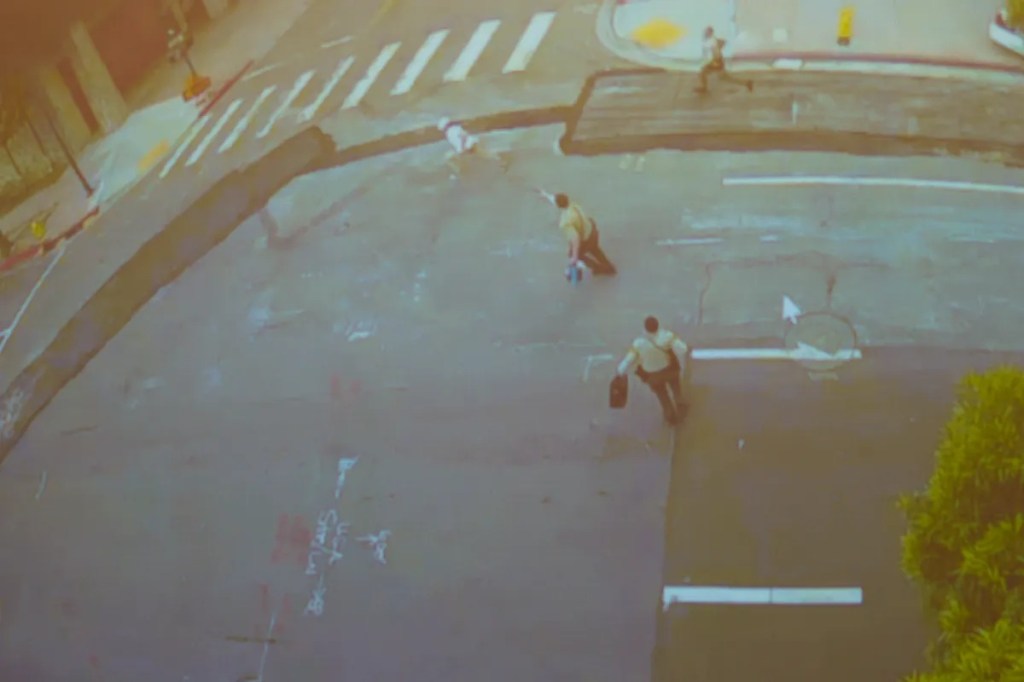
A federal judge ruled Wednesday that a former San Diego County sheriff’s deputy who fatally shot a fleeing detainee in 2020 must stand trial later this month, denying a defense request that sought to delay the civil rights trial because of the “current political climate” following two recent fatal shootings by federal agents in Minneapolis.
Aaron Richard Russell is scheduled to go on trial beginning Feb. 17 in U.S. District Court in San Diego on charges related to the May 2020 shooting death of Nicholas Bils, who had escaped from custody, was unarmed and was running away from law enforcement outside the downtown Central Jail when Russell shot him at least four times.
Russell faces charges of depriving Bils of his rights under color of law and using and discharging a firearm in relation to a crime of violence. Russell was previously tried on the same charges last year, but the jury deadlocked and the judge declared a mistrial. He faces up to life in prison if convicted on the civil rights charge.
Russell and his attorneys filed a motion last week asking U.S. District Judge Todd Robinson to delay the trial by 90 days, arguing that jurors will not be able to be impartial toward him following the recent shootings of Renée Good and Alex Pretti by federal agents in Minneapolis.
“Given parallels to this case, and the likelihood that a significant percentage of the jury pool will be unduly influenced by strong feelings about those incidents, under the current climate, Mr. Russell cannot receive a fair trial,” defense attorneys Jeremy Warren and Miguel Peñalosa wrote in their motion. “There is a grave risk that jurors will be unduly influenced by these external events such that no jury screening or instruction can protect his right to a fair trial and a verdict based on the evidence in this case and not on biases, implicit or explicit, from unrelated current events.”
Prosecutors filed their own motion opposing the delay, arguing there was no guarantee or likelihood that 90 days would be enough time for the news cycle about the Minnesota shootings to pass or the public’s attention to shift away from the use of force by law enforcement.
Assistant U.S. Attorney Seth Askins also argued there was no legal precedent for such a delay, citing multiple cases in which judges allowed trials related to controversial and high-profile political issues to move forward.
Robinson on Wednesday sided with the prosecution’s arguments in denying Russell’s motion to delay the trial.
Russell, 29, previously pleaded guilty in San Diego Superior Court to a charge of voluntary manslaughter and spent about five months in jail for fatally shooting Bils on May 1, 2020. His upcoming federal trial is not a question of whether he killed Bils — all parties agreed that he did — but whether he violated Bils’ civil rights.
On the day of the shooting, California State Park rangers had arrested Bils for violating COVID-19 restrictions at Old Town San Diego State Historic Park. As the rangers were transporting Bils to the downtown jail, he slipped one hand out of his handcuffs and escaped from a ranger’s vehicle.
Russell, who had no patrol experience and had worked as a deputy at the jail for about a year, was walking to work alongside another jail deputy when he saw Bils escape from the opposite curb. Russell stepped into the street and, without shouting any type of warning, quickly fired five shots from close range.
Russell, who resigned from the Sheriff’s Office five days after the shooting, testified during last year’s mistrial that he believed Bils was armed with a gun because of the handcuffs.
Askins told the jury that none of the other law enforcement officers in the area even pulled out their weapons, much less shot at Bils. “Every single one of them knows you can’t shoot an unarmed man in the back just for running away,” Askins told the jury.
In the recent motion opposing the delay, Askins argued that a thorough jury selection process for the upcoming trial will make the “risk of prejudice … very low.”
Potential jurors were given a detailed questionnaire in advance, while Robinson is also allowing the attorneys to question potential jurors and giving them extra challenges.