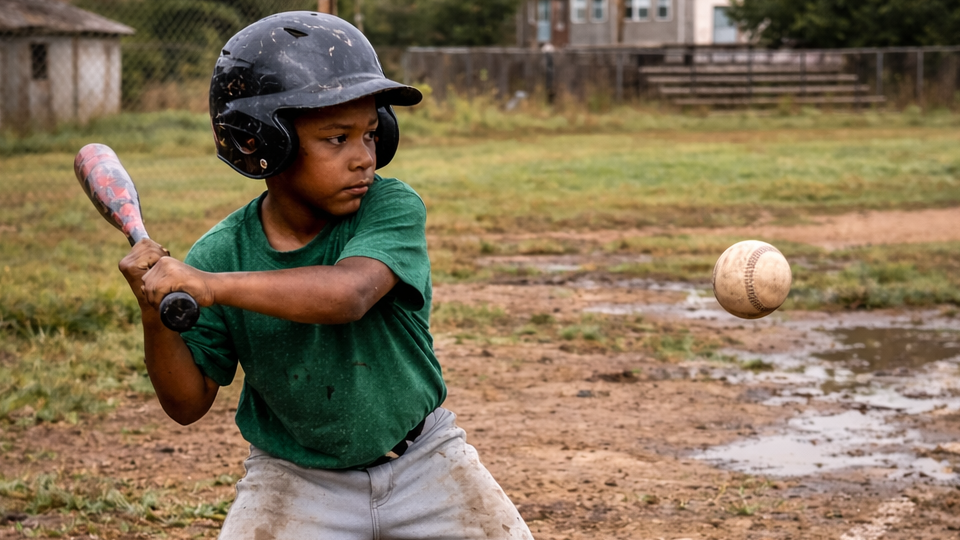

PHILADELPHIA — By late afternoon in Mayfair, the field lights flicker on one by one.
A volunteer drags the infield alone. The dirt is uneven near second base, where rain pooled earlier in the week. Before players arrive, someone walks the baseline picking up bottles and snack wrappers. The dugout bench rocks when a player leans too hard against it.
“We do what we can,” said Jason Swindell, a youth baseball volunteer in the neighborhood. “But the fact is, we need more help. Sadly, I don’t see how what we’re doing right now is sustainable. People are stretched thin and just don’t have the ability to give as much as they used to.”
The scene is familiar across Philadelphia.
So is the strain.
Across the country, community youth baseball is being squeezed from three directions at once: participation that has not fully recovered to its pre-2008 levels, rising costs shaped by travel and private instruction, and a volunteer model that increasingly depends on already stretched working families.
National data shows the share of children ages 6–12 who played baseball regularly fell from 16.5 percent in 2008 to 12.6 percent in 2021 — roughly 3.67 million kids. The sport remains visible. But its base has narrowed.
At the same time, parents who identify baseball as their child’s primary sport report spending an average of $1,112.50 over the past year. Registration fees account for just over $200 of that total. Travel and lodging approach $400. Private lessons add another $150.
Baseball has not simply become more expensive. It has become more stratified.
Recreation leagues exist alongside travel teams, showcase circuits and year-round development programs. Families with flexible work schedules and discretionary income can navigate that system. Others often cannot.
And in Philadelphia, the infrastructure beneath it all is uneven.
A city-funded study examining more than 1,400 public sports facilities found neighborhoods with higher white populations tend to have more fields, better conditions and more youth sports programs. The disparity is measurable in field density, lighting access, maintenance quality and permit stability.
In parts of the Northeast and Northwest, fields are gated and manicured, secured through organized scheduling systems. In sections of North and West Philadelphia — neighborhoods with higher Black and Latino populations — volunteers describe hauling rakes from car trunks, repairing mounds themselves and competing for limited practice windows.
The gap is not ideological. It is logistical.
When facilities are inconsistent, programming becomes inconsistent. When programming becomes inconsistent, participation becomes fragile.
“We’ve hit the point now where we really need to see some changes,” said Gregory Lawlor, a volunteer in Upper Darby. “The structure of youth baseball is doomed right now. We have to beg to get coaches. And sometimes we get coaches who don’t really know the game. Then the kids don’t learn the proper way to play, and as they move up, the game passes them by.”
Baseball remains deeply volunteer-dependent. In a Fall 2024 national survey, 61.6 percent of parents said they volunteer in some capacity with their child’s sports team or club. Baseball families reported about 5.16 volunteer hours per week — more than soccer families.
In other words, baseball still runs on dugout labor.
But dugout labor cannot compensate for structural imbalance forever.
The developmental demands of baseball are technical. Proper throwing mechanics, infield footwork, pitch counts, situational awareness — these require knowledgeable coaching and stable field access. When leagues struggle to recruit experienced volunteers, instruction varies. When instruction varies, retention drops.
And when retention drops disproportionately in certain neighborhoods, the long-term effects show up in high school rosters, college pathways and beyond.
The issue is not that children no longer want to play. Registration caps fill. Waiting lists form. Major League Baseball–linked urban initiatives continue to invest in local programming.
The issue is sustainability — and equity.
Can youth baseball remain a public good in Philadelphia? Accessible. Safe. Neighborhood-owned.
Or does it gradually divide: stable programs in resource-rich areas and survival-mode leagues elsewhere?
Fields are infrastructure. Lighting is infrastructure. Permitting systems are infrastructure. Coaching education is infrastructure. Volunteer pipelines are infrastructure.
Right now, much of that infrastructure rests on goodwill.
That is not a sustainable civic model.
In recent months, youth leaders across Philadelphia have begun discussing more coordinated approaches to access and volunteer stabilization — less competition between leagues and more alignment around shared standards. The focus is not on who wins tournaments. It is on whether every neighborhood can reliably field teams five and ten years from now.
Because youth sports erosion rarely happens all at once.
It happens slowly. One volunteer stepping back. One coach burning out. One family opting out because the costs feel too steep or the field feels too neglected.
Rebuilding participation is exponentially harder than maintaining it.
On weeknights across the city, the games are still being played. The sound of aluminum bats still carries over playground fences.
But the durability of that sound — and whether it echoes equally across every neighborhood — may depend less on nostalgia and more on whether Philadelphia treats youth baseball as infrastructure instead of charity.
The next decade will answer that question.
Recent Philly | Phillies Baseball News
- Philadelphia’s youth baseball is fraying — and the gaps are getting harder to ignore (Feb 25)
- Otto Kemp’s versatility could be crucial to the Phillies’ 2026 World Series hopes (Feb 25)
- Harper’s clock vs. Dombrowski’s calendar: Why a subtle friction runs through Phillies camp (Feb 24)
- Do the Phillies have a leadership problem — or are we asking the wrong question? (Feb 23)
- Arcadia partners with Urban Youth Kings & Queens to expand baseball access in Philadelphia (Feb 23)
- COLLEGE BASEBALL: Coyne’s rotation statement, Welshans’ production pace headline PBR D1 weekly honors (Feb 23)
- Phillies Spring Signals: Kyle Schwarber’s power, the cleanup question and early bullpen insights (Feb 22)
- Crawford’s composure, Hoffman’s extended inning shape Phillies’ spring opener (Feb 22)
- COLLEGE BASEBALL: Arcadia rides big inning to a victory, plus scores from around Division III (Feb 21)
- COLLEGE BASEBALL: Villanova’s six-run surge not enough in 9-8 loss to Lipscomb (Feb 21)
- COLLEGE BASEBALL: Penn falls to No. 24 Texas A&M, 2-1, on walk-off walk in 11th (Feb 21)
- Spring eases in: Phillies open Grapefruit League play in Dunedin (Feb 21)
- COLLEGE BASEBALL: Saint Joseph’s pulls out an extra inning win over Sacramento State (Feb 21)
- COLLEGE BASEBALL: West Chester sweeps doubleheader over IUP to open 2026 campaign; Chestnut Hill secures a split (Feb 20)
- COLLEGE BASEBALL: Penn falls in a heartbreaker to No. 24 Texas A&M (Feb 20)
- COLLEGE BASEBALL: Villanova takes down Lipscomb in extras in series opener (Feb 20)
- COLLEGE BASEBALL: La Salle rallies twice, sweeps Delaware State in dramatic doubleheader at DeVincent Field (Feb 20)
- COLLEGE BASEBALL: Arcadia enters 2026 as MAC Freedom favorite, eyes NCAA return (Feb 20)
- COLLEGE BASEBALL: Saint Joseph’s drops series opener at Sacramento State, 4-1 (Feb 20)
- Phillies to send 11 players, including Harper, Schwarber and Nola, to World Baseball Classic (Feb 19)
- What does elite look like for Bryce Harper and the Phillies in 2026 — statistically (Feb 19)
- Black History Month: The Phillies integrated in 1957, but Dick Allen changed everything in 1964 (Feb 18)
- COLLEGE BASEBALL: Welshans homers again, but Delaware rallies to hand La Salle first loss (Feb 18)
- As Aidan Miller climbs, the Phillies’ third-base future comes into focus (Feb 17)
- YOUTH BASEBALL: Five things every youth baseball parent in Philly needs to understand about arm care (Feb 16)
- COLLEGE BASEBALL: Widener brings back its middle, bets on depth to make noise in the MAC Commonwealth (Feb 16)
- Who should hit cleanup for the Phillies? Bohm vs. García is a study in probability (Feb 16)
- Bryce Harper responds to Dave Dombrowski’s October evaluation as Phillies open Spring Training (Feb 16)
- COLLEGE BASEBALL: La Salle’s Groen, Karpaitis earn Philly Division I Player of the Week honors (Feb 16)
- COLLEGE BASEBALL: Villanova edged 4-3 by FIU on walk-off fly, drops series (Feb 15)
- COLLEGE BASEBALL: La Salle completes sweep, finishes opening weekend with 48 runs (Feb 15)
- Phillies’ Aaron Nola must restore his fastball, and his foundation, in 2026 (Feb 14)
- COLLEGE BASEBALL: La Salle stays hot, routs UMES 14-2 to clinch series (Feb 14)
- COLLEGE BASEBALL: Saint Joseph’s splits doubleheader, powers to first win of season (Feb 14)
- COLLEGE BASEBALL: Villanova falls to FIU after early lead slips away (Feb 14)
- COLLEGE BASEBALL: La Salle erupts for 27 runs in triumphant return to diamond (Feb 13)
- COLLEGE BASEBALL: Villanova rides Whooley’s three-run homer, strong relief to 7-4 win at FIU (Feb 13)
- Phillies News from the Philadelphia Baseball Review
Support the Mission. Fuel the Movement.
You’re not just funding journalism — you’re backing the future of youth baseball in Philly.