When a Los Angeles drug trafficker wouldn’t pay taxes to the 18th Street gang, the order to kill her allegedly came from a high-ranking female member known as “Moms.”
Prosecutors accuse Keiko Gonzalez — also known as La Señora and La Reina — of ordering the 2022 murder and also overseeing the gang’s criminal activity — collecting rent, extortionate taxes and fines and disciplining members, including one shot in the leg and repeatedly struck in the head with a brick.
Federal prosecutors laid out the case in an indictment unsealed Thursday morning, charging seven suspected members and associates of the gang, including Gonzalez, 59, with racketeering and other charges. Gonzalez allegedly received her marching orders from her husband, Jorge Gonzales, a Mexican Mafia member held in a California state prison.
“It is Keiko that functioned as the de facto leader of the 18th Street gang,” LAPD Chief Jim McDonnell said at a news conference.
Authorities announced they arrested 12 members and associates of 18th Street, including Gonzalez, as part of “Operation Dead Horse.” Another six remain at large. The gang allegedly controlled MacArthur Park as an open-air drug marketplace, using tents to blend in with the homeless population and avoid detection by law enforcement, according to the U.S. attorney’s office in L.A.
“For far too long, 18th Street and other criminals have been allowed to turn one of the city’s most beautiful public spaces into a crime-infested pit. That ends today,” First Assistant U.S. Atty. Bill Essayli said in a statement. “We are committed to eliminating violent organized crime and open-air drug markets from Los Angeles.”
At the news conference, Essayli called 18th Street “one of the largest and most violent gangs in the western hemisphere.” He said 14 people have been charged in seven indictments with racketeering and drug trafficking offenses.
During the investigation, federal and local law enforcement seized more than 175 pounds of methamphetamine and fentanyl, authorities said, around $80,000 in cash and six firearms.
In addition to Gonzalez, the defendants identified in the main indictment were Edward Escalante, Edward Alvarenga, George Carillo, Carlos Beltran, Felipe De Los Angeles and Edwin Martinez.
Hours after the news conference, Gonzalez came into the courtroom Thursday afternoon, shackled around the waist, in black slides and a blue shirt, and pleaded not guilty.
Her appointed defense attorney, Richard W. Raynor, asked that Gonzalez be released on bond with conditions, arguing that she had a minimal criminal history that involved only traffic offenses that were more than a decade old.
“We don’t have somebody who’s the decision-maker,” Raynor told the judge.
The magistrate judge, Alka Sagar, denied the request and cited a search of a storage unit under Gonzalez’s control that uncovered numerous firearms and a police radio.
“It supports the government’s claim that she had a critical role,” Sagar said.
Asst. U.S. Atty. Daniel H. Weiner said Gonzalez was the No. 2 person in the gang.
“What she says goes,” Weiner said.
According to the indictment, 18th Street was controlled by at least three Mexican Mafia members in federal prison and one in California state prison. Prosecutors allege it was the latter — identified in the indictment only as “Co-Conspirator 1” — who maintained ultimate control over the gang.
Federal authorities identified “Co-Conspirator 1” on Thursday as Jorge Gonzales, who allegedly was able to orchestrate drug trafficking and other activities via calls on contraband phones.
Gonzales, 70, who has been incarcerated since 1980, is serving a 15-to-life sentence for murder he committed when he was 23, according to state prison records. In 1983, he stabbed an inmate to death at Folsom State Prison and was convicted of manslaughter.
Seven years later, Gonzales, known as “White Horse,” was transferred to Pelican Bay State Prison’s Security Housing Unit, then the most restrictive facility in California, where he was held in solitary confinement for about 25 years. He currently is held at High Desert State Prison in Susanville.
According to the indictment, the imprisoned Gonzales controlled 18th Street on behalf of the Mexican Mafia from within prison by issuing rules and orders to his wife and others. Essayli said Gonzales was not part of the indictment and wouldn’t comment on the possibility of future charges.
Gonzalez directed drug trafficking, violence and other criminal activities within 18th Street territory, including extortion and mediating gang disputes, according to the indictment. Prosecutors say she and Escalante supplied 18th Street gang members and associates with meth and other narcotics. Martinez allegedly operated “casitas” within the gang’s territory, from which 18th Street members and associates engaged in illegal gambling and sold drugs.
While some of the drug operations extended to Hollywood and parts of the San Fernando Valley, much of it was concentrated on MacArthur Park.
City, police and community leaders have spent years fretting over how best to handle the intertwined crises at the park.
The area said to be controlled by 18th Street is known for its bustling energy, with vendors lining Alvarado Street at all times of day, selling everything from baby formula and irons to knockoff Lionel Messi jerseys.
Gang violence, like other violent crime, has receded from the post-pandemic spike citywide and is significantly lower than during the turf wars of the late ‘80s and early ‘90s. Still, the area has been the site of numerous shootings, including one last year in which six people were wounded outside a Japanese fast food restaurant.
The neighborhood’s immigrant community also has been on edge for months over ongoing immigration raids as part of the Trump administration’s nationwide crackdown.
Although police conduct occasional drug busts, the area remains one of the city’s largest open-air drug markets. Police say 18th Street members also are known to extort both licensed and unlicensed vendors in the area. A Rampart police detective wrote in a search warrant affidavit that in “many instances, they work in coordination with the vendors to sell narcotics and thwart law enforcement’s efforts.”
While gang disputes still arise, police and gang interventionists say 18th Street has a tenuous arrangement with traditional rivals like MS-13, Crazy Riders and the Wanderers in which they have divvied up drug-dealing territory in the park.
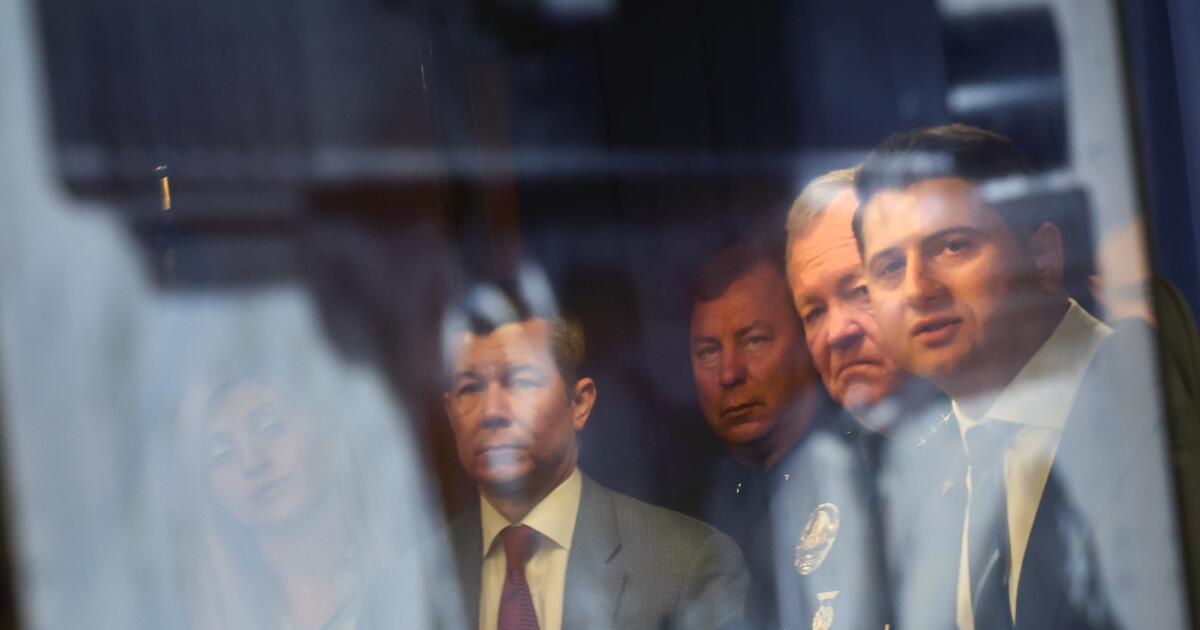
Speaking to reporters Thursday, Essayli referred to the area as “rampant open-air drug dealing, drug trafficking, violence” as images of purported drug use flashed on a TV screen near him.
“These indictments are a significant step of cleaning up the parks,” he said.
According to the indictment, Gonzalez, Carillo, Beltran and De Los Angeles participated in disciplining members or others deemed to have interfered with the criminal activities.
Among the alleged crimes was the murder of a drug dealer identified in the indictment only by their initials, M.Z. Prosecutors allege that around July 2022, Gonzalez ordered the murder of M.Z. for failing to pay extortionate taxes on drug trafficking activities in 18th Street-controlled territory.
Essayli said at Gonzalez’s direction, Carillo and Beltran shot the woman in the head.
Times staff writer Matthew Ormseth contributed to this report.