California state Sen. Sasha Renee Perez (D-Pasadena) announced Friday new legislation that will institute fines and suspend or revoke state issued licenses to immigration detention facilities when they fail to meet minimum health and safety standards.
The proposed law — SB 995 — aims to empower state authorities by ensuring that private detention centers comply with state health and safety standards through inspections.
The detention center operators would be required to correct any deficiencies identified by inspectors or face a civil penalty up to $25,000 a day for each violation. Operators could also risk having their state-issued licenses suspended or revoked.
Though the law would apply to juvenile halls, state hospitals and secure treatment centers, it is the growing number of immigration detention centers facing allegations of inhumane conditions that prompted the proposed legislation.
“This legislation is grounded in a simple principle: If detention centers operate in California, they must meet California standards for safety, dignity and human rights,” Perez said. “In California we will not allow people to suffer behind closed doors without oversight, without transparency and without justice.”

Rep. Judy Chu (D-Monterey Park), chair emerita of the Congressional Asian Pacific American Caucus, conducts a news conference during the House Democrats’ 2026 Issues Conference at the Lansdowne Resort in Leesburg, Va., on Feb. 26.
(Tom Williams / CQ-Roll Call via Getty Images)
In a report released last year, California Atty. Gen. Rob Bonta reviewed six private immigration detention facilities in the state and found serious deficiencies, including inadequate medical and mental health care, inadequate suicide prevention protocols, a lack of transparency regarding use-of-force practices, and due process rights violations including access to legal counsel.
Perez and immigrant rights groups say these issues have persisted, if not worsened, despite federal inspections conducted under Immigration and Customs Enforcement’s standards.
There are at least six immigration detention facilities in California, some of which were closed but reopened to meet a surge in immigration detainees as President Trump carried out mass deportations.
U.S. Rep. Judy Chu, who has inspected facilities across the country, said what the Trump administration has been doing at detention centers is “vile, abhorrent and totally unacceptable.”
“And what I’ve seen are denials of basic necessities, denials of medications; in fact, no matter what the condition the detainee faces they’re prescribed ibuprofen,” she said. “It’s about profit because these private prison facilities make a billion dollars per year, it’s about cutting down on food, cutting down on medication, cutting down on any essential treatment, even cutting down on the temperature so they don’t have to be able to provide the most basic level of comfort.”
A spokesperson for the Department of Homeland Security could not immediately be reached for comment.
There are currently 68,289 immigrants in detention centers across the U.S. with at least 74% of detainees having no criminal convictions, according to TRAC, a data research organization.
Many of those with convictions are for minor offenses, including traffic violations.
Earlier this year, the U.S. Department of Homeland Security said about 70% of people whom the agency has arrested have been convicted or charged with a crime in the United States.
In the first nine months of the administration’s immigration crackdown, from Jan. 1 to Oct. 15, a Times analysis of nationwide ICE arrests found that percentage to be about the same.
In Los Angeles, the same analyses found that of the more than 10,000 Los Angeles residents who were arrested in immigration operations, about 45% were charged with a criminal conviction and an additional 14% had pending charges.

Cars are in the parking lot at a private prison in California City as CoreCivic has begun “preliminary activation” of an immigration processing center.
(Claudia Elliott)
Friday’s announcement comes as the Trump administration looks to increase the number of detention centers across the country.
But looming over the administration is the growing number of immigrants who have died while in the custody of federal immigration authorities.
Last year, 33 people died while in the custody of ICE, according to detainee death reports published by the Department of Homeland Security. Some deaths have occurred at facilities in California.
Perez said at least 10 people have died this year so far.
Among them is 48-year-old Alberto Gutierrez-Reyes, a Mexican national, who was detained in January and sent to the Adelanto ICE Processing Center. The father and husband died at a local hospital after repeated cries for help were ignored by the Adelanto staff, according to Chu and the man’s family.
It is the latest death to occurred at the facility. Last year, Ismael Ayala-Uribe, 39, and Gabriel Garcia-Aviles, 56, both Mexican immigrants, died after falling ill at the facility.
The Adelanto facility is facing a federal class-action lawsuit alleging inhumane conditions.
A spokesperson for Geo Group Inc., which operates the Adelanto ICE Processing Center, could not immediately be reached for comment.
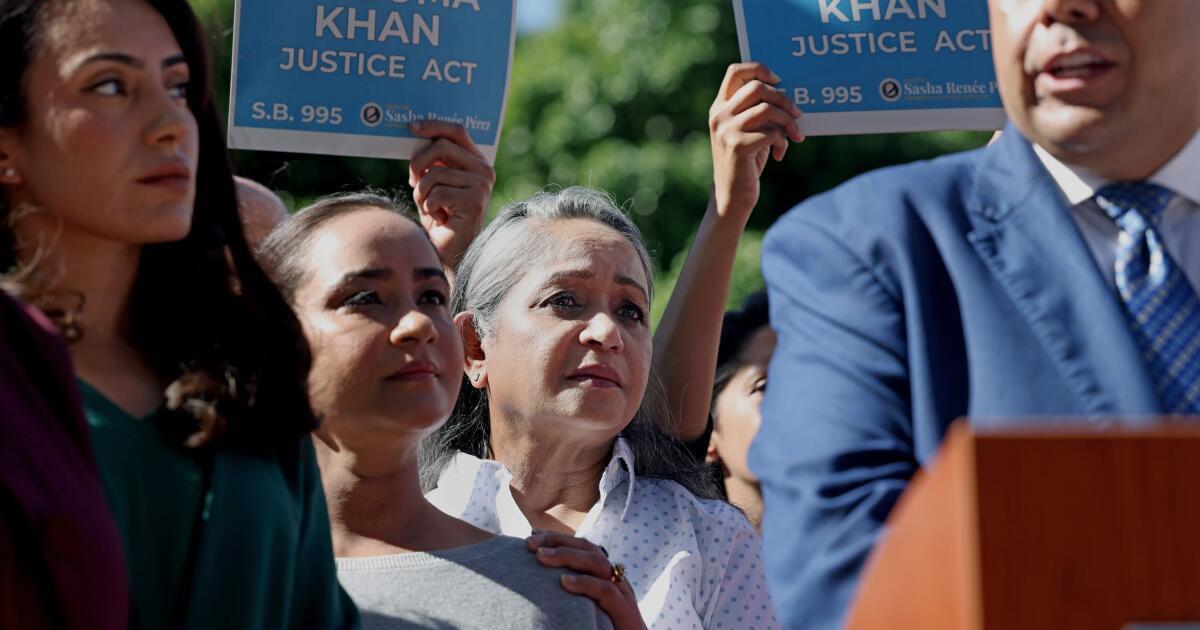
SB 995 is named after Masuma Khan, an immigrant from Bangladesh and Eaton fire survivor who was detained in October at the California City Detention Facility, a former prison in the Mojave Desert, some 67 miles east of Bakersfield.
The facility was the subject of a federal class-action lawsuit filed by seven immigrants who alleged inhumane conditions and mistreatment.
Last month, a federal Judge ruled on the case, ordering ICE and Homeland Security to provide “constitutionally adequate healthcare” to people detained at the facility. She also required an external monitor to ensure compliance.
Ryan Gustin, a spokesman for CoreCivic, which operates the facility, told The Times then that they “work closely with our government partner to ensure we are providing all required services and meeting applicable standards.”
Khan said she was kept in frigid conditions, often without warm clothes, appropriate food or access to vital medicine. In November, a federal judge ordered Khan be released and blocked her detention until the court could consider the government’s argument on why it needed to detain her.
Masuma’s daugther, Riya Kahn, said she feared losing her mother when she was being held at the detention center.
“This has been one of the most difficult journeys of our lives,” she said.

Masuma Khan, right, and her daughter Riya, left, attend a news conference announcing the introduction of SB 995, dubbed the Masuma Khan Justice Act, at the California Community Foundation in downtown Los Angeles on Friday.
(Christina House / Los Angeles Times)
Hector Villagra of the Mexican American Legal Defense and Educational Fund said SB 995 was carefully crafted so that it is constitutional and does not intrude on federal authority.
“What it says is if you want to operate a facility that holds people involuntarily, if it is above a certain size, then it has to meet basic standards for air and food quality, for temperature and occupancy and fire safety,” he said. “It says that these apply to no matter who you are, no matter who you contract with.”
Angelica Salas, executive director of the Coalition for Humane Immigrant Rights (CHIRLA) and who is also co-sponsoring the bill, said the state must employ its policing powers to ensure residents in detention centers have access to basic necessities, care and safety.
“It is unconscionable to continue to operate these facilities without oversight given the unprecedented numbers of individuals detained in our state,” she said
Perez said the bill, dubbed the Masuma Khan Justice Act, might begin the legislative process by mid-May.