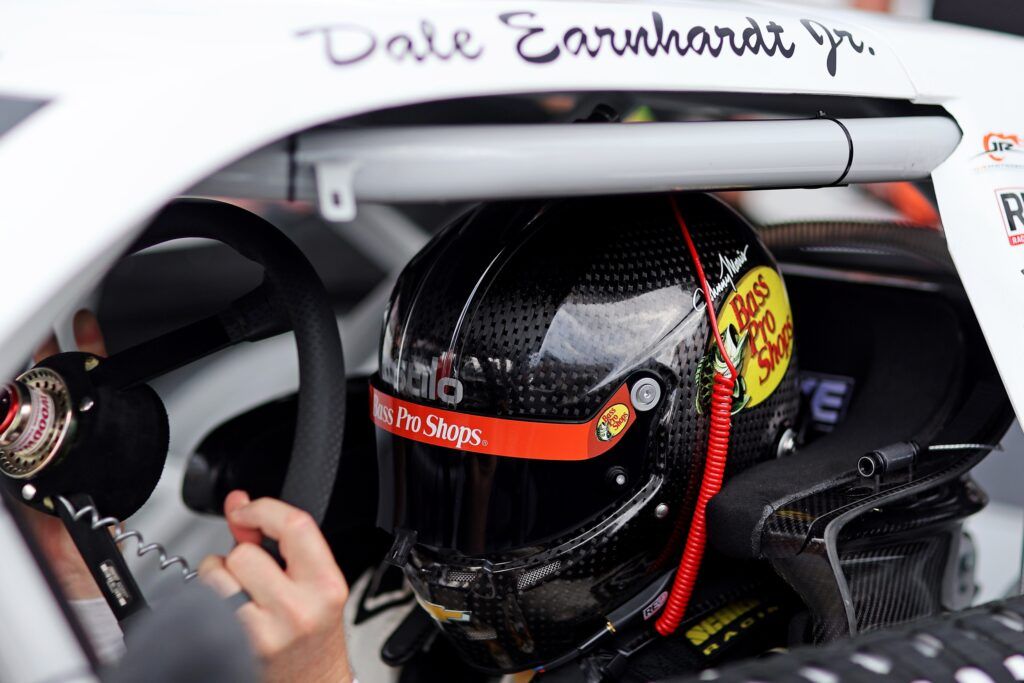
NASCAR fans have long noticed peculiar tape markings on Cup Series cars’ steering wheels, small strips positioned at precise angles. These aren’t random decorations or driver quirks. Dale Earnhardt Jr. just pulled back the curtain on their critical purpose during his “Ask Jr.” podcast segment.
The markings serve dual roles: diagnosing suspension damage mid-race and enabling lightning-fast pit stops. Earnhardt’s insight reveals how minute details separate contenders from backmarkers.
Dale Earnhardt Jr. Explains How Center Tape Becomes a Damage Diagnostic Tool
On the recently livestreamed “Ask Jr.” segment of the “Dale Jr. Download” podcast, a fan asked Earnhardt, “What are the tape marks on the steering wheels that the drivers put?”
“So, there’s obviously the center mark that’s always kind of been there to help a driver understand where the center is,” Earnhardt replied promptly.
The center stripe’s function evolved beyond tradition. While it historically helped drivers straighten wheels after spins, today it’s a real-time suspension monitor. “That’s not only- I mean, that used to be helpful when we would bust our ass and spin out and we’d need to kind of get the wheel straight and get it,” Earnhardt Jr. revealed.
“But now I think you use it to tell if you have a bent toe link or any kind of toe damage. You’re driving the steering, you know, and you’re driving, you can see it’s offset a little bit. It’s just a thing,” he added.
Drivers glance down mid-corner, and if the tape sits off-center while driving straight, something’s bent. Immediate detection prevents worsened damage or catastrophic failures, as this visual cue allows crews to strategize repairs before irreversible harm occurs.
Earnhardt and TJ Majors Reveal Steering Wheel Tape Marks’ Importance for Pit Stop Precision
During pit stops, every millisecond counts. The tape at 1 and 11 o’clock positions isn’t for aesthetics, but a pit crew’s lifeline. “There’s other marks on the steering wheel at kind of like the one and the 11 o’clock. So, those are where you need to have the steering wheel to be able to change tires on the pit stop,” Earnhardt Jr. explained.
His longtime spotter, TJ Majors, confirmed, and said, “Yeah, that’s different tire changers to get the tire off. Sometimes you need to a little bit to the right, you go to the left side.”
The geometry is unforgiving because tight wheel wells and aggressive camber angles require exact wheel orientation. Drivers cock the wheel slightly right for left-side tire changes, creating clearance for the impact gun. They swing it left for right-side changes.
Without those tape markers, fumbling for position costs precious seconds. “Due to the geometry in the front and the casters, cambers, and all those things and how tight the wheel openings are,” Earnhardt Jr. emphasized.
“When you come to pit road, for the right side tire changer, you cock the wheel a little bit, so you can get the wheel off and on. And then when they come around the left, you cock the wheel the other way, so they can get the wheel off and on.”
This ritual shaves tenths off stops, which is often the difference between winning and losing.
Earnhardt’s breakdown highlights NASCAR’s hidden intricacies. What appears trivial, tapes on a steering wheel, becomes race-defining, as pit crews gain efficiency through preset angles and drivers gain a mechanical sixth sense. In a sport where victories hinge on details, these markings are silent game-changers.