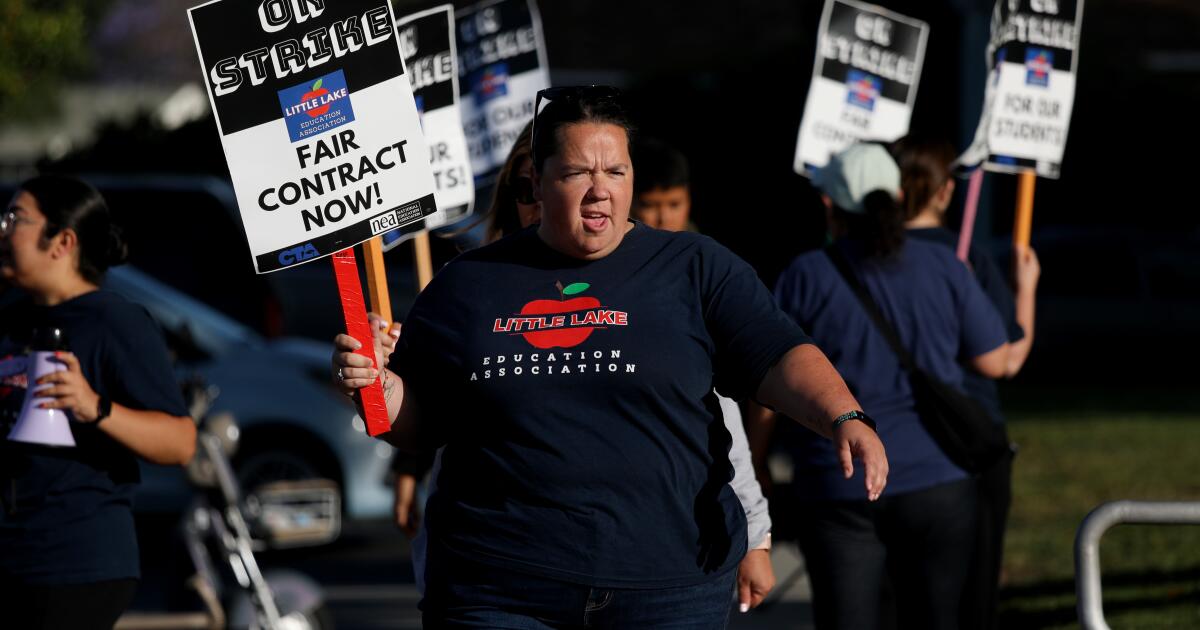
The Little Lake school district in southeast Los Angeles County and its teachers union reached a tentative agreement Monday night, ending one of the longest teacher strikes in state history after its 200-member union walked out over significant issues straining districts throughout California.
The agreement brings the strike to a close and teachers will return to the classroom Thursday, a district spokesperson said.
“This agreement reflects meaningful progress and a renewed focus on what matters most: restoring stability for students, supporting our teachers, and getting educators back into classrooms as quickly as possible while maintaining the fiscal responsibility needed to protect the long-term stability of the District,” the district said in a statement Wednesday night.
The Little Lake Education Assn. thanked parents for their support.
“During the strike, Little Lake educators and community members joined together at every action — from morning picket lines to mid-day marches through the community, family-friendly actions, and more,” the union said in a statement.
The teachers walked out over healthcare costs increasing by $14,000 a year for some, crowded special education classes and proposed class size increases in a district grappling with declining enrollment and unsustainable past spending. They were not asking for a pay raise — but their high-cost benefits were tantamount to a big pay cut.
The deal calls for employees to pay zero to $630 a month in healthcare premiums — depending on their choice of health plan, said Raul A. Riesgo, district spokesperson. Class size will not rise. Budget cuts will be necessary, including the loss of some intervention teachers who serve students who need intensive academic help.
The union sought a one-time $4,000 bonus for its members, but not a permanent increase. The pay scale for teachers ranges from $58,752 to $118,363. The tentative agreement calls for a one-time $1,000 payment, Riesgo said.
The union statement said “educators fought to protect class sizes and won” and praised winning “additional support for Little Lake’s growing population of students with special education needs after the district had initially rejected the request.”
The protracted strike took a toll. It consumed about 6% of the academic year. Most parents kept children home, while scrambling to manage disrupted work and home routines — especially difficult in a school system where about 80% of students qualify for a free or reduced-price lunch because of family poverty. Teachers lost several thousand dollars of pay that they are unlikely to get back.
“We’re trying to stay positive but every day feels like a punch to the gut,” Sabrina Ireland, a 6th grade math and science teacher, said on the picket line Wednesday in front of her campus, Lake Center Middle School. “I’m losing sleep. … We have some teachers that both the husband and the wife teach here. They have no income right now.”
It has been hard for Little Lake to be noticed alongside the mammoth L.A. Unified School District, which has about 390,000 students. An L.A. Unified strike was dramatically averted with hours to spare on April 14 in a conflict that commanded local and national attention for weeks.
But this district — with seven elementary and two middle schools — endured a crippling strike, affecting about 3,400 students drawn from Santa Fe Springs and parts of Norwalk and Downey.
In terms of lost instructional days, Little Lake ranks high. Earlier this school year, teachers went out for 12 days in the sizable Twin Rivers Unified School District in north Sacramento County. Teachers in New Haven Unified in Union City in Alameda County struck for 14 days in 2019. And an Oakland teachers strike in 1996 lasted about a month.
Teacher demands statewide
Numerous shorter walkouts and near strikes have unfolded throughout the state this year, part of a loosely coordinated effort by the California Teachers Assn. to align unions’ contract expiration dates and benefit from collective force. The union dubbed the effort as “We Can’t Wait.”
The issues surfacing in Little Lake echoed the dynamic in L.A. Unified and elsewhere.
“Up and down the state, educators have won life-changing healthcare benefits and support for special education and have forced districts to create the safe and stable classrooms our students deserve,” said Gabriella Landeros, a spokesperson for the California Teachers Assn.
In the broad picture, district budgets throughout the state are likely to be a little larger, level or somewhat smaller — and schools could yet receive a big boost by the time the state’s budget is adopted in June.

Martin Gonzalez,13, left, a seventh-grade student at Lake Center Middle School, and Sebastian Escobedo, 11, a sixth-grade student at Lake Center Middle School, join striking Little Lake teachers at Lakeland Elementary School on Wednesday in Norwalk.
(Gary Coronado/For The Times)
But cost pressures have escalated quickly in many regions. In Little Lake, as in L.A. Unified, the cost of services for students with disabilities and percentage of students identified as having disabilities have risen sharply. Healthcare costs also have gone up fast.
Meanwhile, enrollment is declining, offsetting the benefit of state increases in spending per pupil. Inflation hit hard in recent years, while prompting employee groups, especially in urban areas, to fight for wage boosts to keep pace. This comes as one-time pandemic relief aid has expired.
Thousands more for healthcare
In Little Lake, strike supporters said they were willing to fightover issues that justified the sacrifice. Starting in January, the monthly premiums for the health plan used by many teachers rose from zero to $1,400 a month paid over 10 months each year — an enormous reduction in take-home pay.
To back off from that charge, district officials proposed raising average class sizes in kindergarten through fourth grade from 24-to-1 to 28-to-1, according to the district. Union negotiators pushed to keep class sizes where they are.
District officials acknowledged their proposals were painful but said they face an unsustainable financial situation.
“We are at a point fiscally where the district can no longer support 100%,” of healthcare premiums, said acting Supt. Monica Martinez-Johnson, a career district employee who started as a teacher.
A fact-finding report endorsed that account but also noted that the district suddenly ended health subsidies on Jan. 1, when a previous agreement expired. Employees were immediately forced to pay about 40% of the cost of their monthly premiums.

Jennifer Conforti, center, a teacher at Lake Center Elementary, pickets at Lake Center Middle School in Santa Fe Springs on Wednesday.
(Gary Coronado/For The Times)
Dollars and sensitivities
The financial implications of the strike are difficult to calculate at this juncture, but the district won’t necessarily lose money. Subs made $500 a day, but there were fewer subs than teachers, and striking teachers forfeit pay.
In-person student attendance ranged from 18% to 31%, which will mean lost funding linked to student attendance. The annual operating budget of the district is $73 million, of which salaries and benefits are $53 million, according to the district.
Many parents and students joined teachers on picket lines.
“We’ve stuck it out this long, we wouldn’t want them to fold on an agreement that doesn’t benefit them,” Melissa Maggard, who has two daughters at Lakeland Elementary, said earlier Wednesday.
Therapist Sherry Gonzalez kept her fourth-grade son at home, rescheduling work hours, hiring babysitters. Her son receives special services for a disability at Lake Center Elementary, and home routines are harder without this support.
“I don’t feel comfortable taking him in during a strike with subs who do not know my son’s needs,” Gonzalez said, before the tentative agreement was announced. “As a parent it’s just been hard. It’s been so frustrating. We feel worn down, tired, and we feel like we’re being ignored and unheard.
“To see this drive a wedge between the community, it feels hurtful,” she added. When asked how she’s been trying to cope, she responded: “Crying.”