
There is no Italian word for “jitney.”
But the 1982 August Wilson play named for Pittsburgh’s brand of unlicensed cab is the first of his works to be translated into Italian. And the internationally touring production of “Jitney” featuring a cast of Black Italian actors gets four performances here this weekend at the Hill District’s Madison Arts Center — in the same neighborhood where the play is set, and a short drive from the house where Wilson was born.
“It made all the sense in the world to do it right where it all began, in the Hill District,” said Denise Turner, executive director of the nonprofit August Wilson House, who helped bring the show to town. “The themes in Mr. Wilson’s plays are universal themes. He did that and captured it through the Black experience, but they are universal themes to everyone. And this shows that his language is just not local, regional, national — that there’s an international reach for his voice.”
A car ride through the Hill
Wilson is best known for his Century Cycle of plays depicting Black American life in each decade of the 20th century, including Pulitzer-winners “Fences” and “The Piano Lesson.” While his work has been translated for performances in other languages, including Chinese and Spanish, Sardegna Teatro and La Piccionaia Centro Produzione Teatrale’s touring “Jitney” is the first Wilson-in-translation ever staged in Pittsburgh.

Courtesy of Renzo Carbonera
Renzo Carbonera directs the Italian-language “Jitney.”
The show was sparked by a chance encounter seven years ago.
Italian filmmaker Renzo Carbonera, in town to show one of his films at a festival at the University of Pittsburgh, was being driven through the Hill. Carbonera said his hired driver, a Black man, told him about Wilson, of whom Carbonera had never heard. Then on his way out of town, a festival organizer with whom he’d spoken about Wilson handed him a copy of “Jitney” that he read on the plane home.
Carbonera was hooked by this story set in the 1970s, among unlicensed cab drivers, centering on the bitter relationship between an estranged father and son.
“After that I read all the August Wilson plays,” he said.
Carbonera, coincidentally, already wanted to branch into theater and to work more with Black Italian actors. So in 2023, he directed his country’s first-ever all-Black stage production. It was “Jitney,” translated into Italian. (Carbonera continued to visit Pittsburgh; the Italian “Jitney” was the subject of a short documentary made by Pitt professor Carl Kurlander and Pitt film students.)
Carbonera said the translation, by Angela Soldà, doesn’t try to replicate Wilson’s version of Black American English. But as refined in collaboration with the cast of the 2023 production, it seeks to honor the spirit of the original.
“We try to be as faithful as we can to the original text, original words, but we also put in some Italian slang,” Carbonera said earlier this month, in a video call from Sardinia. “What came out is definitely not what it is in the United States for an American audience.”
Pittsburgh audiences will recognize the technically untranslatable word “jitney” in the dialogue, but as for English-speaking audiences in other cities, Wilson’s original text will be projected in supertitles on the stage.
A new look
Meanwhile, the play’s look might be nearly as surprising to fans of Wilson’s work as will be the sound of the translated dialogue.
Laura Farneti
/
Courtesy of Renzo Carbonera
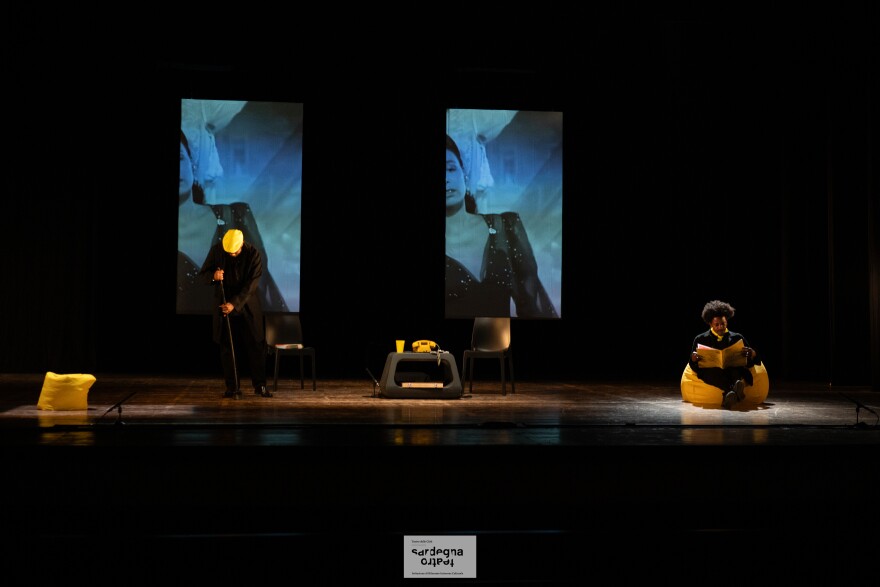
The Sardegna Teatro/La Piccionaia production uses a minimalist set.
Theater companies have long staged Wilson’s plays on naturalistic sets that capture the grit of working-class Pittsburgh. Carbonera’s “Jitney” is artier, with minimalist sets, a stylized, Pittsburgh-centric color scheme of black and gold, and even some video projections. Even the costumes are stylized, black-and-gold outfits, rather than the authentic, ’70s-style garb audiences saw when Pittsburgh Playwrights Theatre Co. staged “Jitney” in the backyard of the August Wilson House in 2022.
But Playwrights founder and artistic director Mark Clayton Southers said the new show constitutes a welcome departure.
Southers was among those who worked with the Wilson House’s Turner to bring the Italian “Jitney” to the U.S. After its premiere in Sardinia in April, Carbonera and the cast flew to U.S. to take the stage at St. Louis’ Black Rep (May 1 to 3) and Cleveland’s Powerful Long Ladder (May 5 and 6). After that, they’ll head back for another Italian date; they’ll be back for some fall performances in the American South, followed by more dates in Italy.
Southers knew Wilson and regards him as a mentor, and since founding Playwrights has surely directed more productions of Wilson’s plays than anyone in town. But he said after seeing “Jitney” some 100 times, he’s ready for something new.
“I think if they tell the story, we’ll get a different type of story, a different type of feel for it, a different type of vibe for it,” he said. “I don’t want to see the same thing!”
‘Jitney,’ our way
In “Jitney,” Wilson tells a story of fathers and sons, of love and jealousy and, not least, of a workplace — a jitney station of the sort where, as a young man, Wilson himself sometimes hung out to soak in the personalities and atmosphere.

Bill O’Driscoll
/
90.5 WESA
August Wilson House executive director Denise Turner stands in the house, where August Wilson was born in 1945.
But while the play’s themes are universal, Wilson came of artistic age in a particular historical and cultural setting — the Hill District of the ’60s and ’70s, and the Black Arts Movement. His plays, most set in the Hill, have a similar cultural specificity, and most American theatergoers who see them have at least some grasp on the history of chattel slavery, segregation, gentrification and everyday racism that inform them.
The Black experience in Italy is very different. Most Black Italians are immigrants or the children of immigrants, and together they make up only 1% or 2% of Italy’s population.
In short, just as there’s no word for “jitney” in a country with good public transportation and no history of licensed cabs that won’t serve certain parts of town, actor Miguel Gobbo Diaz says there’s no real Italian analogue to Black American culture.
Gobbo Diaz was born in the Dominican Republic and moved to Italy with his family at age 3. Growing up in the ’90s, he was the only Black kid around, he said.
In 2017, he became one of Italy’s first Black TV stars with the primetime police drama “Nero a Metà” (a.k.a. “Carlo and Malik”).
But Gobbo Diaz, 36, said roles for Black actors remain scarce in Italy, and lately he has focused on international film productions and theater. In “Jitney” he plays the central role of Becker, the jitney station manager whose son, Booster, has just finished a long prison stint. (The cast also includes Marcos Piacentini, Rosanna Sparapano, Federico Lima Roque and Tomiwa Samson Segun Aina.)
Gobbo Diaz, speaking by video call from St. Louis, said the Italian “Jitney” can’t be American, and doesn’t try.
“We bring our kind of culture, and we try to do ‘Jitney’ in our way, as Italian Black actors,” he said.
“What we are trying to do is create a bridge to start an Italian Black culture through this, but also by coming back to the United States to show … in America that this black American culture can get exported, can make sense to other African diaspora around the world.”
Carbonera said a successful translation would help cement Wilson’s work as “a modern classic.”
Terrence Spivey, artistic director of Powerful Long Ladder, agreed. “Arthur Miller and them can have their translations and productions all over the country over the years,” he said. “August can be the same.”